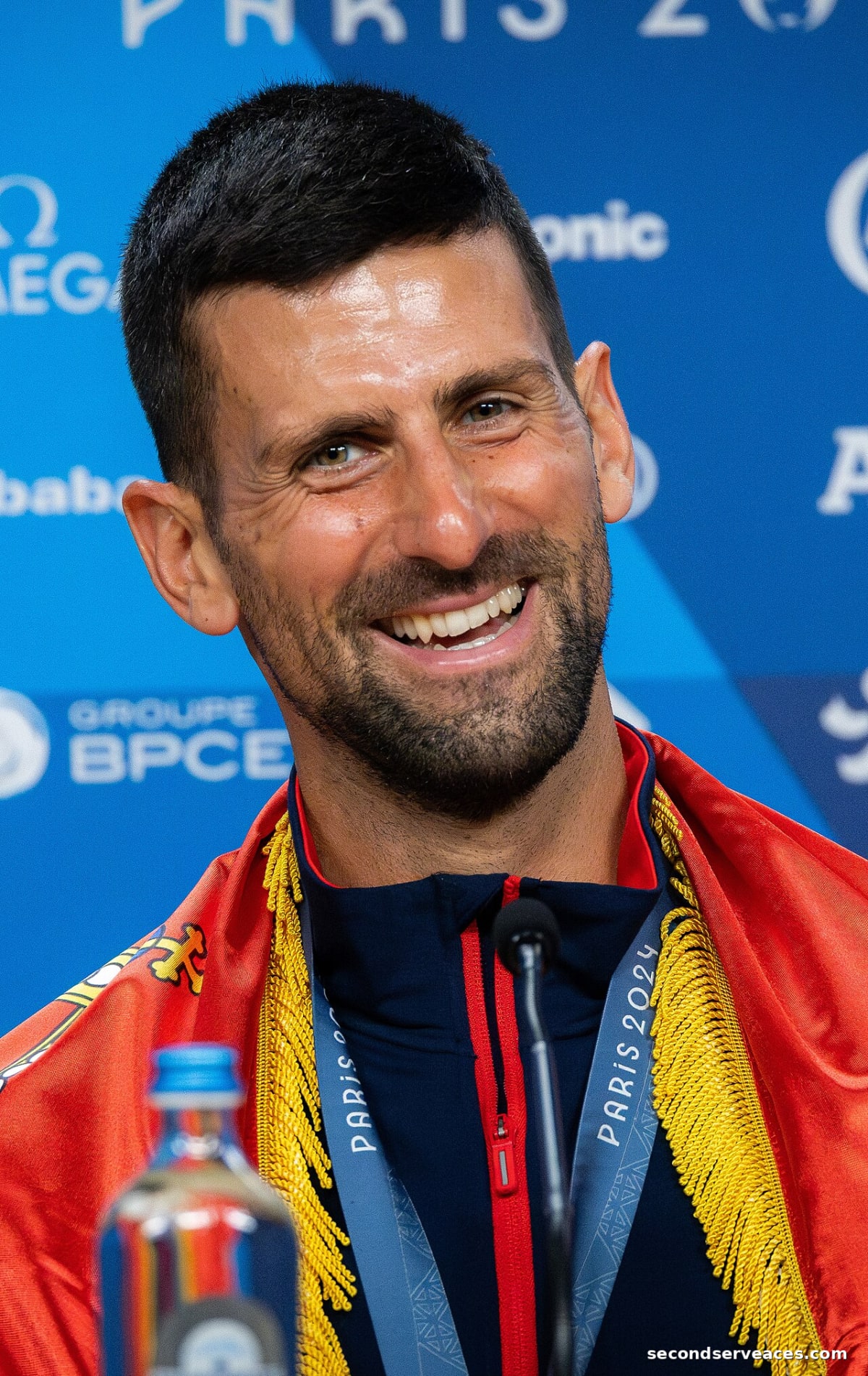
There is a certain physical metaphysics to SW19, an almost religious quietude that exists before the gates swing open and the grass is subjected to the violent, kinetic geometry of modern professional tennis. To stand near the practice courts in the late June heat is to witness a collision of eras. Here, under the watchful eyes of coaches and early-arriving cognoscenti, Serena Williams and Novak Djokovic shared a warm, laughter-filled reunion. It was a moment of profound gravity—two titans who have bent the trajectory of the sport to their collective wills, sharing a patch of manicured perennial ryegrass before the real, brutal business of the draw begins on Friday, June 26.
Listen to the Second Serve Podcast
Get our daily AI-synthesized audio briefings and match reviews on the go.
The 2022 US Open Farewell and the Kinetic Pull of Grass
When Serena Williams walked off the court at Flushing Meadows in 2022, the tennis world collectively accepted a narrative of finality. It felt like the heat-death of an era, a closing of the ledger on a career defined by raw power and unmatched competitive resolve. Yet, the competitive urge is not so easily extinguished; it remains a low-burning ember, waiting for the specific, low-friction glide of the grass-court season to fan it back into existence. Her return to the singles draw via a wildcard represents one of the most audacious experiments in modern sports history.
This is not a sudden, unprompted leap into the deep end. Williams has spent the preceding weeks meticulously recalibrating her joint mechanics and spatial awareness in doubles play. We watched her navigate the lawns of the Queen's Club Championships alongside the promising Victoria Mboko, followed by a highly instructive stint at the Berlin Tennis Open with Karolína Muchová. These appearances were less about trophy-hunting and more about the tedious, necessary work of re-aligning her visual tracking to the skidding, unpredictable bounces of the natural surface.
By accepting wildcards for both the singles and doubles draws—the latter a highly anticipated reunion with her sister, Venus Williams—Serena is challenging the very limits of athletic longevity. To understand the historical weight of this sisterly partnership, one must only look back to our evergreen analysis of Hingis vs. The Williams Sisters: A Clash of Tennis Paradigms. The doubles court offers Serena a tactical sanctuary, a place to sharpen her reflex volleys and serve-plus-one patterns without the exhausting lateral coverage demanded by the singles game.
The Biomechanical Demands of the Low Grass Court Bounce
To appreciate what Serena and Novak are attempting, one must understand the sheer physical toll of transitioning from hard courts to grass. On a hard court, the ball bounces true and high, allowing players to strike the ball comfortably within their natural hip-to-shoulder strike zone. Grass, however, is a surface of concession. It demands that the player descend to the ball, forcing an extreme degree of knee flexion and a radical lowering of the contact point height.
Consider the biomechanical data comparing Djokovic and Jannik Sinner. On grass, Djokovic’s average contact point on his slice backhand drops to an astonishing 54 centimeters off the turf, compared to roughly 79 centimeters on hard courts. This requires a profound level of core stability and quadricep strength. Sinner, conversely, often struggles to lower his center of gravity quite as fluidly, occasionally mistiming his contact point by up to 12 centimeters on low-skidding balls, which leads to a higher rate of unforced errors. Even veterans like Stan Wawrinka, with his heavy, looping topspin, must flatter out their strokes to survive on this surface.
The footwork adjustments are equally severe. On hard courts, players utilize explosive, friction-heavy slides to stop on a dime. On grass, that same movement would result in a torn ligament or a catastrophic slip. Djokovic has mastered a proprietary, highly controlled sliding technique on grass, utilizing a wider base and micro-steps to decelerate. Younger, more explosive players like Ben Shelton, who rely on vertical leap and high contact points, often find the transition jarring, as they cannot load their weight as cleanly on the slippery, shifting lawn.
The Micro-Climatic Crucible of Centre Court
Beyond the biomechanics, there is the silent, hostile architecture of Wimbledon itself. Centre Court is not merely a tennis court; it is an atmospheric micro-climate. The high, imposing stands, combined with the structural framing of the retractable roof, create unpredictable wind swirls that can turn a routine ball into a nightmare of late-flight deviation. A player must possess an almost instinctual capacity for mid-swing correction.
Then there is the visual challenge. The rich, dark green backdrop of the court perimeter contrasts sharply with the bright yellow felt of the ball. As the late afternoon sun creeps over the stadium lip, it casts long, jagged shadows across the court, creating a strobing effect that plays havoc with a player's depth perception. This visual noise is why even the most technically perfect players look human on these lawns.
Nowhere is this atmospheric difficulty more apparent than in the execution of the overhead smash. Djokovic’s historical overhead conversion rate sits at a surprisingly human 68.2%, a notable contrast to the ATP tour average of 74.5%. This curious vulnerability—often exacerbated by the swirling wind and the high, white-cloud backdrops of SW19—is a phenomenon we explored in detail in our analysis of the Wimbledon overhead smash difficulty. For Serena, whose overhead has historically been an absolute weapon, managing these environmental variables after a long layoff will be paramount.
The Pursuit of the Twenty-Fifth Crown
While Serena’s return is a celebration of athletic defiance, Djokovic’s campaign is a cold, calculated march toward immortality. The Serbian is chasing a record-extending 25th Grand Slam title, a number that would break his current tie with Margaret Court and place him alone on the highest peak of tennis history. His practice sessions have been masterclasses in efficiency, focused heavily on first-serve placement and immediate court positioning.
According to the official Wimbledon tournament data, Djokovic’s first-serve accuracy on grass has hovered at an elite 71% over his past three campaigns. By keeping his service games short and low-stress, he preserves the physical reserves necessary for the grueling second-week matches. This calculated conservation of energy is what separates him from the rest of the field, allowing him to peak precisely when the pressure reaches its maximum.
As the WTA and ATP stars finalize their preparations, the tennis world waits with bated breath. Serena's return is a poetic reminder of why we watch this sport—not just for the clean, sterile statistics, but for the human struggle against time, gravity, and the fading of the light. Whether she wins a round or lifts the trophy, her presence on the lawns of SW19 alongside Djokovic is a testament to the enduring, kinetic art of the game.
What Novak Djokovic Plays With
Head Speed Pro
Luxilon ALU Power 125
Head Prime Tour (12-Pack)
Asics Court FF 3 Novak
Analyze Novak Djokovic vs. Serena Williams
Predict tactical adjustments, momentum swings, and serve strategy options for this match-up using our AI simulator.
The Aces Tactical Panel
This report was curated and edited by Bhaskar Goel. Tactical analysis and technical insights were provided by our specialized panel of expert correspondents.
Julian Price
Senior Tactical Correspondent
Stuffy, pedantic British academic and historian specializing in match momentum and historical context.
Elena Cruz
Director of Analytical Research
Data scientist specializing in court surface physics and movement patterns.
Bhaskar
The Editor & Fan
Passionate tennis player and site editor bringing everyday amateur insights and relatable fan commentary.
Arthur Vance
Senior Existential Analyst
Deep, eccentric, and DFW-inspired. Models court metaphysics, kinetic beauty, and player psychology.
Leo Sterling
High-Performance Consultant
Hard-nosed ex-trainer from Melbourne with a no-nonsense view on tour fitness.
Related Reports
Quick Answers
When will the draw for the 2026 Wimbledon Championships be revealed?+
The official draw reveal for the 2026 Wimbledon Championships is scheduled to take place on Friday, June 26.
Who is Serena Williams partnering with in the doubles draw at Wimbledon?+
Serena Williams has accepted a doubles wildcard to play alongside her sister, Venus Williams.
Which warm-up tournaments did Serena Williams play before Wimbledon 2026?+
Serena Williams prepared for the grass-court season by playing doubles at the Queen's Club Championships with Victoria Mboko and at the Berlin Tennis Open with Karolína Muchová.