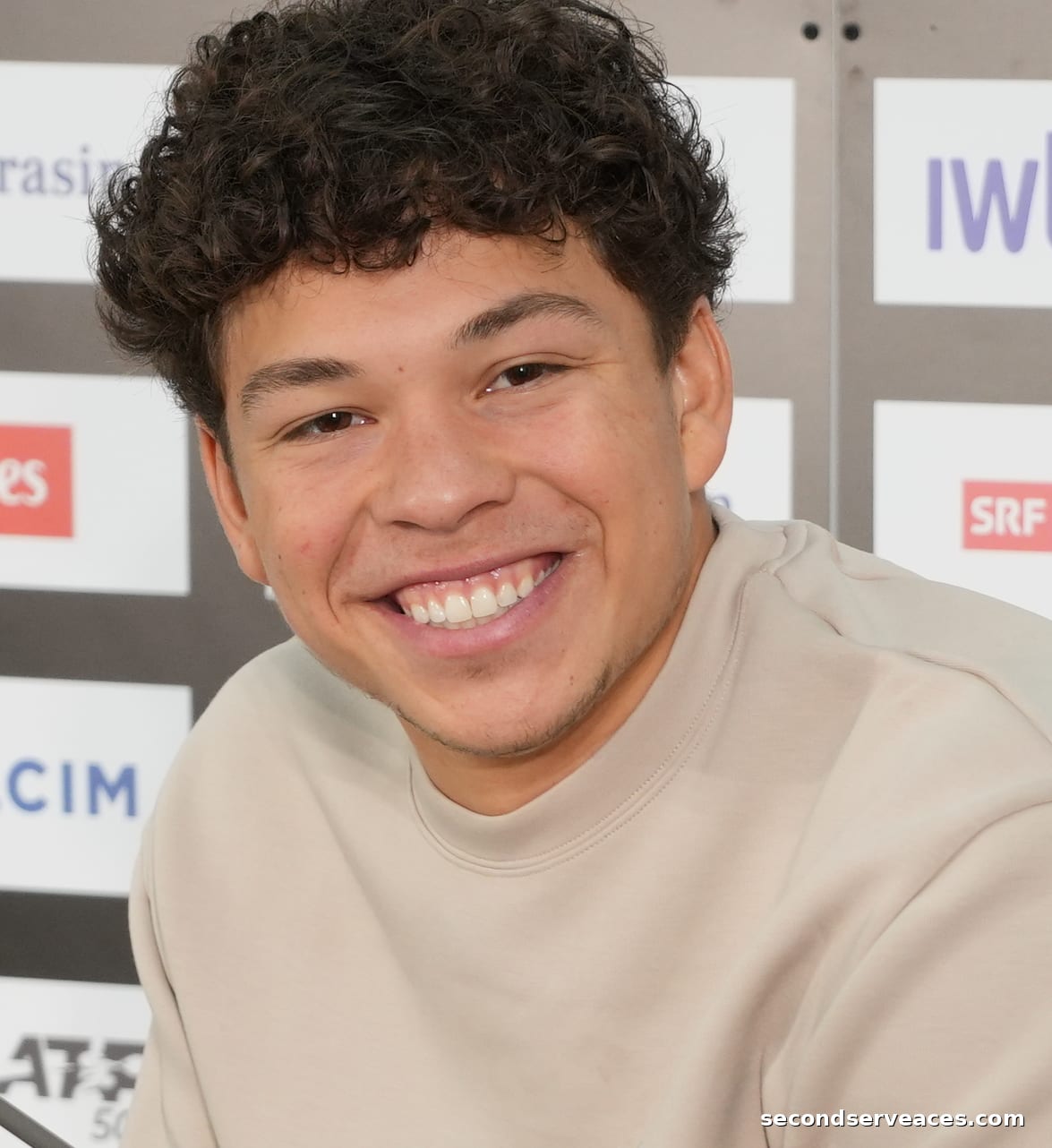
Redefining Resilience Amidst the Concrete Hazards of Montreal
On Wednesday, August 12, Ben Shelton secured his place in his second consecutive Canadian Open final with a 6-2, 6-3 victory over Learner Tien. But this was not a standard baseline masterclass. It was a test of pure physical survival, defined by a terrifying second-set tumble that left the world No. 10 bleeding on the hard court.
Listen to the Second Serve Podcast
Get our daily AI-synthesized audio briefings and match reviews on the go.
Leading by a set, Shelton chased a deep defensive ball, tripped over a thick rubber mat covering on-court cables, and crashed heavily into the electronic advertising boards. The impact sliced into his skin, forcing an immediate halt to play. It was a stark reminder of the razor-thin margin between athletic peak and sudden, structural injury in modern professional tennis.
Despite the visible cuts and the sudden interruption to his rhythm, the young left-hander refused to let the physical shock derail his focus. According to the official ATP rankings, Shelton's athletic evolution has been built on this brand of raw, unyielding intensity, allowing him to absorb physical trauma and maintain his aggressive court positioning.
The Sixth-Game Crisis and the Fight to Control Court Geometry
The defining moment of the match arrived in the sixth game of the second set, with Tien leading 30-0 on his own serve. Shelton was forced to take an extended medical timeout to stop the bleeding from his legs and hands. The delay threatened to completely shift the momentum toward Tien, a tactical counterpuncher who thrives when opponents lose their physical edge.
When play resumed, Shelton adjusted his approach, focusing on winning quick points behind his massive first serve rather than engaging in extended, side-to-side rallies that tested his injured limbs. He targeted Tien’s backhand wing, winning 78% of his first-serve points to neutralize Tien’s elite return game and prevent the match from slipping into a deciding set.
This physical turnaround highlights Shelton's growth since his earlier struggles on North American hard courts. As we noted in our tactical preview of his path, Shelton's ability to protect his second serve—winning over 60% of those points in Montreal—has become the foundation of his hard-court success, allowing him to dictate play even when his movement is compromised.
Rennae Stubbs Demands Player Safety Reform on the Professional Tour
The bloody incident immediately sparked outrage off the court, led by veteran coach and analyst Rennae Stubbs. Taking to X, Stubbs launched a fierce critique of the tournament's court design, demanding the immediate removal of the heavy cable mats placed at the back of the court. She argued that player safety must take precedence over commercial advertising boards and television cable routing.
Modern tennis players slide and sprint far beyond the baseline, making any foreign object in the run-back area an active hazard. Stubbs pointed out that Shelton’s fall could have easily resulted in a season-ending joint injury rather than superficial cuts. The incident has reignited a wider tour debate about the lack of standardized safety zones behind the baseline.
Tournament officials have yet to issue a formal response regarding the court layout for the upcoming final. However, the outcry from coaches and former players suggests that player unions will press for stricter regulations on electronic boards and cable management systems at future ATP Masters 1000 events.
Rivalry Matchup & Player Profiles
Prior to this Montreal encounter, Tien had held a commanding psychological edge over Shelton, leading their head-to-head rivalry 2-0. Their most notable battle occurred at the 2026 Indian Wells Masters, where Tien used his tactical counterpunching style to secure a 7-6(3), 4-6, 6-3 victory. This win in Montreal represents a massive hurdle cleared for Shelton as he continues to establish himself as the top-ranked American.
Shelton now turns his attention to the final, where he will face fellow American Brandon Nakashima. To prepare for this championship matchup, fans can read our detailed Montreal final matchup preview to understand how Nakashima's baseline consistency matches up against Shelton's explosive serve.
The physical toll of the Montreal run will undoubtedly test Shelton's recovery protocols over the next 24 hours. Facing a disciplined opponent like Nakashima requires absolute physical precision, and Shelton's ability to manage his bandaged cuts will decide whether he can claim his seventh career ATP singles title.
| Metric | Ben Shelton | Learner Tien |
|---|---|---|
| Rank | 10 | 19 |
| Age | 23 | 20 |
| Country | United States | United States |
| Height | 6 ft 4 in (1.93 m) | 5 ft 11 in (1.80 m) |
| Handedness | Left-handed | Left-handed |
| Play Style | Aggressive baseliner with a powerful serve | Tactical counterpuncher with high tennis IQ |
| Career Titles | 6 ATP Singles Titles | 2 ATP Singles Titles |
What Ben Shelton Plays With
Yonex Ezone 98 (7th Gen)
Yonex Poly Tour Pro 125
Yonex Super Grap (12-Pack)
Analyze Ben Shelton vs. Learner Tien
Predict tactical adjustments, momentum swings, and serve strategy options for this match-up using our AI simulator.
The Aces Tactical Panel
This report was curated and edited by Bhaskar Goel. Tactical analysis and technical insights were provided by our specialized panel of expert correspondents.
Julian Price
Senior Tactical Correspondent
Stuffy, pedantic British academic and historian specializing in match momentum and historical context.
Elena Cruz
Director of Analytical Research
Data scientist specializing in court surface physics and movement patterns.
Bhaskar
The Editor & Fan
Passionate tennis player and site editor bringing everyday amateur insights and relatable fan commentary.
Arthur Vance
Senior Existential Analyst
Deep, eccentric, and DFW-inspired. Models court metaphysics, kinetic beauty, and player psychology.
Leo Sterling
High-Performance Consultant
Hard-nosed ex-trainer from Melbourne with a no-nonsense view on tour fitness.
Related Reports
Quick Answers
What caused Ben Shelton's injury during the Canadian Open match?+
Ben Shelton suffered bleeding cuts after tripping over a rubber cable mat at the back of the court and crashing into an electronic advertising board.
At what point in the match did Shelton take a medical timeout?+
Shelton took an extended medical timeout during the sixth game of the second set, while Learner Tien was leading 30-0 on serve.
Who will Ben Shelton play in the Canadian Open final?+
Shelton is scheduled to play fellow American Brandon Nakashima in the final.