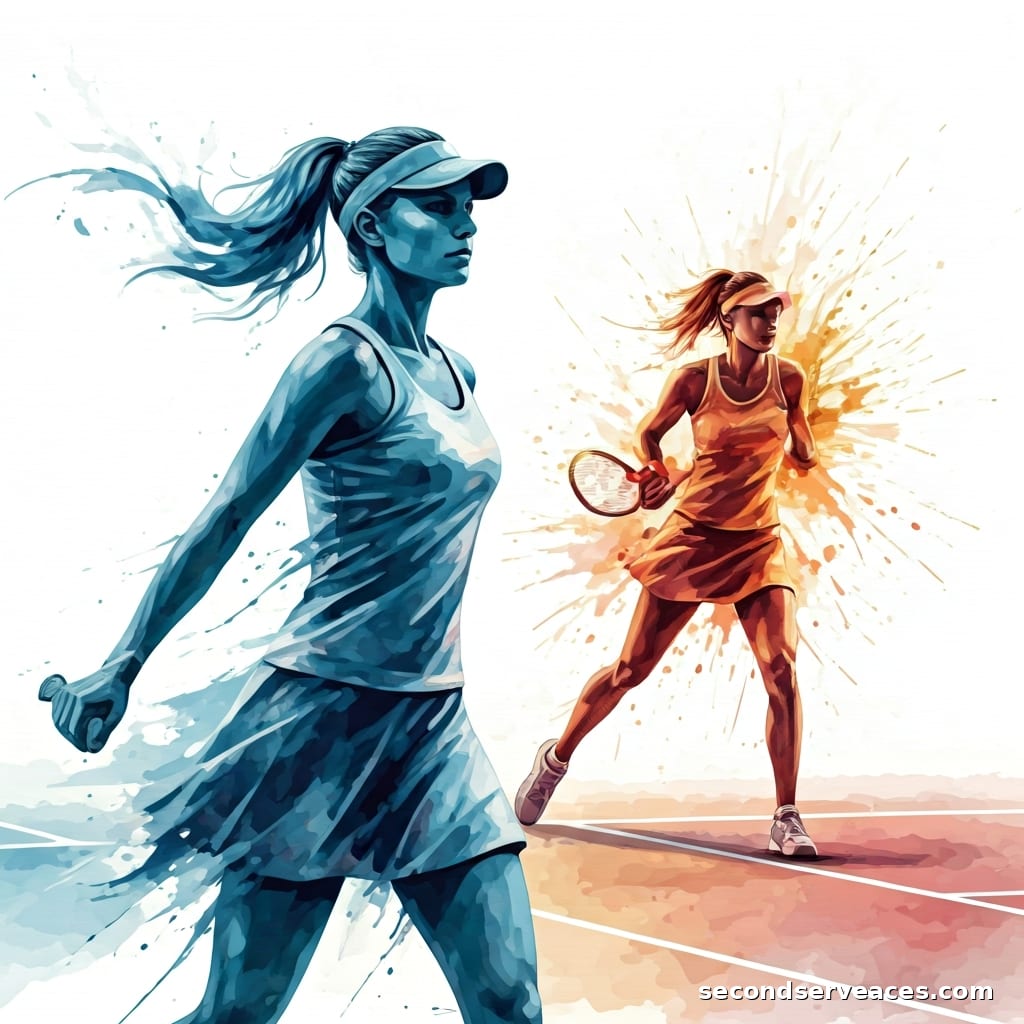
Hingis vs. The Williams Sisters: A Clash of Tennis Paradigms
To sit in the stands during the late 1990s was to witness a quiet, almost agonizingly beautiful ontological war on the court. On one side of the net stood Martina Hingis—a Swiss prodigy whose tennis was less a series of athletic feats and more a sequence of geometric proofs. On the other stood Venus and Serena Williams, two forces of kinetic nature who did not merely play tennis but seemed to actively redefine what the human body could extract from a yellow felt ball.
Listen to the Second Serve Podcast
Get our daily AI-synthesized audio briefings and match reviews on the go.
This was not merely a rivalry of personalities; it was an existential referendum on the very nature of the sport.
The Geometric Scalpel vs. Kinetic Physics
Hingis, who ascended to the top of the WTA Tour with a racket that functioned like a scalpel, relied on a delicate, almost preternatural understanding of court geometry. She was a master of the court's negative space, utilizing angles that seemed to defy the laws of trigonometry. Like the masters of the touch game we celebrated in our previous tactical breakdown of the drop shot, Hingis operated under the belief that tennis was a game of chess played at high velocity.
But the Williams sisters brought a different philosophy—one rooted in raw, unvarnished physics. When Venus Williams and her sister Serena Williams burst onto the scene, they did not just beat opponents; they overwhelmed them. Their groundstrokes were not mere returns but kinetic proclamations. The sound of the ball leaving their rackets was different—a deep, resonant thud that signaled the arrival of a new, uncompromising era of power.
The Shrinking Window of Time
Hingis’s game was built on anticipation and redirection. She would absorb the opponent’s pace and redirect it with microscopic precision, turning their own momentum against them. But the Williams sisters presented a problem that redirection could not solve: sheer, unadulterated velocity. When a ball is coming at you with the force of a small projectile, the window for geometric calculation shrinks to near zero. Hingis found herself starved of the one commodity she needed most: time.
The matches they played during this transitional era—most notably at the US Open and the Australian Open—were masterclasses in tension. It was the classic struggle between the classical and the modern, the delicate and the muscular. Hingis, with her tactical cunning, tried to pull the sisters into a web of drop shots and lobs, while Venus and Serena simply sought to tear the web apart with sheer force.
The Legacy of the Shift
In retrospect, this rivalry was the fulcrum upon which modern tennis tipped. The Williams sisters did not just win matches; they permanently altered the physical requirements of the sport. They proved that power and athleticism were not the enemies of grace, but rather a new, more robust form of it. The era of the pure tactician, operating without a devastating weapon, was drawing to a close. Hingis’s struggles against the sisters’ relentless power foretold a future where every player on tour would need to possess both the chess player’s mind and the sprinter’s explosiveness.
It was a beautiful, fleeting moment in tennis history—a brief window where two entirely different philosophies of movement and space could meet on equal terms, leaving us to wonder whether tennis is ultimately a game of angles or an exercise in pure, kinetic power.
Essential Matchday Add-Ons
Tournament-tested accessories and high-frequency consumables every competitive player keeps in their bag.
Tourna Grip Original Dry Feel Overgrip (10-Pack)
4.8 ★ (12,000+ reviews)
The gold standard for sweaty hands. Proprietary dry feel absorbs moisture better as play intensifies.
Luxilon ALU Power 125 Silver String Set
4.9 ★ (3,500+ reviews)
Unrivaled control and spin potential used by over 50% of the ATP Top 100 players.
Babolat Custom Damp Vibration Dampener (2-Pack)
4.7 ★ (4,200+ reviews)
Customizable dampening with removable central O-ring for fine-tuning court feedback and sound.
Penn Championship Extra Duty Tennis Balls (4-Can Pack)
4.7 ★ (8,900+ reviews)
Official ball of USTA League Tennis with extra-duty felt designed for abrasive hard courts.
Analyze Martina Hingis vs. Venus Williams
Predict tactical adjustments, momentum swings, and serve strategy options for this match-up using our AI simulator.
The Aces Tactical Panel
This report was curated and edited by Bhaskar Goel. Tactical analysis and technical insights were provided by our specialized panel of expert correspondents.
Julian Price
Senior Tactical Correspondent
Stuffy, pedantic British academic and historian specializing in match momentum and historical context.
Elena Cruz
Director of Analytical Research
Data scientist specializing in court surface physics and movement patterns.
Bhaskar
The Editor & Fan
Passionate tennis player and site editor bringing everyday amateur insights and relatable fan commentary.
Arthur Vance
Senior Existential Analyst
Deep, eccentric, and DFW-inspired. Models court metaphysics, kinetic beauty, and player psychology.
Leo Sterling
High-Performance Consultant
Hard-nosed ex-trainer from Melbourne with a no-nonsense view on tour fitness.
Related Reports



Quick Answers
How did Martina Hingis's tactical style contrast with Venus and Serena Williams's approach?+
Hingis relied on precise court geometry, anticipation, and redirection, whereas the Williams sisters introduced unprecedented kinetic power, velocity, and athletic dominance that overwhelmed traditional tactical play.
Which tournaments hosted the most notable matches of the Hingis-Williams rivalry?+
Their most significant and high-stakes clashes took place during the late 1990s and early 2000s at major tournaments like the US Open and the Australian Open.
Why is the Hingis-Williams rivalry considered a paradigm shift in modern tennis?+
It marked the transition from classical, touch-based tactical tennis to the modern era of high-velocity, power-dominant play, forcing subsequent generations to combine both tactical minds and explosive athleticism.