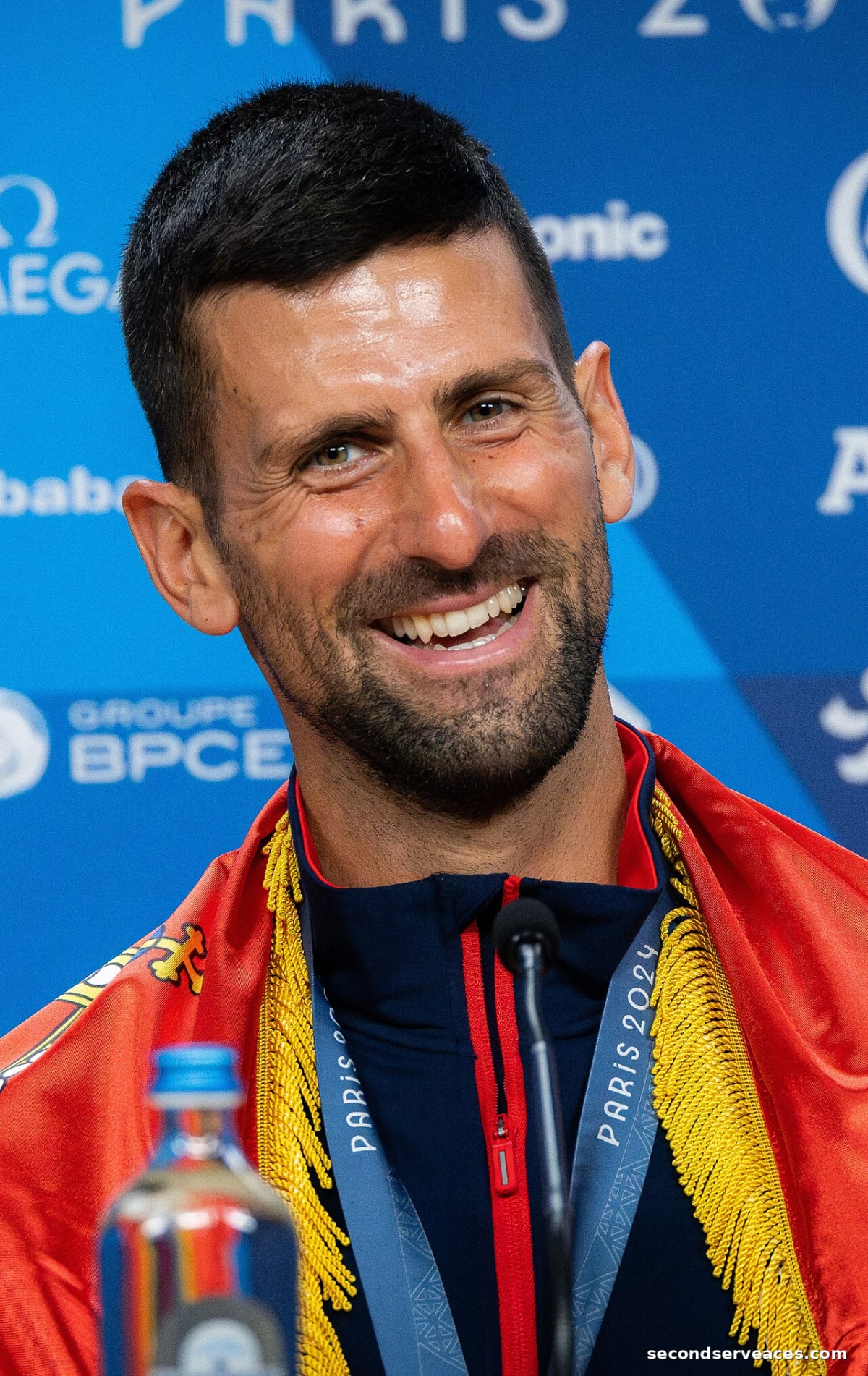
To the casual spectator, the overhead smash is the ultimate executive shot in tennis—a simple, high-velocity put-away that requires little more than basic hand-eye coordination. Yet, for elite professionals operating at the absolute pinnacle of the sport, this vertical stroke represents a complex biomechanical puzzle. Even Novak Djokovic, a 24-time Grand Slam champion with arguably the most complete technical arsenal in tennis history, openly struggles with this shot, leading fans to affectionately dub his mistimed overheads the 'Djokosmash'.
Listen to the Second Serve Podcast
Get our daily AI-synthesized audio briefings and match reviews on the go.
The Decoupling of Kinetic Chains in the Infamous 'Djokosmash'
The primary issue with the overhead smash lies in the sudden interruption of a player's horizontal movement patterns. While groundstrokes rely on a linear or rotational kinetic chain starting from the feet and moving through the hips, the overhead requires a vertical launch and a highly synchronized shoulder-to-wrist snap. When tracking a defensive lob, Djokovic frequently experiences a minor desynchronization in his racket-prep timing. His head drops slightly too early, which alters his peripheral vision and disrupts the optimal contact point just ahead of the shoulder line.
On the slick grass courts of Wimbledon, these micro-errors are magnified tenfold. Unlike hard courts, where a player can rely on a consistent bounce if they choose to let the ball drop, grass demands an immediate, airborne strike. The low-bounce nature of the surface means letting a lob bounce is rarely a viable option. For a player like Djokovic, whose baseline game is built on microscopic precision, the vertical variability of the overhead remains a rare mechanical vulnerability.
This technical struggle is not unique to the Serbian legend. Even world No. 1 Jannik Sinner has shown vulnerability when forced to transition rapidly from his aggressive baseline stance to a backward vertical leap. As we explored in our previous tactical analysis, Sinner's extreme linear acceleration on his groundstrokes does not always translate seamlessly into vertical kinetic energy, leaving his overheads prone to depth control errors.
Grass Court Micro-Adjustments and Low-Bounce Trajectories at SW19
The physics of grass-court tennis introduce unique variables that complicate visual tracking. At Wimbledon, the green backdrop and shifting English sunlight make tracking a yellow ball against a high trajectory incredibly difficult. Because the ball skids off the turf rather than gripping it, players must anticipate a faster, lower incoming trajectory from defensive lobs. This forces an incredibly compact backswing, a technical adjustment that runs counter to the long, looping motions players practice on clay.
Consider the technical approach of Canadian world No. 23 Leylah Fernandez. Fernandez relies on exceptionally quick footwork and a highly abbreviated take-back to handle overheads on faster surfaces. By keeping her non-dominant hand pointed at the ball longer, she maintains her shoulder alignment, preventing the premature chest opening that often causes right-handed players like Djokovic to push the ball wide or dump it into the net.
Furthermore, racket specifications play a massive role in how these overheads behave. Players often lower their string tension slightly on grass to generate more depth from the baseline. However, this lower tension reduces the dwell time on the string bed during high-velocity overhead impacts. If the player does not strike the ball exactly in the center of the sweet spot, the launch angle becomes highly unpredictable, turning an easy put-away into an unforced error.
The Psychological Leverage of the Defensive Lob
Because the overhead is statistically expected to be a winner, the psychological pressure on the attacking player is immense. Opponents are fully aware of this dynamic. When facing Djokovic or Sinner, defenders will intentionally loft high, defensive lobs with heavy topspin, daring them to execute the smash. This tactical targeting creates a mental bottleneck, forcing the attacker to overthink a shot that should be purely instinctual.
We are seeing this tactical trend weaponized by the next generation of clay-court specialists who are transitioning their heavy topspin games to grass. For example, Diana Shnaider, who reached the French Open semifinals in June 2026, and Flavio Cobolli, the French Open runner-up in June 2026, both utilize high-trajectory defensive lobs as a core part of their baseline counter-punching. These high, looping balls force opponents into deep overhead positions near the baseline, where the smash is statistically much less effective.
For Sinner, whose contact point is highly optimized for flat groundstrokes, the vertical tracking required for an overhead disrupts his natural rhythm. The transition from horizontal baseline movement to vertical airborne coordination is one of the steepest learning curves on the ATP Tour, especially when facing opponents who can transition from defense to offense in a single stroke.
Racket Specs and Tension Dynamics Under the London Sky
To understand why these errors occur, we must look at the gear. Djokovic's Head Speed Pro, configured with an 18x20 string pattern, offers incredible control but has a highly demanding sweet spot. When tracking a ball vertically, even a millimeter of misalignment on the string bed can result in a dead response, causing the ball to clip the tape. The dense string pattern requires perfect physical alignment—something that is difficult to achieve when backtracking on slippery grass.
Sinner's Head Speed MP utilizes a slightly more open 16x19 pattern, which provides a higher launch angle. While this assists in generating depth on his baseline groundstrokes, it can cause the ball to sail long on overheads if the racket face is even slightly open at contact. This technical trade-off is the price players pay for optimizing their setups for baseline dominance.
Ultimately, the overhead smash remains the ultimate test of a player's complete athletic coordination. While groundstrokes can be masked by elite footwork and racket-head speed, the overhead exposes any minor flaw in a player's kinetic chain. As the grass-court season progresses, the ability to clean up these vertical mechanics will be a major factor in determining who lifts the trophy at SW19.
What Novak Djokovic Plays With
Head Speed Pro
Luxilon ALU Power 125
Head Prime Tour (12-Pack)
Asics Court FF 3 Novak
Analyze Novak Djokovic vs. Jannik Sinner
Predict tactical adjustments, momentum swings, and serve strategy options for this match-up using our AI simulator.
The Aces Tactical Panel
This report was curated and edited by Bhaskar Goel. Tactical analysis and technical insights were provided by our specialized panel of expert correspondents.
Julian Price
Senior Tactical Correspondent
Stuffy, pedantic British academic and historian specializing in match momentum and historical context.
Elena Cruz
Director of Analytical Research
Data scientist specializing in court surface physics and movement patterns.
Bhaskar
The Editor & Fan
Passionate tennis player and site editor bringing everyday amateur insights and relatable fan commentary.
Arthur Vance
Senior Existential Analyst
Deep, eccentric, and DFW-inspired. Models court metaphysics, kinetic beauty, and player psychology.
Leo Sterling
High-Performance Consultant
Hard-nosed ex-trainer from Melbourne with a no-nonsense view on tour fitness.
Related Reports
Quick Answers
Why is Novak Djokovic's overhead smash nicknamed the 'Djokosmash'?+
The nickname 'Djokosmash' refers to the 24-time Grand Slam champion's occasional mechanical struggles and mistimed contacts on the overhead smash, a shot that otherwise contrasts with his elite baseline game.
How do grass courts at Wimbledon affect the overhead smash?+
The low-bounce and skidding nature of grass at Wimbledon forces players to make micro-adjustments quickly, making visual tracking and vertical alignment much more difficult than on clay or hard courts.
Which rising stars have demonstrated success with baseline lobs against top players?+
Younger players like Diana Shnaider, a June 2026 French Open semifinalist, and Flavio Cobolli, the June 2026 French Open runner-up, utilize high-topspin defensive lobs to exploit their opponents' overhead vulnerabilities.