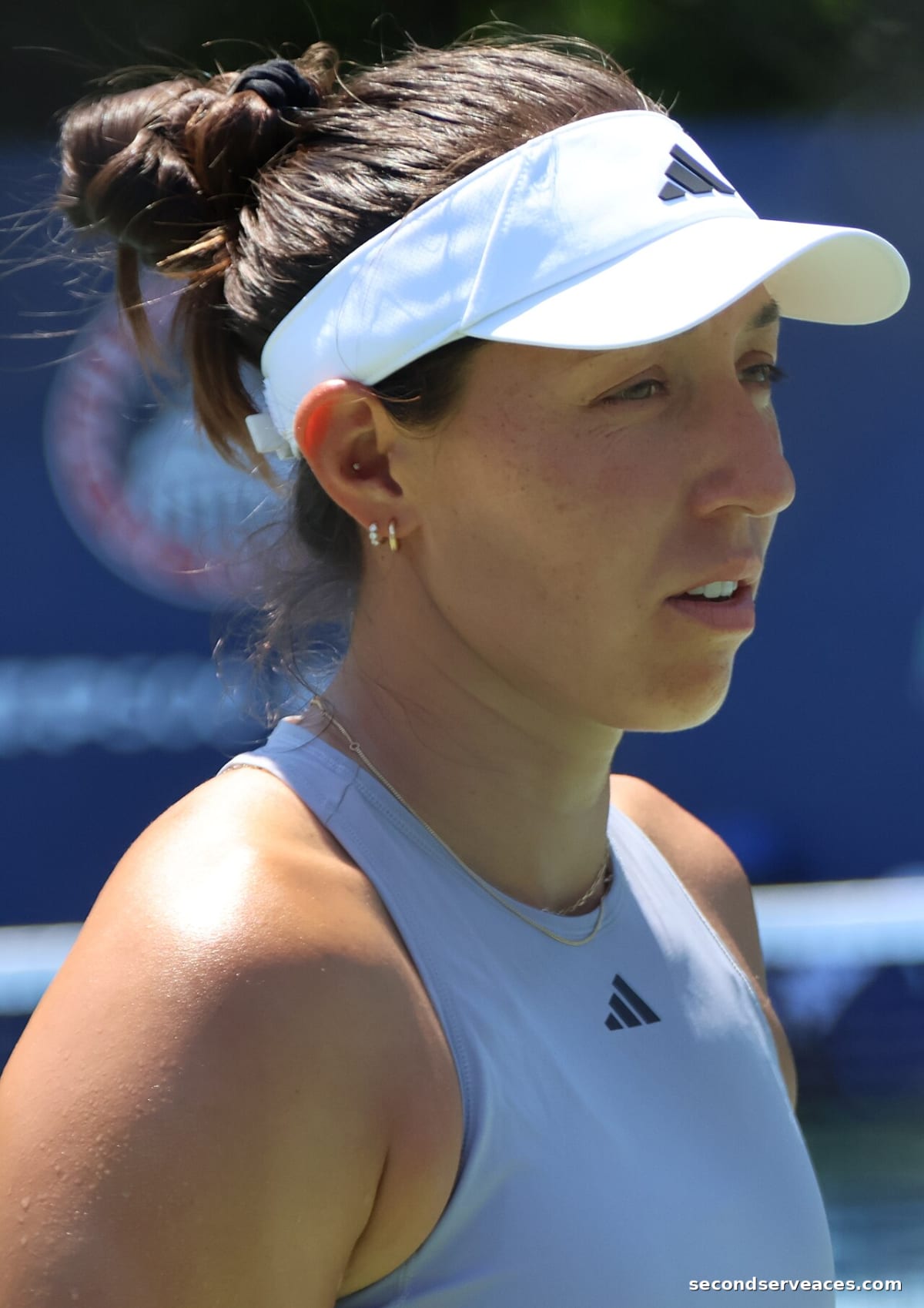
The grass-court transition is the ultimate test of a tennis player's soul. It is a sudden, jarring shift from the sliding clay to a slick surface where the ball skids low and fast, forcing players to bend their knees until their thighs burn. On the hallowed lawns of Wimbledon, there is no luxury of time. You do not build points; you survive them. It is an open-book test of adaptation, where raw athletic ego gets stripped away and only pure instinct remains.
Listen to the Second Serve Podcast
Get our daily AI-synthesized audio briefings and match reviews on the go.
The Mental Crucible of Transitioning to the Low-Bouncing Lawns
Jessica Pegula understands this physical and mental grind intimately. Her recent run to the final of the WTA 500 event in Berlin proved she has the resilience to handle the slickest lawns on tour. By defeating heavy hitters like Aryna Sabalenka and Madison Keys along the way, Pegula demonstrated a refined tactical maturity. We saw hints of this shift during Sabalenka's recent struggles, but Pegula has channeled that chaos into clinical, rhythmic baseline execution that translates beautifully to grass.
Her opponent, Darja Vidmanova, enters this arena carrying a completely different kind of momentum. Fresh off winning a WTA 125 outdoor hardcourt tournament in Portugal, Vidmanova is riding a wave of competitive adrenaline. However, moving from the high, predictable bounce of Portuguese hardcourts to the slick, unforgiving turf of London is a brutal test of footwork. If Vidmanova cannot adjust her center of gravity within the first three games, Pegula’s depth will quickly overwhelm her.
The tactical battle here lies in the first strike. Pegula’s ability to take the ball early and redirect pace will test Vidmanova's defensive movement on a surface where recovery steps are notoriously difficult. For Vidmanova to stand a chance, she must serve with high efficiency and avoid getting dragged into long, lateral running rallies where Pegula's experience will inevitably dictate the outcome.
The Meteoric Rise of Qualifying Survivors and Clay-Court Stars
The beauty of the grass-court season is how quickly it exposes who has spent the last month adapting their game and who is still stuck in a clay-court mindset. Take Maja Chwalinska, whose fairy-tale run as a qualifier to the Roland-Garros final captivated the tennis world. Though she ultimately fell to Mirra Andreeva, her ranking skyrocketed from No. 114 to No. 21 in just three weeks, according to the official WTA Rankings.
Now, Chwalinska must prove that her clay-court variety can translate to the lightning-fast lawns of SW19. Grass rewards those who can absorb pace and redirect it with interest, a skill she will need to summon immediately. The mental hangover of a major final can either weigh a player down or propel them to new heights. For Chwalinska, the pressure is no longer about climbing the ranks; it is about defending her newly minted status as a top-25 threat on a surface that offers zero margin for error.
Meanwhile, the qualifying fields at Roehampton have produced their own battle-tested warriors. Mananchaya Sawangkaew, currently ranked World No. 164, fought her way into the main draw by grinding out three grueling victories. That kind of match play is invaluable. While the top seeds have been practicing on pristine, untouched courts, Sawangkaew has been in the trenches, learning exactly how the ball behaves when the wind swirls and the turf begins to wear down.
Analyzing the Tactical Discrepancies in the Mid-Tier Clashes
Beyond the marquee names, the first round features fascinating tactical puzzles where previous matchups tell the entire story. Take the impending clash between Zeynep Sonmez and Ann Li. On paper, Li sits comfortably at No. 29 in the world, seemingly holding the upper hand against the 54th-ranked Sonmez. Yet, the raw numbers reveal a psychological roadblock that Li has yet to overcome.
Sonmez holds a commanding 2-0 head-to-head advantage over Li, a statistic that looms large over this matchup. In tennis, a matchup disadvantage is like a recurring nightmare; you know exactly what your opponent is going to do, but your muscles refuse to cooperate. Sonmez's ability to absorb Li's pace and exploit her movement on the run has been the deciding factor in their previous encounters, and the low bounce of grass will only amplify these dynamics.
To break this pattern, Li must abandon her comfort zone and look to finish points at the net. The low bounce of the lawn will punish any hesitation, meaning passive baseline rallies will play right into Sonmez's hands. It is a classic test of tactical flexibility, forcing a higher-ranked player to reinvent her strategy under the ultimate pressure of a Grand Slam stage.
Finding Value in the Opening-Round Betting Lines
For those looking at the analytical side of the draw, the opening round offers several intriguing opportunities where the bookmakers may have undervalued the qualifiers. Sawangkaew's underdog status against more established opponents ignores the sheer volume of grass-court reps she accumulated at Roehampton. In the first week of Wimbledon, backing a rhythm-blessed qualifier against a rusty seed is often the smartest play on the board.
Similarly, Vidmanova's hardcourt success makes her a dangerous wildcard, but the steep learning curve of grass-court movement suggests Jessica Pegula is a safe bet to cover the game spread. Pegula’s ability to take the ball early and keep her shots low to the court will likely prevent Vidmanova from establishing her aggressive baseline rhythm. We expect Pegula to dictate the terms of the engagement from the very first service game.
Ultimately, the first round is about survival, adaptation, and managing the psychological scar tissue of past defeats. As players look to assert their dominance, the grass will test every ounce of their physical preparation. It is a beautiful, brutal spectacle, and only those willing to embrace the discomfort will find themselves playing in the second week.
What Aryna Sabalenka Plays With
Wilson Blade 98 v9 (16x19)
Luxilon ALU Power 125
Analyze Jessica Pegula vs. Darja Vidmanova
Predict tactical adjustments, momentum swings, and serve strategy options for this match-up using our AI simulator.
The Aces Tactical Panel
This report was curated and edited by Bhaskar Goel. Tactical analysis and technical insights were provided by our specialized panel of expert correspondents.
Julian Price
Senior Tactical Correspondent
Stuffy, pedantic British academic and historian specializing in match momentum and historical context.
Elena Cruz
Director of Analytical Research
Data scientist specializing in court surface physics and movement patterns.
Bhaskar
The Editor & Fan
Passionate tennis player and site editor bringing everyday amateur insights and relatable fan commentary.
Arthur Vance
Senior Existential Analyst
Deep, eccentric, and DFW-inspired. Models court metaphysics, kinetic beauty, and player psychology.
Leo Sterling
High-Performance Consultant
Hard-nosed ex-trainer from Melbourne with a no-nonsense view on tour fitness.
Related Reports


Quick Answers
How did Jessica Pegula perform in her preparation for Wimbledon?+
Pegula reached the final of the WTA 500 event in Berlin, securing notable victories over Aryna Sabalenka and Madison Keys.
What is the head-to-head record between Zeynep Sonmez and Ann Li?+
Zeynep Sonmez holds a 2-0 head-to-head advantage over Ann Li heading into their Wimbledon first-round clash.
How much did Maja Chwalinska's ranking improve after Roland-Garros?+
Following her run as a qualifier to the Roland-Garros final, Chwalinska's ranking rose from No. 114 to No. 21 in just three weeks.