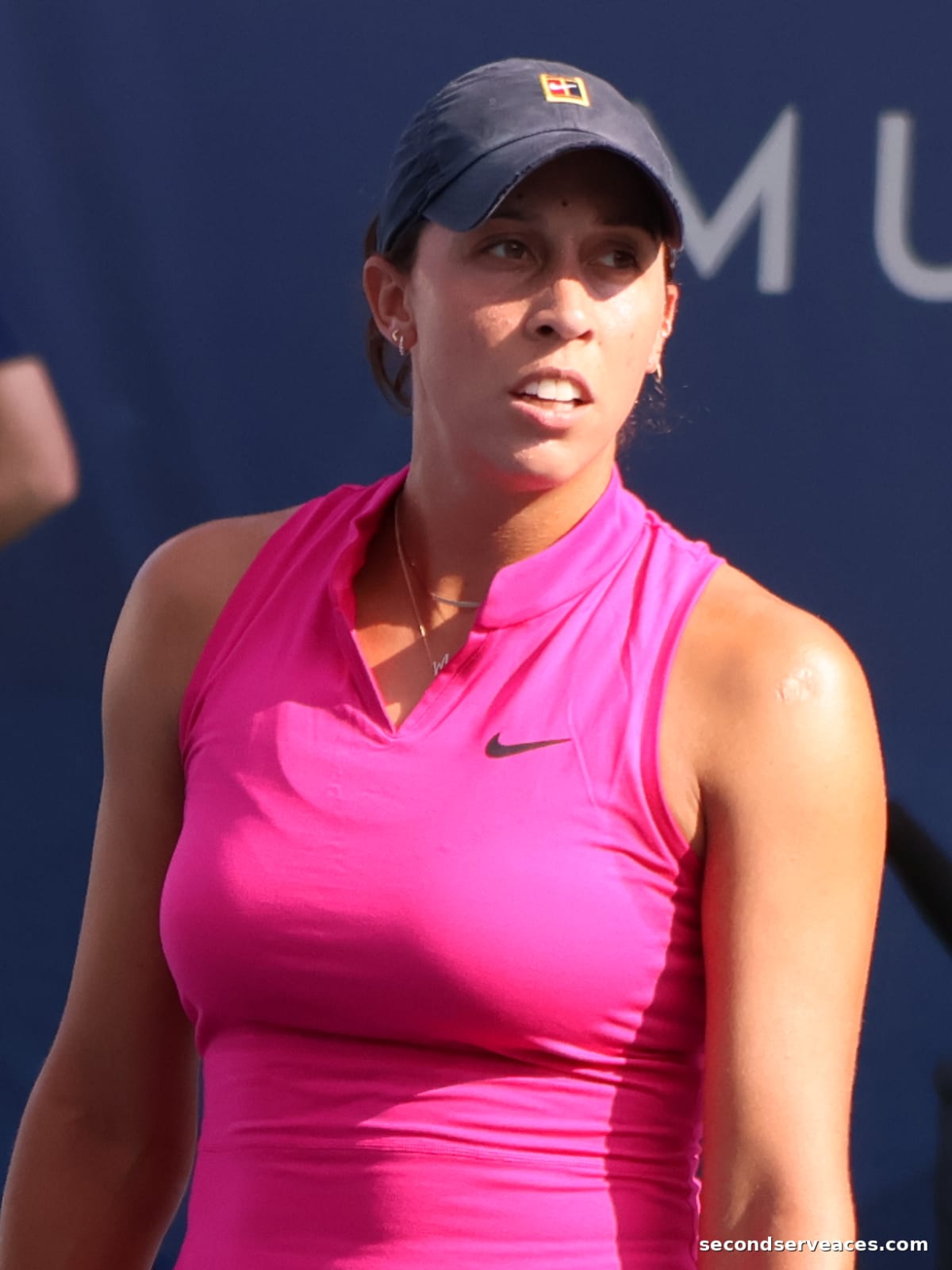
Madison Keys' grass-court prowess was on full display as she defeated Germany's Tatjana Maria 7-5, 6-4 to win the Eastbourne title for a third time. Keys, wielding her high-swingweight frame tuned for maximum plow-through, navigated the low-skidding slices of her opponent with technical precision. The victory marks a major milestone for the 31-year-old American, serving as her first title since winning her maiden Grand Slam crown at the 2025 Australian Open, according to official WTA Tour records.
Listen to the Second Serve Podcast
Get our daily AI-synthesized audio briefings and match reviews on the go.
The First-Set Baseline Grind at 5-5
During the opening stages of the match, Keys had to solve the unique aerodynamic puzzle of Maria's backhand slice. Maria's slice consistently skids under 20 centimeters off the grass, forcing opponents into uncomfortable low-bend positions. In our previous preview of the Eastbourne semifinals, we highlighted this exact clash of styles. At 5-5 in the first set, Keys adjusted her launch angle, utilizing her heavy topspin to generate the necessary net clearance while maintaining deep court positioning.
Keys' racket setup—strung with high-tension polyester to control her explosive power—allowed her to absorb Maria's change of pace without losing control of the baseline. By targeting Maria's forehand wing with heavy-topspin drives, Keys forced the German into defensive positions. This tactical adjustment prevented the frame from twisting on off-center hits, allowing Keys to secure the critical break and serve out the opening set.
Keys' Final Push to Seal the 7-5, 6-4 Victory
In the second set, Keys consolidated her tactical advantage by focusing on first-serve efficiency. She converted a critical break point at 4-4 in the second set, utilizing a high-velocity first serve to shift the match momentum entirely. Her ability to maintain structural stability at contact proved crucial on the slick Eastbourne turf, preventing Maria from finding any rhythm on her return games.
Closing out the match at 5-4, Keys relied on her high-velocity groundstrokes to dictate play, ultimately sealing the 7-5, 6-4 victory. This triumph marks her third title at the Eastbourne International, establishing her as one of the most efficient grass-court players of her generation. Her physical durability and clean ball-striking suggest her current gear setup is perfectly calibrated for the low-bounce conditions of the grass-court season.
Osaka's Bad Homburg Final Retirement at 6-1, 1-0
Meanwhile, at the Bad Homburg Open, the physical demands of the grass-court transition took a heavy toll. Naomi Osaka's highly anticipated final against Karolina Muchova ended prematurely. We previously analyzed Osaka's path in our Bad Homburg preview, but physical limitations cut her run short. Osaka withdrew from the Bad Homburg Open final due to a foot injury, retiring while trailing 6-1, 1-0.
The injury appeared to limit Osaka's explosive first-step lateral movement, a critical component when playing on low-friction grass courts. Muchova's varied slice and drop-shot combinations forced Osaka into uncomfortable positions, exacerbating the load on her foot. This retirement prevents Osaka from capturing a crucial warm-up title, shifting her focus entirely to recovery ahead of the year's third Major.
The Upcoming Grass-Court Gear Shifts for Wimbledon
As the tour transitions to SW19, both players face distinct structural challenges. Madison Keys is scheduled to face Kayla Day in the first round on Tuesday at Wimbledon. Keys' string setup—typically a hybrid configuration designed to balance raw power with tension maintenance—will need to remain highly consistent to handle Day's heavy left-handed topspin.
For Osaka, the priority is physical rehabilitation before her first-round clash against Elsa Jacquemot. Playing on grass requires pristine footwork and low-center-of-gravity stability; any lingering foot issues will be severely exposed by Jacquemot's court coverage. From a gear perspective, optimizing footwear traction with specialized grass-court pimple outsoles will be just as critical as any racket customization for both competitors.
Essential Matchday Add-Ons
Tournament-tested accessories and high-frequency consumables every competitive player keeps in their bag.
Tourna Grip Original Dry Feel Overgrip (10-Pack)
4.8 ★ (12,000+ reviews)
The gold standard for sweaty hands. Proprietary dry feel absorbs moisture better as play intensifies.
Luxilon ALU Power 125 Silver String Set
4.9 ★ (3,500+ reviews)
Unrivaled control and spin potential used by over 50% of the ATP Top 100 players.
Babolat Custom Damp Vibration Dampener (2-Pack)
4.7 ★ (4,200+ reviews)
Customizable dampening with removable central O-ring for fine-tuning court feedback and sound.
Penn Championship Extra Duty Tennis Balls (4-Can Pack)
4.7 ★ (8,900+ reviews)
Official ball of USTA League Tennis with extra-duty felt designed for abrasive hard courts.
Analyze Madison Keys vs. Tatjana Maria
Predict tactical adjustments, momentum swings, and serve strategy options for this match-up using our AI simulator.
The Aces Tactical Panel
This report was curated and edited by Bhaskar Goel. Tactical analysis and technical insights were provided by our specialized panel of expert correspondents.
Julian Price
Senior Tactical Correspondent
Stuffy, pedantic British academic and historian specializing in match momentum and historical context.
Elena Cruz
Director of Analytical Research
Data scientist specializing in court surface physics and movement patterns.
Bhaskar
The Editor & Fan
Passionate tennis player and site editor bringing everyday amateur insights and relatable fan commentary.
Arthur Vance
Senior Existential Analyst
Deep, eccentric, and DFW-inspired. Models court metaphysics, kinetic beauty, and player psychology.
Leo Sterling
High-Performance Consultant
Hard-nosed ex-trainer from Melbourne with a no-nonsense view on tour fitness.
Related Reports
Quick Answers
Who did Madison Keys defeat to win the Eastbourne International title?+
Madison Keys defeated Germany's Tatjana Maria 7-5, 6-4 to secure her third Eastbourne championship.
Why did Naomi Osaka retire from the Bad Homburg Open final?+
Naomi Osaka retired from the final against Karolina Muchova due to a foot injury while trailing 6-1, 1-0.
Who are Madison Keys and Naomi Osaka playing in the first round of Wimbledon?+
Madison Keys is scheduled to face Kayla Day on Tuesday, while Naomi Osaka will play Elsa Jacquemot in her opening match.