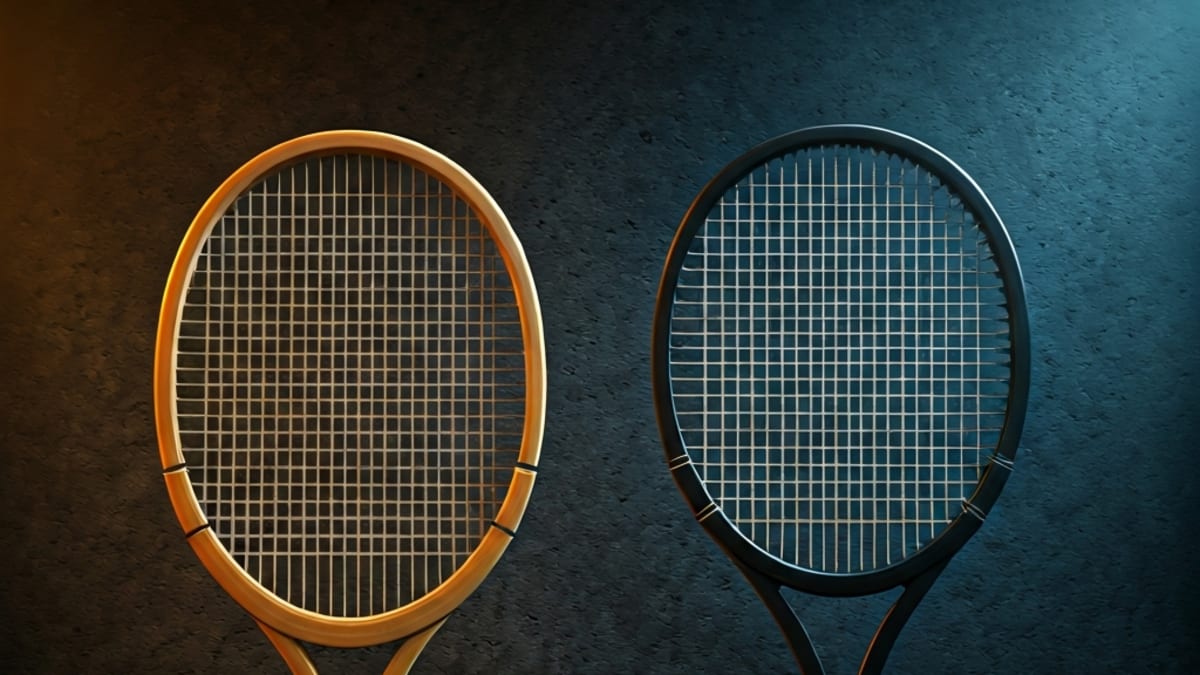
From Wood to Carbon: The Engineering of the Modern Racket
There is a persistent, misty-eyed nostalgia in tennis circles for the era of laminated timber. We romanticize the warm, woodsy thud of a ball meeting a Dunlop Maxply Fort or a Wilson Jack Kramer Autograph. But from a pure engineering standpoint, wooden rackets were highly inefficient energy-transfer devices. They were heavy, structurally inconsistent, prone to warping under humidity, and severely limited in head size. The transition to carbon fiber composite—commonly referred to as graphite—was not just an aesthetic upgrade; it was a revolution in frame stiffness, torsional stability, and swingweight dynamics.
Listen to the Second Serve Podcast
Get our daily AI-synthesized audio briefings and match reviews on the go.
The Structural Limitations of Timber
To understand the massive leap to graphite, we must first analyze the specs of the classic wooden frame. A standard wood racket weighed an astonishing 380 to 400 grams static weight, yet featured a minuscule head size of just 65 square inches. The RA rating—a measure of frame stiffness—was incredibly low, typically sitting below 30 RA. This meant that upon ball impact, the frame flexed violently, absorbing a massive percentage of the player's kinetic energy.
Furthermore, the polar moment of inertia (resistance to twisting) was virtually non-existent. Hit a ball even slightly off-center on a 65-square-inch wooden frame, and the racket would twist in your hand, resulting in a dead, unpredictable response. Legendary champions like Björn Borg compensated by tensioning their natural gut strings to over 80 pounds, turning their rackets into rigid boards to extract whatever control they could salvage. But this put immense strain on the player’s shoulder and elbow.
The Graphite Paradigm Shift and the RA Rating
By the early 1980s, aerospace-grade carbon fiber composites changed everything. Unlike wood, which is limited by the natural grain of the timber, carbon fiber allows engineers to manipulate the layup—the direction and thickness of the carbon sheets—to customize stiffness and flex points.
This engineering freedom allowed manufacturers to increase head sizes to 85, 95, and eventually the modern 100-square-inch standard without increasing overall weight. In fact, static weight dropped from 390g to a highly maneuverable 300-320g, while the RA stiffness rating skyrocketed to the 60-70 range. Players like Ivan Lendl pioneered this new era, utilizing stiff, graphite-silicon frames to dictate play from the baseline with heavy, penetrating groundstrokes.
As we discussed in our look at the one-handed backhand's fade, this massive boost in frame stiffness and head size allowed players to swing faster and with more vertical trajectories. This stiffness, combined with the later introduction of polyester strings (which we detailed in The Poly Revolution), fundamentally altered court geometry and player movement on the modern ATP Tour.
Durability and "Bang for Buck"
From a consumer perspective, the shift to graphite represents the ultimate "bang for buck" evolution in sports equipment. A wooden racket was essentially a consumable item; top players would warp or crack multiple frames per month, and even club players had to store their timber in wooden presses to prevent warping.
Graphite, by contrast, is incredibly durable. A high-quality carbon composite frame retains its structural integrity, stiffness profile, and flex characteristics for years, resisting fatigue through thousands of impact cycles. While modern rackets command premium prices, their cost-per-hour of play is exceptionally low compared to the fragile timber of yesteryear. The modern racket is a marvel of materials science—a rigid, highly efficient energy transmitter that has turned tennis into a game of pure physics.
Essential Matchday Add-Ons
Tournament-tested accessories and high-frequency consumables every competitive player keeps in their bag.
Tourna Grip Original Dry Feel Overgrip (10-Pack)
4.8 ★ (12,000+ reviews)
The gold standard for sweaty hands. Proprietary dry feel absorbs moisture better as play intensifies.
Luxilon ALU Power 125 Silver String Set
4.9 ★ (3,500+ reviews)
Unrivaled control and spin potential used by over 50% of the ATP Top 100 players.
Babolat Custom Damp Vibration Dampener (2-Pack)
4.7 ★ (4,200+ reviews)
Customizable dampening with removable central O-ring for fine-tuning court feedback and sound.
Penn Championship Extra Duty Tennis Balls (4-Can Pack)
4.7 ★ (8,900+ reviews)
Official ball of USTA League Tennis with extra-duty felt designed for abrasive hard courts.
Analyze Bjorn Borg vs. Ivan Lendl
Predict tactical adjustments, momentum swings, and serve strategy options for this match-up using our AI simulator.
The Aces Tactical Panel
This report was curated and edited by Bhaskar Goel. Tactical analysis and technical insights were provided by our specialized panel of expert correspondents.
Julian Price
Senior Tactical Correspondent
Stuffy, pedantic British academic and historian specializing in match momentum and historical context.
Elena Cruz
Director of Analytical Research
Data scientist specializing in court surface physics and movement patterns.
Bhaskar
The Editor & Fan
Passionate tennis player and site editor bringing everyday amateur insights and relatable fan commentary.
Arthur Vance
Senior Existential Analyst
Deep, eccentric, and DFW-inspired. Models court metaphysics, kinetic beauty, and player psychology.
Leo Sterling
High-Performance Consultant
Hard-nosed ex-trainer from Melbourne with a no-nonsense view on tour fitness.
Related Reports



Quick Answers
Why did tennis players transition from wood to graphite rackets?+
Graphite offered superior torsional stability, lighter weight, and significantly higher stiffness (RA rating), allowing players to swing faster and generate unprecedented spin and power.
What is the average head size difference between wood and modern graphite rackets?+
Wood rackets typically featured a head size of 65 square inches, whereas modern graphite rackets standardly range from 98 to 100 square inches, vastly expanding the sweet spot.
How does the durability of graphite compare to traditional wooden rackets?+
Unlike wood, which warps under moisture and loses tension over time, graphite frames retain their structural integrity and stiffness profile for years, offering exceptional long-term value.