The Poly Revolution: How Strings Changed Tennis Forever
There was a time, not so long ago, when the sound of a tennis ball meeting a string bed was a crisp, high-pitched ping. It was the sound of natural gut—the gold standard. It offered touch, it offered tension maintenance, and it offered a certain, dare I say, gentility. Then, like a seismic shift in the tectonic plates of the sport, polyester arrived. And with it, the game didn't just change; it was fundamentally dismantled and reassembled.
The Geometry of Friction
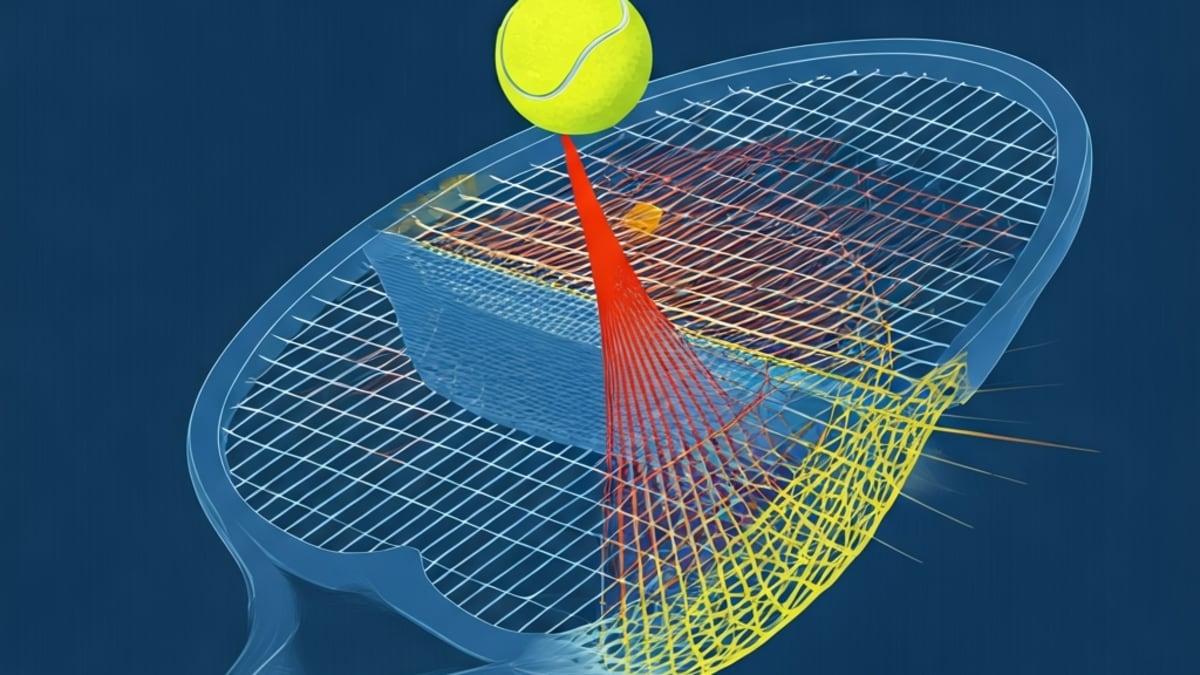
To understand the modern game, you have to look at the physics of the snap-back. Before polyester, the strings stayed where you put them. You hit the ball, and the strings stayed locked in a rigid grid. With modern co-poly strings, we have the 'snap-back' effect. When a player swings with that massive, windshield-wiper finish, the main strings are displaced by the ball, and they 'snap' back into place with violent speed, imparting an absurd amount of revolutions per minute (RPM). We are talking about spin rates that would have been physically impossible in the 1980s.
Court Positioning: The Baseline is Now a Fortress
Because the modern player can generate so much heavy, dipping topspin, the geometry of court positioning has shifted. You no longer need to approach the net to end a point. You can stand five feet behind the baseline, unleash a heavy, looping cross-court forehand, and watch as your opponent is pushed to the back fence. The string technology has turned the ball into a guided missile that dips sharply inside the baseline, making it a nightmare for anyone trying to take the ball on the rise.
Listen to the Second Serve Podcast
Get our daily AI-synthesized audio briefings and match reviews on the go.
The Trade-off of Stiffness
- The RPM Advantage: Unparalleled spin generation that forces errors.
- The Biomechanical Cost: The loss of 'feel' and the increase in vibration transmission, leading to more arm issues.
- Tactical Obsolescence: The demise of the touch volley, as the strings are essentially too 'dead' for finesse.
We are watching players who don't need to construct points with angles and volleys. They construct them through sheer kinetic violence. The racket hasn't just become a tool; it has become a centrifuge. The question isn't whether they can hit the spot; it's how much spin they can afford to lose while still keeping the ball in play.
What Rafael Nadal Plays With
Babolat Pure Aero Rafa
Babolat RPM Blast 1.35
Babolat VS Original (12-Pack)
Analyze Rafael Nadal vs. Novak Djokovic
Predict tactical adjustments, momentum swings, and serve strategy options for this match-up using our AI simulator.
The Aces Tactical Panel
This report was curated and edited by Bhaskar Goel. Tactical analysis and technical insights were provided by our specialized panel of expert correspondents.
Julian Price
Senior Tactical Correspondent
Stuffy, pedantic British academic and historian specializing in match momentum and historical context.
Elena Cruz
Director of Analytical Research
Data scientist specializing in court surface physics and movement patterns.
Bhaskar
The Editor & Fan
Passionate tennis player and site editor bringing everyday amateur insights and relatable fan commentary.
Arthur Vance
Senior Existential Analyst
Deep, eccentric, and DFW-inspired. Models court metaphysics, kinetic beauty, and player psychology.
Leo Sterling
High-Performance Consultant
Hard-nosed ex-trainer from Melbourne with a no-nonsense view on tour fitness.