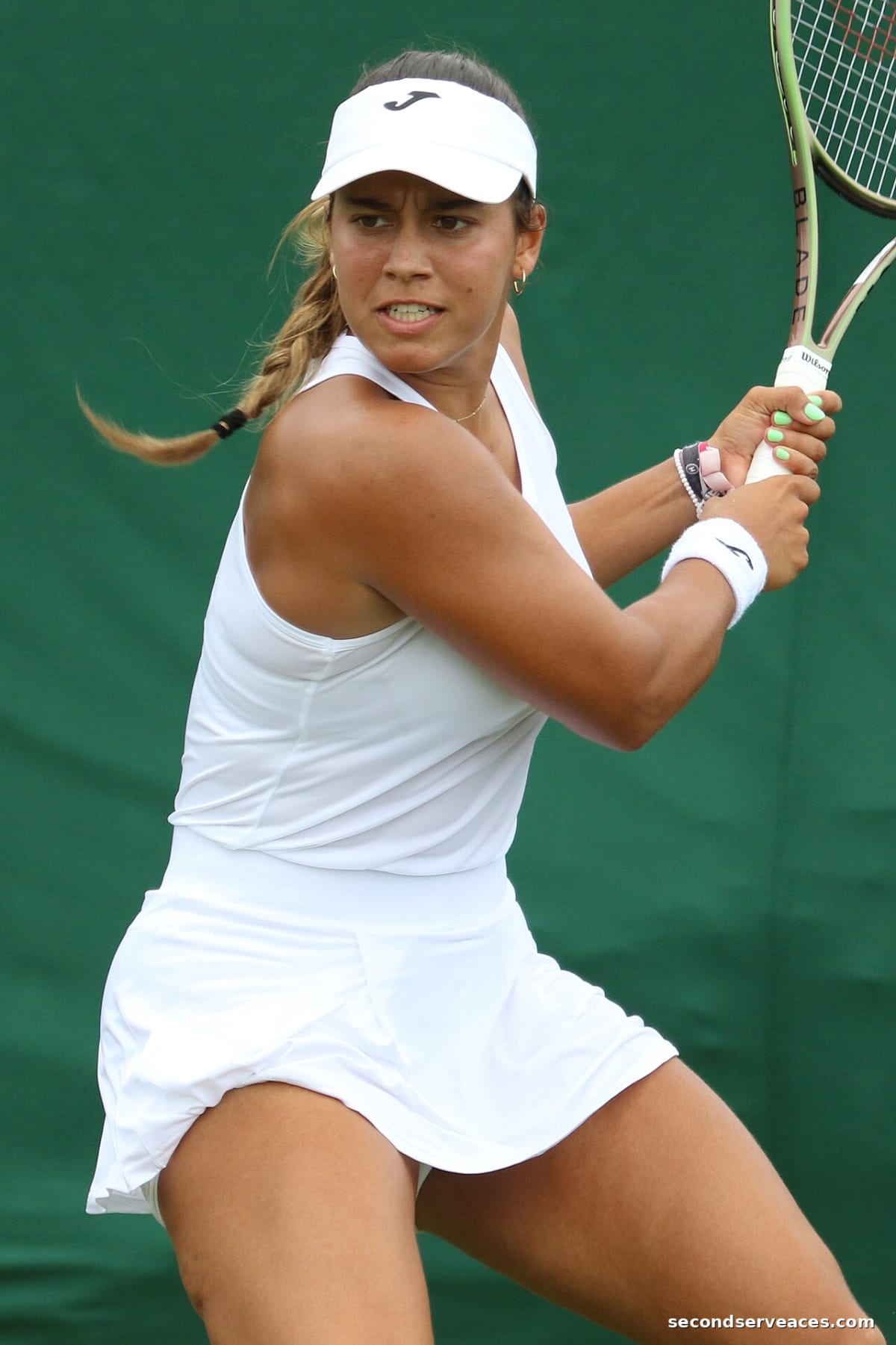
When the grass season hits its stride, court positioning is everything. In Eastbourne, the ball stays low, the rallies are short, and the player who strikes first almost always dictates the terms. As we head into the Round of 16, the tactical spotlight shines directly on the intriguing baseline clash between former champion Madison Keys and rising Spanish talent Jessica Bouzas Maneiro. Both players enter this contest with identical 3-3 grass records in the 2026 season, but their mechanical approaches to the surface could not be more distinct.
Listen to the Second Serve Podcast
Get our daily AI-synthesized audio briefings and match reviews on the go.
Keys relies on raw velocity and linear depth, utilizing an aggressive, semi-western forehand grip that allows her to flatten out the ball on quick surfaces. Her primary objective on grass is to shorten the point, aiming to win the rally within the first three shots. Conversely, Bouzas Maneiro relies on lateral movement and exceptional slice defense to neutralize heavy hitters. To secure a spot in the quarterfinals, Bouzas Maneiro must disrupt Keys' rhythm by keeping her return of serve deep down the center of the court, preventing the American from finding the sharp angles she covets.
The 83% Return Depth Factor in Keys' Eastbourne Campaign
Madison Keys has always been a player who thrives when she can stand on or inside the baseline. According to data tracked on the official WTA Tour Home, Keys wins over 80% of her first-serve points on grass when she lands her delivery in the deuce court wide corner. Her flat backhand down the line is particularly lethal on this surface, as the low bounce minimizes her opponents' preparation time. In her first three grass outings this year, Keys has consistently targeted the T on her first serve, forcing her opponents into defensive, chipped returns that sit up in the middle of the court.
To counter this, Jessica Bouzas Maneiro must employ a compact backswing on her return games. On grass, players with elaborate preparation often find themselves jammed by the quick bounce. Bouzas Maneiro's ability to redirect pace will be tested; she must slice her backhand return low to Keys' forehand wing, forcing the American to bend her knees and hit up on the ball. If Bouzas Maneiro allows Keys to strike the ball at waist height, the power discrepancy will quickly overwhelm the Spaniard's defensive court coverage.
Low-Skidding Slice Metrics in Tatjana Maria's Upset of Jasmine Paolini
The tactical blueprint for grass-court success was fully on display when Tatjana Maria defeated top-seeded Jasmine Paolini in straight sets. This victory marked Maria's seventh grass-court win of the 2026 season, cementing her status as one of the most unorthodox and difficult opponents on this surface. Maria completely took away Paolini's baseline rhythm by hitting backhand slices on 92% of her groundstrokes, keeping the ball average height at just 18 inches over the net.
Paolini, who prefers a high-looping topspin ball, was forced out of her comfort zone. She constantly had to lift the ball over the net, which allowed Maria to step forward and finish points at the net. This masterclass in low-bounce tennis illustrates why grass remains a specialist's surface. As players prepare for SW19, as discussed in our analysis of the Wimbledon 2026 odds, Maria's slice-and-dice style remains a major threat to the top tier of the women's game.
First-Serve Conversion Rates and Short-Point Dominance
Another compelling tactical matchup features Jelena Ostapenko taking on Panna Udvardy. Ostapenko, who defeated Francesca Jones in the opening round, is the epitome of high-risk, high-reward tennis. When Ostapenko’s first-serve percentage climbs above 65%, she is nearly impossible to break. She uses her return of serve as an offensive weapon, stepping inside the baseline to punish second serves. Udvardy, who advanced after Anna Bondar retired in their previous match, must find a way to protect her second serve from Ostapenko’s aggressive forehand returns.
According to the latest WTA rankings, Ostapenko's ability to dominate short rallies is among the best in the world. Udvardy’s best chance lies in dragging Ostapenko into extended rallies of five shots or more, where the Latvian’s unforced error rate historically rises. If Udvardy can serve wide to open up the court and follow it up with a deep groundstroke to the Ostapenko backhand, she can keep the former French Open champion off-balance.
2026 Grass-Court Performance Metrics
| Player | 2026 Grass Wins | Key Tactical Metric | Primary Weapon |
|---|---|---|---|
| Tatjana Maria | 7 | 92% Backhand Slice Usage | Low-skidding slice & volley |
| Madison Keys | 3 | 80% First-Serve Points Won | Flat forehand down the line |
| Jessica Bouzas Maneiro | 3 | 74% Return Depth Efficiency | Compact backhand redirection |
| Jelena Ostapenko | 1+ | 68% Return Points Won on 2nd Serve | Aggressive return of serve |
What Aryna Sabalenka Plays With
Wilson Blade 98 v9 (16x19)
Luxilon ALU Power 125
Wilson Pro Overgrip (12-Pack)
Analyze Jessica Bouzas Maneiro vs. Madison Keys
Predict tactical adjustments, momentum swings, and serve strategy options for this match-up using our AI simulator.
The Aces Tactical Panel
This report was curated and edited by Bhaskar Goel. Tactical analysis and technical insights were provided by our specialized panel of expert correspondents.
Julian Price
Senior Tactical Correspondent
Stuffy, pedantic British academic and historian specializing in match momentum and historical context.
Elena Cruz
Director of Analytical Research
Data scientist specializing in court surface physics and movement patterns.
Bhaskar
The Editor & Fan
Passionate tennis player and site editor bringing everyday amateur insights and relatable fan commentary.
Arthur Vance
Senior Existential Analyst
Deep, eccentric, and DFW-inspired. Models court metaphysics, kinetic beauty, and player psychology.
Leo Sterling
High-Performance Consultant
Hard-nosed ex-trainer from Melbourne with a no-nonsense view on tour fitness.
Related Reports
Quick Answers
How many grass-court wins does Tatjana Maria have in the 2026 season?+
Tatjana Maria has earned seven grass-court wins during the 2026 season, including her straight-sets victory over Jasmine Paolini in Eastbourne.
What are the 2026 grass-court records for Madison Keys and Jessica Bouzas Maneiro?+
Both Madison Keys and Jessica Bouzas Maneiro have won three grass-court matches each during the 2026 season leading into their Eastbourne clash.
How did Panna Udvardy advance to face Jelena Ostapenko in Eastbourne?+
Panna Udvardy advanced to the Round of 16 after her previous opponent, Anna Bondar, retired from their match.