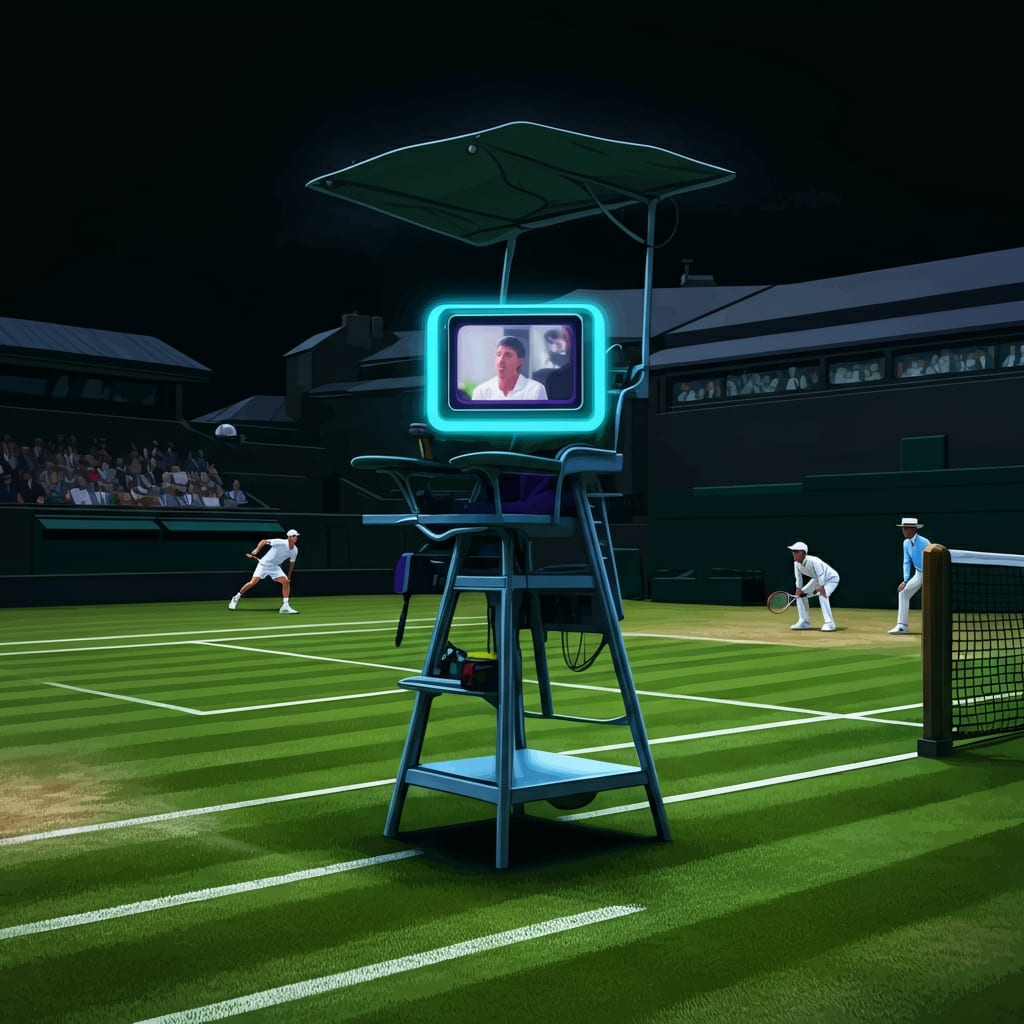
It is about time. For generations, professional tennis players have stepped onto the pristine lawns of SW19 knowing full well they had two opponents to beat: the player across the net, and the chair umpire's inherently flawed human vision. Grass-court tennis is a relentlessly fast, chaotic discipline where balls skid, chalk flies unpredictably, and split-second decisions dictate championship legacies. Finally, the All England Club is doing something to level the playing field.
Listen to the Second Serve Podcast
Get our daily AI-synthesized audio briefings and match reviews on the go.
Breaking away from centuries of rigid tradition, Wimbledon is set to introduce video review technology for the very first time at this year's tournament. The implementation of this technology will take place entirely this season, marking a monumental shift in how the world’s most prestigious grass-court event is governed. For the first time in the tournament's history, players will have a digital safeguard against the catastrophic subjective errors that have historically derailed entire campaigns.
Let us not mince words here: officiating a modern grass-court match is an absolute nightmare. The ball keeps incredibly low, heavy topspin visually distorts the flight path, and the sheer velocity of modern groundstrokes makes tracking a baseline clip virtually impossible for the naked eye. Relying solely on human judgement for double bounces, foul hits, and net touches in an era where millions of dollars and ranking points are on the line is archaic. Wimbledon’s decision to embrace the screen is the loudest admission yet that the sport has outgrown its Victorian-era regulatory constraints.
The Tactical Breakdown
You might be asking how an officiating change alters actual match tactics. If you think video review is just about correcting a bad call, you are ignoring the deep, psychological warfare that dictates professional tennis. This new technological layer fundamentally reshapes how players manage Match Momentum, approach the net, and disrupt their opponents' rhythm.
Here is how the introduction of video review rewrites the tactical playbook on grass:
- The Double Bounce Deterrent: Grass courts demand heavy usage of the drop shot. The ball dies quickly on the slick surface, leading to desperate forward sprints. Historically, players would routinely dig out a drop shot a fraction of a second after the second bounce, knowing the chair umpire rarely possessed the angle or eyesight to catch it. With video review looming, players will think twice before playing on, altering the geometry of front-court exchanges.
- Net Touch Accountability: Serve-and-volley tactics, while less common today than in the 1980s, still see a massive uptick on grass. Bang-bang plays at the net often result in racquets crossing the plane or subtle net touches. Knowing the eye in the sky is recording every pixel means aggressive net-rushers must refine their deceleration mechanics to avoid clear-cut technical fouls.
- Icing the Server: Let’s call it what it is—technology is a weapon for momentum disruption. Facing a break point against a server who is hitting their spots flawlessly? Requesting a video review on a questionable hindrance or foul hit grants a player a crucial 45-second breather. It breaks the server’s rhythm, cools the crowd, and provides a tactical timeout hidden behind the guise of a rule check.
Furthermore, this dramatically alters the dynamic between the player and the official. Chair umpires have long utilized a shield of absolute authority to quickly shut down player arguments and keep the match moving. When a player possesses the power to definitively prove the umpire wrong on the big screen, the entire power structure shifts. We are moving from a system of unquestioned obedience to one of verifiable accuracy.
The Bigger Picture
Wimbledon’s relationship with modernity has always been a slow, grudging dance. This is the tournament that mandates an all-white dress code, refused to play on Middle Sunday until recently, and still serves strawberries and cream as if it were 1885. Yet, when push comes to shove, the All England Club recognizes that the integrity of the competition must supersede blind adherence to tradition.
Look at the timeline of innovation at SW19. They fiercely resisted installing a roof on Centre Court until the British weather forced their hand. They eventually adopted Hawk-Eye line-calling when the pace of the modern game made line judges a liability. Now, by integrating full video review for subjective calls, they are crossing the final frontier of tennis technology.
The historical precedent here is massive. Think back to the sheer volume of dramatic meltdowns on these very lawns. Rackets smashed into splintered graphite, furious tirades aimed at terrified officials, and matches completely unravelling over a single missed hindrance call. While purists might mourn the loss of that raw, unhinged drama, the players will breathe a collective sigh of relief. The psychological burden of feeling "robbed" on the game's biggest stage has been permanently lifted.
As we march toward the summer, the narrative shifts from whether the umpires will ruin a classic, to how effectively the world's elite can utilize this new tool. The introduction of video review at Wimbledon this year guarantees one profound truth: the days of hiding behind a bad call are over. The lens sees everything, the screen doesn't lie, and finally, the tennis will do the talking.
Essential Matchday Add-Ons
Tournament-tested accessories and high-frequency consumables every competitive player keeps in their bag.
Tourna Grip Original Dry Feel Overgrip (10-Pack)
4.8 ★ (12,000+ reviews)
The gold standard for sweaty hands. Proprietary dry feel absorbs moisture better as play intensifies.
Luxilon ALU Power 125 Silver String Set
4.9 ★ (3,500+ reviews)
Unrivaled control and spin potential used by over 50% of the ATP Top 100 players.
Babolat Custom Damp Vibration Dampener (2-Pack)
4.7 ★ (4,200+ reviews)
Customizable dampening with removable central O-ring for fine-tuning court feedback and sound.
Penn Championship Extra Duty Tennis Balls (4-Can Pack)
4.7 ★ (8,900+ reviews)
Official ball of USTA League Tennis with extra-duty felt designed for abrasive hard courts.
Run Match-Point Simulations
Simulate high-pressure scenarios, score leverage points, and tactical responses for ATP and WTA players.
The Aces Tactical Panel
This report was curated and edited by Bhaskar Goel. Tactical analysis and technical insights were provided by our specialized panel of expert correspondents.
Julian Price
Senior Tactical Correspondent
Stuffy, pedantic British academic and historian specializing in match momentum and historical context.
Elena Cruz
Director of Analytical Research
Data scientist specializing in court surface physics and movement patterns.
Bhaskar
The Editor & Fan
Passionate tennis player and site editor bringing everyday amateur insights and relatable fan commentary.
Arthur Vance
Senior Existential Analyst
Deep, eccentric, and DFW-inspired. Models court metaphysics, kinetic beauty, and player psychology.
Leo Sterling
High-Performance Consultant
Hard-nosed ex-trainer from Melbourne with a no-nonsense view on tour fitness.