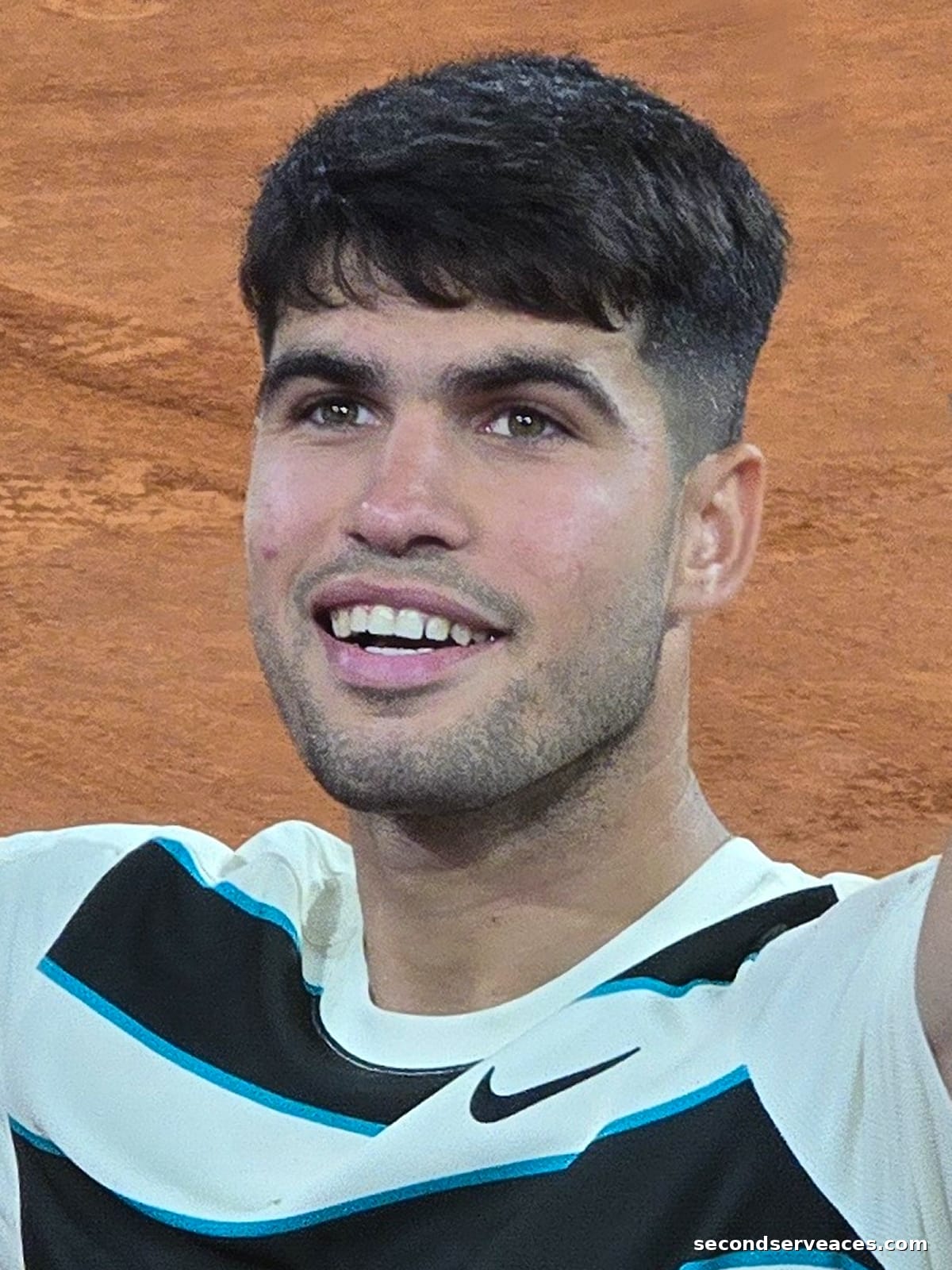
A record £64.2 million total prize pool has been established for the upcoming championships, representing a steep 20 percent escalation from last season’s £53.5 million. On its surface, this financial expansion presents itself as a benevolent gesture of institutional health. Yet, beneath the pristine turf and the meticulous logistics of the All England Club, this surge in capital highlights a profound, almost philosophical friction between the governing bodies of the sport and the biomechanical laborers who actually generate its value.
Listen to the Second Serve Podcast
Get our daily AI-synthesized audio briefings and match reviews on the go.
The 13 Percent Chasm in Grand Slam Revenue Sharing
To watch Carlos Alcaraz or Jannik Sinner slide across the baseline is to witness a masterclass in kinetic efficiency. However, the economic efficiency of the sport is far more contested. Last year, Wimbledon’s total prize pool represented less than 13 percent of its gross revenue, a stark contrast to major team sports where revenue sharing frequently approaches a fifty-fifty split. The Professional Tennis Players Association (PTPA) has actively lobbied for grand slam compensation to reflect closer to 22 percent of tournament revenues, arguing that the current model structurally undervalues the physical toll extracted from the athletes.
This economic chasm is not merely a theoretical debate; it is the catalyst for an active lawsuit pursued by the PTPA against Wimbledon, the French Open, and the US Open, alleging systemic abuse and anti-competitive practices. As we monitor the financial trajectories of the game's elite in our 2026 prize money tracker, the disparity between soaring tournament revenues and player compensation remains the central narrative tension of the professional circuit.
A 20 Percent Compensation Surge Against the Backdrop of Litigation
The revised compensation structure ensures that the singles champions—whether it be Alcaraz defending his crown or Aryna Sabalenka overpowering the field—will receive £3.6 million, a notable bump from the £3 million distributed last summer. Furthermore, a 25 percent increase has been directed toward the qualifying rounds, raising that specific pool to £6.2 million. This targeted distribution acknowledges the brutal reality of the lower tiers, where the financial margins of professional tennis are notoriously thin.
Yet, these adjustments are viewed by critics as incremental concessions rather than structural reforms. The official Wimbledon administration maintains that its financial model is designed to preserve the long-term integrity of the tournament. However, when top-tier performers like Coco Gauff draw global eyeballs, the argument that players should settle for a minor fraction of the tournament's financial windfall becomes increasingly difficult for the governing bodies to justify.
The Mathematical Friction of Debbie Jevans' Rejection
All England Club chair Debbie Jevans recently rejected the players' demands to link prize money directly to revenue percentages, declaring that such a formula "makes no sense" because it fails to account for the club's wider investments back into the sport's infrastructure. This perspective treats the tournament as a holistic ecosystem, wherein the revenue generated by elite play must subsidize grass-roots development and facility maintenance. The players, conversely, view this as an unfair tax on their brief, high-risk careers.
This ideological divide is what makes the current legal landscape so volatile. While the ATP Tour attempts to navigate these labor disputes, the grand slams operate with a degree of unilateral authority that the PTPA is actively trying to dismantle. The table below outlines the specific shifts in Wimbledon's compensation structure, illustrating the physical capital now at stake on the southwest London turf.
| Compensation Category | Previous Year (£) | Current Year (£) | Percentage Increase |
|---|---|---|---|
| Total Prize Pool | 53.5 Million | 64.2 Million | 20% |
| Singles Champions | 3.0 Million | 3.6 Million | 20% |
| Qualifying Pool | 4.96 Million | 6.2 Million | 25% |
What Carlos Alcaraz Plays With
Babolat Pure Aero 98
Babolat RPM Blast 1.30
Nike Vapor Pro 2
Analyze Carlos Alcaraz vs. Jannik Sinner
Predict tactical adjustments, momentum swings, and serve strategy options for this match-up using our AI simulator.
The Aces Tactical Panel
This report was curated and edited by Bhaskar Goel. Tactical analysis and technical insights were provided by our specialized panel of expert correspondents.
Julian Price
Senior Tactical Correspondent
Stuffy, pedantic British academic and historian specializing in match momentum and historical context.
Elena Cruz
Director of Analytical Research
Data scientist specializing in court surface physics and movement patterns.
Bhaskar
The Editor & Fan
Passionate tennis player and site editor bringing everyday amateur insights and relatable fan commentary.
Arthur Vance
Senior Existential Analyst
Deep, eccentric, and DFW-inspired. Models court metaphysics, kinetic beauty, and player psychology.
Leo Sterling
High-Performance Consultant
Hard-nosed ex-trainer from Melbourne with a no-nonsense view on tour fitness.
Related Reports
Quick Answers
What is the total prize money pool for Wimbledon this year?+
The total prize pool has risen to a record £64.2 million, which is a 20 percent increase from the previous year's £53.5 million.
How much will the singles champions receive at Wimbledon?+
The men's and women's singles champions will each receive £3.6 million, an increase from the £3 million awarded last year.
Why is the PTPA pursuing a lawsuit against the Grand Slams?+
The PTPA is alleging systemic abuse, anti-competitive practices, and disregard for player welfare, while lobbying for prize money to reflect 22 percent of tournament revenues.