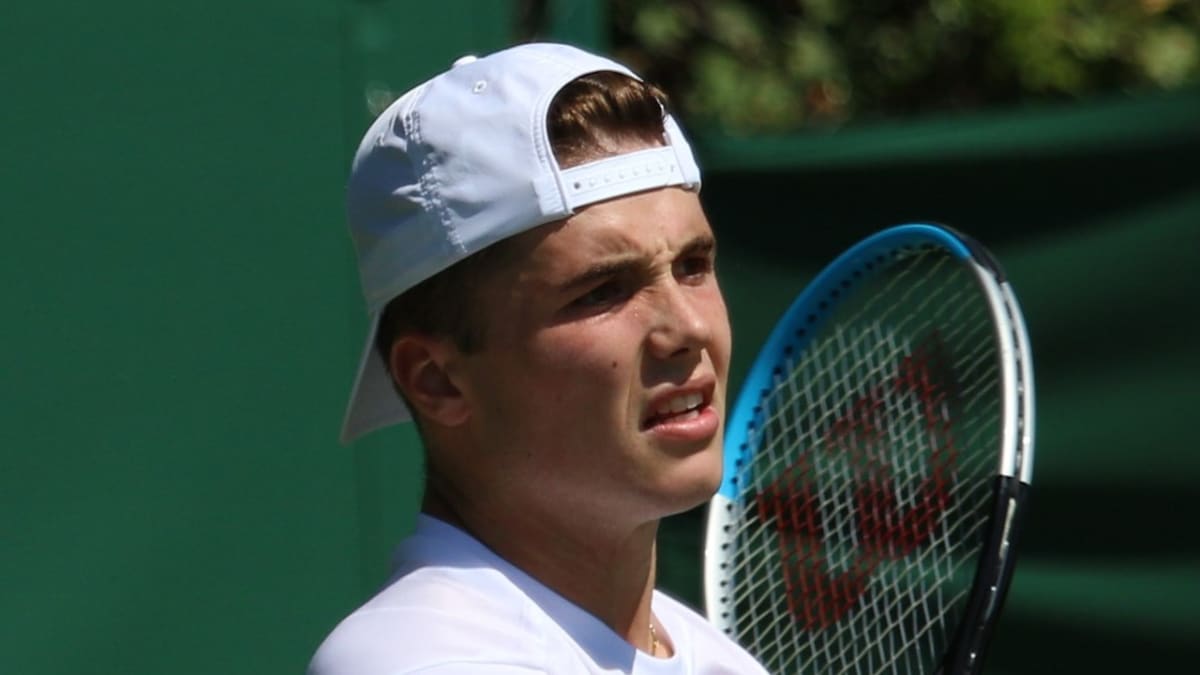
The number 114 holds a strange, almost mathematical significance in tennis history. Long before the modern era of hyper-optimized training regimens, Patrick McEnroe carved out a historic run at the 1991 Australian Open. Ranked exactly 114th in the world, the Stanford University alumnus became the first player outside the top 100 to reach a Grand Slam semi-final. It was a masterclass in maximizing limited resources, proving that tactical variation and collegiate experience could disrupt the tour's heavy hitters.
Listen to the Second Serve Podcast
Get our daily AI-synthesized audio briefings and match reviews on the go.
Patrick McEnroe's 1991 Blueprint and the Magic of 114
Decades after McEnroe's historic Australian Open run, that exact ranking of 114 has re-emerged as a launchpad for modern underdogs. The transition from college tennis to the grueling professional circuit requires a high level of physical durability and mental resilience. McEnroe's run established that players coming out of the American collegiate system possess the tactical maturity to compete on the biggest stages without the immediate benefit of high-end seedings or corporate backing.
This historical precedent provides critical context for the recent breakthroughs of British talent Arthur Fery and Polish tactician Maja Chwalinska. Both players entered their respective Grand Slam campaigns carrying that same 114th ranking, embodying the high-yield, low-cost efficiency that defines the sport's most compelling stories. Their performances remind us that tennis is not just a game of raw power, but of leverage, angles, and maximizing every single point.
To understand how these athletes achieved such high returns on their physical investments, one must look closely at their technical specifications. Neither player relies on the standard baseline-bashing template. Instead, they utilize specialized court coverage and high-stringency tactical variation to force opponents out of their comfort zones, turning matches into chess games of physical attrition.
Arthur Fery's Serve-and-Volley Mechanics at the All England Club
At Wimbledon, Arthur Fery showcased a highly efficient grass-court game. Standing at 1.75 meters, Fery does not rely on the raw, kinetic power of modern baseline giants. Instead, his game is built on low-skidding slices, rapid court coverage, and a highly disciplined serve-and-volley transition. This technical blueprint allowed him to navigate the early rounds with remarkable efficiency, preserving his physical reserves for the deep end of the tournament.
Fery's run eventually concluded in the semi-finals against eventual finalist Alexander Zverev, whose post-tournament actions we analyzed in our discussion of the Zverev Wimbledon celebration controversy. Despite the defeat, Fery's ability to hold his own against top-tier opponents highlighted the viability of his versatile style. According to the official ATP rankings, Fery has since surged to a career-high of No. 36, proving that his grass-court success was no flash in the pan.
From a gear and durability perspective, Fery's performance on the slick lawns of SW19 was a testament to footwork and racket-head speed. Utilizing a two-handed backhand to absorb pace, he repeatedly redirected heavy groundstrokes to neutralize opponents. His tactical discipline on return games allowed him to manufacture break points without over-committing to high-risk winners, a high-value strategy for any player looking to maximize their on-court economy.
Maja Chwalinska's Sponsorship Pivot and the Clay-Court Grind
Meanwhile, on the red clay of Paris, Maja Chwalinska was busy rewriting the history books. Entering the tournament as a qualifier ranked 114th, the Polish lefty defeated Diana Shnaider to secure her place in the final. In doing so, Chwalinska became only the second qualifier in the entire Open Era—male or female—to reach a Grand Slam singles final, joining an elite club of ultimate value-for-money performers who outplayed their market valuation.
What makes Chwalinska's journey even more remarkable is the sheer lack of corporate backing she had entering the tournament. Before her historic run at Roland-Garros, Chwalinska did not even have a clothing sponsor. She took to the courts wearing mismatched, off-the-rack outfits, a stark visual contrast to the highly tailored, custom gear of her opponents. It was only midway through the tournament that the brokerage firm XTB recognized her immense ROI and signed her to a formal sponsorship deal.
This lack of early sponsorship highlights a systemic issue in professional tennis, where lower-ranked players must absorb massive travel and coaching expenses without guaranteed returns. Chwalinska's breakthrough is a case study in athletic resilience, proving that elite performance can be achieved without the luxury of premium backing. Her crafty, defensive style, which relies heavily on drop shots and extreme angles, proved to be highly durable on the slow Parisian clay.
The Philippe-Chatrier Tactician and the Nine-Game Turning Point
In the final match on Philippe-Chatrier, Chwalinska faced the formidable Mirra Andreeva in a clash of contrasting tactical styles. Early on, Chwalinska's craftiness was on full display as she secured a 3-2 lead in the first set, using her left-handed slice to disrupt Andreeva's rhythm. Her ability to change the pace and depth of her groundstrokes initially kept the Russian off-balance, showcasing the high tactical ceiling of her defensive playstyle.
However, the physical demands of playing through the qualifying rounds eventually took their toll. Andreeva adjusted her positioning, taking the ball earlier to rob Chwalinska of the time needed to execute her delicate drop shots. The Russian went on to win nine consecutive games, capturing the match in straight sets and demonstrating the brutal efficiency required to close out a Grand Slam final.
Despite the final scoreline, Chwalinska's run propelled her to No. 21 in the WTA rankings. Her performance demonstrated that variety, court coverage, and tactical intelligence remain highly effective tools on clay. For players looking to maximize their competitive longevity, Chwalinska's clay-court campaign offers a masterclass in defensive geometry and physical efficiency.
Rivalry Matchup & Player Profiles
While Arthur Fery and Maja Chwalinska compete on different tours, their parallel rises in 2026 highlight a shared blueprint for success. Below is a side-by-side comparison of their career profiles:
| Metric | Arthur Fery | Maja Chwalinska |
|---|---|---|
| Rank | No. 36 (ATP, July 13, 2026) | No. 21 (WTA, June 8, 2026) |
| Age | 24 | 24 |
| Country | Great Britain | Poland |
| Height | 1.75 m (5 ft 9 in) | 1.65 m (5 ft 5 in) |
| Handedness | Right-handed (two-handed backhand) | Left-handed (two-handed backhand) |
| Play Style | Versatile, consistent, net-rusher | Crafty, tactical, defensive, slice-heavy |
| Career Titles | 1 ATP Challenger, 10 ITF singles | 3 WTA 125, 7 ITF singles |
Both athletes are 24 years old and have used their technical versatility to overcome physical limitations against taller, more powerful opponents. Fery's net-rushing style at Wimbledon and Chwalinska's spin-heavy craftiness at Roland-Garros show that there are multiple pathways to elite status in the modern game.
As they establish themselves inside the top 40 of their respective tours, their durability and tactical depth will be tested. Without the raw power to blow opponents off the court, both Fery and Chwalinska must rely on high-percentage tennis and precise physical execution. Their breakthrough seasons have proved that underdogs with the right tactical toolkit can consistently outperform their seedings.
What Alexander Zverev Plays With
Head Gravity Pro
Head Hawk Touch 1.25
Head Prime Tour (12-Pack)
Analyze Arthur Fery vs. Maja Chwalinska
Predict tactical adjustments, momentum swings, and serve strategy options for this match-up using our AI simulator.
The Aces Tactical Panel
This report was curated and edited by Bhaskar Goel. Tactical analysis and technical insights were provided by our specialized panel of expert correspondents.
Julian Price
Senior Tactical Correspondent
Stuffy, pedantic British academic and historian specializing in match momentum and historical context.
Elena Cruz
Director of Analytical Research
Data scientist specializing in court surface physics and movement patterns.
Bhaskar
The Editor & Fan
Passionate tennis player and site editor bringing everyday amateur insights and relatable fan commentary.
Arthur Vance
Senior Existential Analyst
Deep, eccentric, and DFW-inspired. Models court metaphysics, kinetic beauty, and player psychology.
Leo Sterling
High-Performance Consultant
Hard-nosed ex-trainer from Melbourne with a no-nonsense view on tour fitness.
Related Reports


Quick Answers
What historic milestone did Maja Chwalinska achieve at the French Open?+
Maja Chwalinska became only the second qualifier in the Open Era, male or female, to reach a Grand Slam singles final.
Which clothing sponsor signed Maja Chwalinska midway through the French Open?+
The brokerage firm XTB signed Maja Chwalinska to a sponsorship deal midway through the tournament after she started without a clothing sponsor.