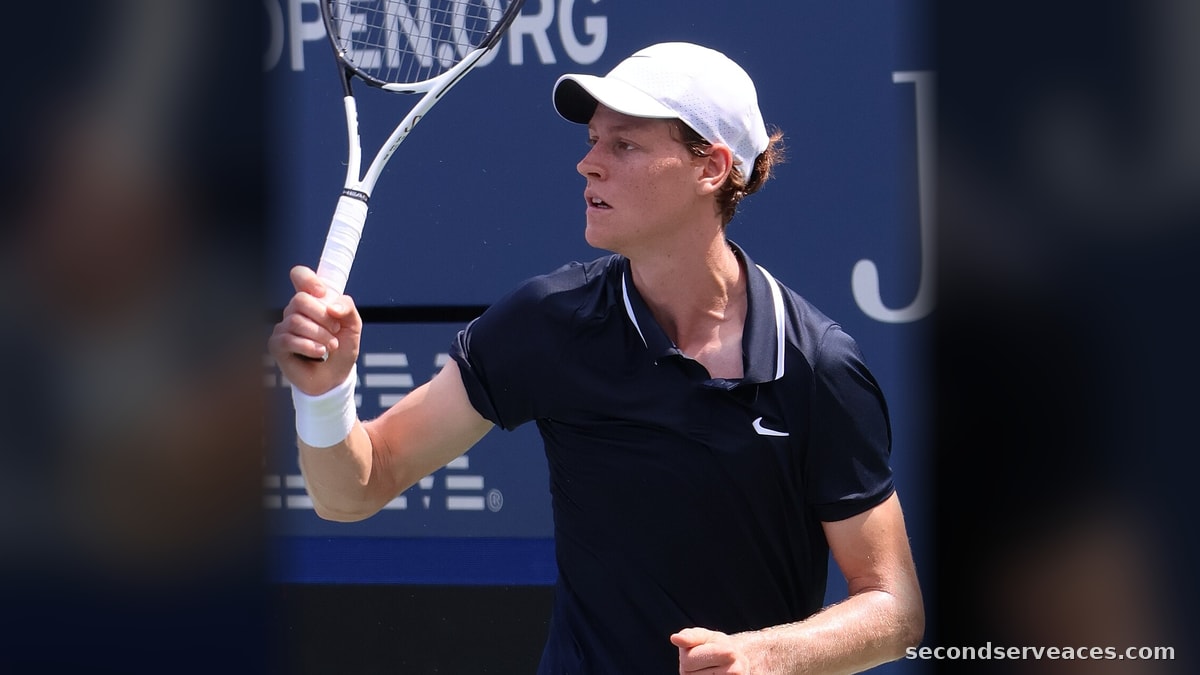
The modern sporting landscape, for all its scientific advancement and physiological monitoring, remains ultimately beholden to the fragile architecture of the human body. One cannot help but look back with a certain wistful nostalgia to the era of wood rackets and languid summer afternoons, where the legendary Björn Borg would transition seamlessly from the lawns of the All England Club to the concrete of Flushing Meadows without the aid of a traveling medical caravan. Today, however, the sheer velocity of the sport demands a physical toll that even the most finely tuned modern athletes cannot escape.
Listen to the Second Serve Podcast
Get our daily AI-synthesized audio briefings and match reviews on the go.
The July Coronation at the All England Club
It was on the afternoon of July 12 that Jannik Sinner achieved what many considered the crowning achievement of his spectacular campaign, dismantling Alexander Zverev to claim the prestigious Gentlemen's Singles Trophy at Wimbledon. This triumph, which secured Sinner his fifth major title, was a masterclass in controlled aggression and baseline supremacy. The Italian displayed the kind of unyielding discipline that has become his trademark, cementing his position at the absolute summit of the global game.
Yet, the euphoria of that July afternoon was to be short-lived. The physical exertion required to navigate a fortnight of high-stakes grass-court tennis, where low bounces force a 6'3" frame into constant, deep knee flexions, left a silent but significant legacy. That victory on the historic Centre Court would, in fact, mark Sinner's final competitive appearance of the season, drawing a premature and bittersweet curtain on his year.
To those of us who have observed the game across several decades, the physical demands of Sinner's style are as breathtaking as they are perilous. The modern baseline game requires extreme lateral sliding and explosive recovery steps. When a player of Sinner's dimensions repeatedly subjects his joints to these extreme forces, the margin for error is razor-thin, and the transition to harsher surfaces only amplifies the risk.
The September Alliance with Master Trainer Marco Panichi
To fully comprehend the physical evolution of "The San Candido Sentinel," one must examine the critical period between September 2024 and June 2025, during which the esteemed fitness coach Marco Panichi guided Sinner's athletic preparation. Panichi, a revered figure in tennis conditioning circles, was brought into the Italian's camp to fortify his slender frame against the grueling demands of the tour. This partnership was instrumental in building the robust aerobic and muscular foundation that propelled Sinner to the top of the ATP rankings.
During their ten months together, Panichi focused meticulously on Sinner's core stability and joint preservation. The challenge of training a modern giant is complex; one must develop explosive power without sacrificing the fluid flexibility required to defend from the corners. Panichi's tailored programs were designed to protect Sinner's knees and hips from the repetitive strain of high-impact movement.
Although their formal professional association concluded in June 2025, Panichi's intimate understanding of Sinner's biomechanics remains unparalleled. His perspective on Sinner's current physical setbacks carries the weight of authoritative experience, offering a sober contrast to the superficial diagnoses often circulating in contemporary sports media.
The Autumn Diagnosis of Iliotibial Band Syndrome
The tennis community was plunged into collective disappointment earlier this month when Sinner announced that he would not contest another match in 2026. This decision to shut down his season highlighted the severity of the right knee ailment that had been quietly troubling him. Shortly after the announcement, Sky Sport Italy confirmed that the world No. 1 was suffering from iliotibial band syndrome (ITBS).
Iliotibial band syndrome is a painful overuse injury that occurs when the thick band of fibrous tissue running down the outside of the thigh becomes inflamed from repetitive friction against the knee joint. For a tennis player, whose movement is defined by sudden deceleration and lateral changes of direction, this condition can render competitive play virtually impossible. The pain is sharp, persistent, and highly resistant to quick-fix solutions.
This physical setback evokes memories of other modern stars who have run afoul of the sport's unforgiving schedule, a theme we observed in our previous coverage of Daniil Medvedev. Sinner's decision to bypass the lucrative autumn indoor swing in favor of complete rehabilitation is a prudent, albeit frustrating, acknowledgment of his body's limits.
The Hard-Court Toll on the Modern Baseline Gladiator
Offering his expert commentary on the diagnosis, Marco Panichi explained that iliotibial band syndrome is fundamentally an overuse inflammation. He pointed out that the condition is heavily associated with running and sliding on hard surfaces. Unlike the organic cushion of grass or the sliding-friendly friction of red clay, hard courts offer no give, transferring the entire kinetic shock of every explosive step directly into the athlete's lower joints.
In the 1970s, the variety of court surfaces and a less frantic tournament schedule allowed players to manage minor joint irritations with basic rest and ice. In the modern era, however, the relentless succession of hard-court events forces players to compete on what is essentially painted concrete for months on end. Panichi's analysis underscores the systemic danger this poses to the longevity of today's elite competitors.
For Sinner, the path back to full fitness will require meticulous patience and a gradual rebuilding of his movement patterns. There are no shortcuts with iliotibial band syndrome; the tissue must be allowed to heal completely to prevent the inflammation from becoming chronic. The tennis world must wait until 2027 to see "The San Candido Sentinel" return to the court, hoping that this enforced period of rest will preserve his brilliant career for years to come.
Rivalry Matchup & Player Profiles
| Metric | Jannik Sinner |
|---|---|
| Rank | World No. 1 |
| Country | Italy |
| Age | 25 |
| Height | 6'3" (1.91 m) |
| Handedness | Right-handed |
| Play Style | Aggressive baseliner |
| Career Titles | 30 |
At just 25 years of age, Jannik Sinner has already compiled a resume of astonishing depth, highlighted by 30 career titles and a firm grip on the World No. 1 ranking. His aggressive baseline style relies heavily on extreme physical commitment, utilizing his 6'3" frame to dictate rallies from deep within the court. This high-octane approach has yielded immense rewards, including his fifth major championship on the historic lawns of Wimbledon.
However, as former fitness coach Marco Panichi has astutely observed, this style of play places extraordinary demands on the joints, particularly when transitioning to unforgiving hard courts. As Sinner embarks on his rehabilitation program, his team's primary challenge will be to balance his explosive baseline movement with long-term joint preservation, ensuring that the Italian superstar can continue to dominate the tour without compromising his physical longevity.
What Jannik Sinner Plays With
Head Speed MP 2024
Head Hawk Touch 1.25
Head Prime Tour (12-Pack)
Nike GP Challenge 1
Simulate Jannik Sinner Match Scenarios
Simulate high-pressure scenarios, score leverage points, and tactical responses for ATP and WTA players.
The Aces Tactical Panel
This report was curated and edited by Bhaskar Goel. Tactical analysis and technical insights were provided by our specialized panel of expert correspondents.
Julian Price
Senior Tactical Correspondent
Stuffy, pedantic British academic and historian specializing in match momentum and historical context.
Elena Cruz
Director of Analytical Research
Data scientist specializing in court surface physics and movement patterns.
Bhaskar
The Editor & Fan
Passionate tennis player and site editor bringing everyday amateur insights and relatable fan commentary.
Arthur Vance
Senior Existential Analyst
Deep, eccentric, and DFW-inspired. Models court metaphysics, kinetic beauty, and player psychology.
Leo Sterling
High-Performance Consultant
Hard-nosed ex-trainer from Melbourne with a no-nonsense view on tour fitness.
Related Reports
Quick Answers
Who diagnosed Jannik Sinner's knee injury as iliotibial band syndrome?+
Sky Sport Italy reported the diagnosis, and Sinner's former fitness coach, Marco Panichi, subsequently analyzed the overuse nature of the injury.
When did Sinner last compete before shutting down his 2026 season?+
Jannik Sinner has not played competitively since defeating Alexander Zverev to win the Wimbledon final on July 12.
What causes the iliotibial band syndrome affecting Jannik Sinner?+
According to fitness coach Marco Panichi, iliotibial band syndrome is an overuse inflammation associated with running on hard surfaces.