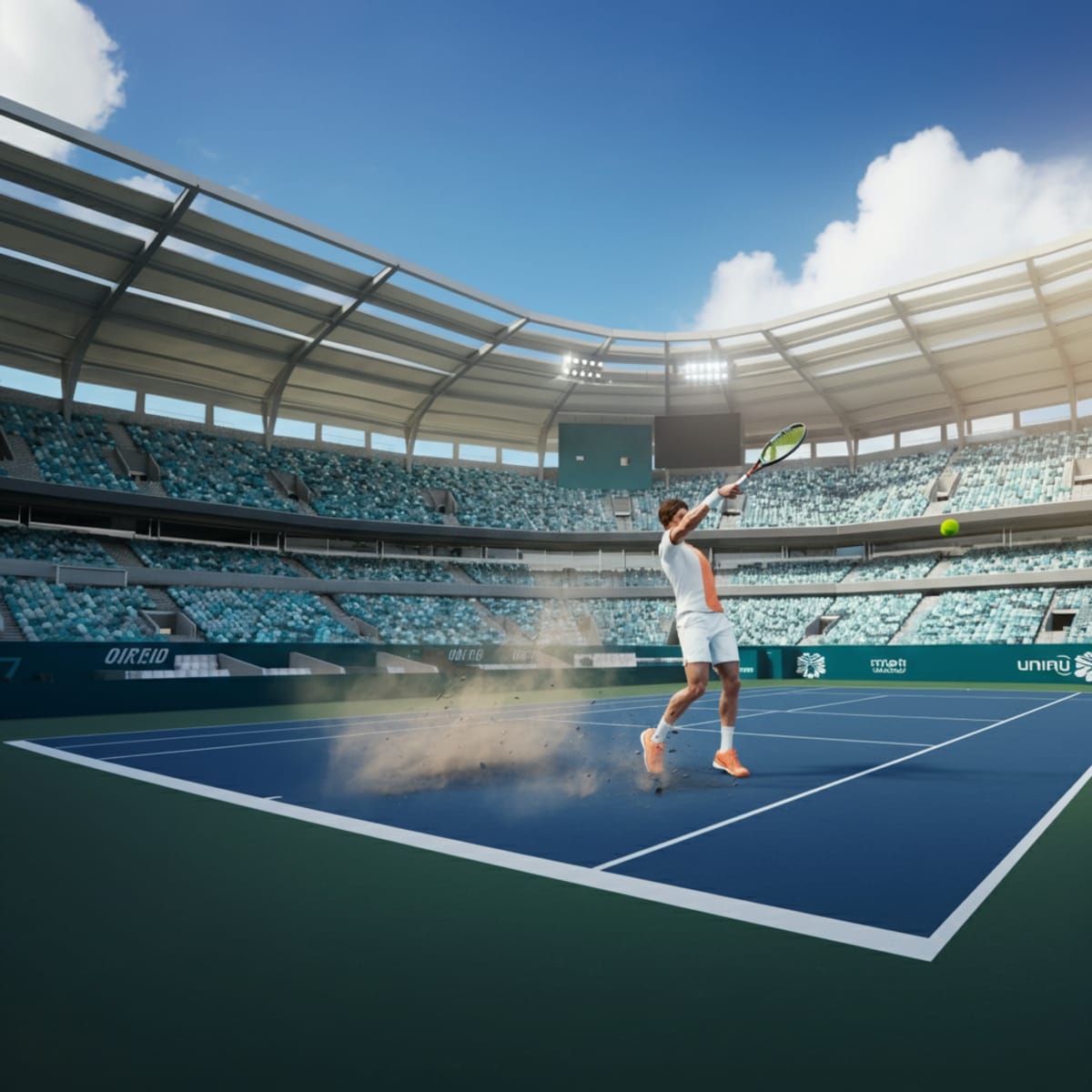
The modern ATP Tour is currently operating under a localized weather system, and its name is Jannik Sinner. At the Miami Open, the Italian advanced to the semi-finals by conceding a mere two games to Frances Tiafoe. This was not merely a victory; it was a clinical, suffocating display of modern hard-court geometry.
Listen to the Second Serve Podcast
Get our daily AI-synthesized audio briefings and match reviews on the go.
Relentlessly efficient, Sinner continues to operate at a frequency that his peers are struggling to tune into. The tour is witnessing an evolutionary leap in baseline consistency, where the traditional ebb and flow of a tennis match is being replaced by systematic, high-octane pressure.
By The Numbers: Sinner's Stratospheric Run
- The 30-Set Benchmark: Sinner has now won 30 consecutive sets at the Masters 1000 level, an astonishing streak dating back to the 2025 Shanghai Masters.
- Blemish-Free Titles: This current run includes sweeping both the Paris Masters and Indian Wells without dropping a single set.
- The Tiafoe Hex: The Italian has now secured five straight victories against the American, a head-to-head dominance that began at the 2021 Vienna Open.
- Next in Line: Alexander Zverev awaits in a highly anticipated semi-final clash.
The Tactical Breakdown
To understand how a top-tier athlete like Tiafoe gets restricted to just two games, we have to look at court positioning and rally tolerance. Tiafoe thrives on match momentum, utilizing heavy topspin and raw athleticism to construct points and ignite the crowd. Sinner, however, strips the oxygen from the environment before a fire can even start.
The Italian plays a remarkably flat, geometry-first game. By hugging the baseline and taking the ball exceptionally early off both wings, Sinner turns the court into a claustrophobic space. Every time Tiafoe attempted to create an angle, the ball was already rushing back at his feet, denying him the necessary time to set up his explosive forehand. This constant time deficit forces errors that don't appear in the standard unforced error column—they are purely a product of induced panic.
Furthermore, Sinner’s serve placement during high-leverage situations remains immaculate. Whenever a rare break point window threatens to open, he seamlessly finds the corners of the service box, immediately neutralizing the return. It is a baseline blueprint built on structural integrity, eliminating the defensive volatility that plagues lesser players.
The Bigger Picture
We are witnessing a level of hard-court consistency that demands serious historical framing. A 30-set streak at the elite Masters 1000 level is staggering. During the peak years of Roger Federer, Rafael Nadal, and Novak Djokovic, consecutive set streaks of this magnitude were the ultimate hallmark of their stranglehold on the men's game. Sinner is rapidly approaching that atmospheric altitude, establishing a clear separation from the rest of the locker room.
Mid-tier stalwarts like Tallon Griekspoor simply lack the firepower to pierce this baseline shield, while top-ranked competitors are finding their tactical toolkits inadequate. The structural gap on hard courts is widening in a manner reminiscent of the flat, penetrating efficiency Elena Rybakina frequently deploys on the WTA hard-court swing. Sinner has effectively solved the physical puzzle of the modern hard court, minimizing his own energy expenditure while maximizing his opponent's distress.
The upcoming semi-final against Alexander Zverev represents a fascinating clash of architectural styles. Zverev possesses the massive first serve and formidable backhand required to challenge Sinner's cross-court patterns. However, if Sinner maintains this flawless level of ball-striking, the rest of the tour is simply playing for second place.
What Jannik Sinner Plays With
Head Speed MP 2024
Head Hawk Touch 1.25
Nike GP Challenge 1
Analyze Frances Tiafoe vs. Jannik Sinner
Predict tactical adjustments, momentum swings, and serve strategy options for this match-up using our AI simulator.
The Aces Tactical Panel
This report was curated and edited by Bhaskar Goel. Tactical analysis and technical insights were provided by our specialized panel of expert correspondents.
Julian Price
Senior Tactical Correspondent
Stuffy, pedantic British academic and historian specializing in match momentum and historical context.
Elena Cruz
Director of Analytical Research
Data scientist specializing in court surface physics and movement patterns.
Bhaskar
The Editor & Fan
Passionate tennis player and site editor bringing everyday amateur insights and relatable fan commentary.
Arthur Vance
Senior Existential Analyst
Deep, eccentric, and DFW-inspired. Models court metaphysics, kinetic beauty, and player psychology.
Leo Sterling
High-Performance Consultant
Hard-nosed ex-trainer from Melbourne with a no-nonsense view on tour fitness.