The Shifting Kinetic Landscape
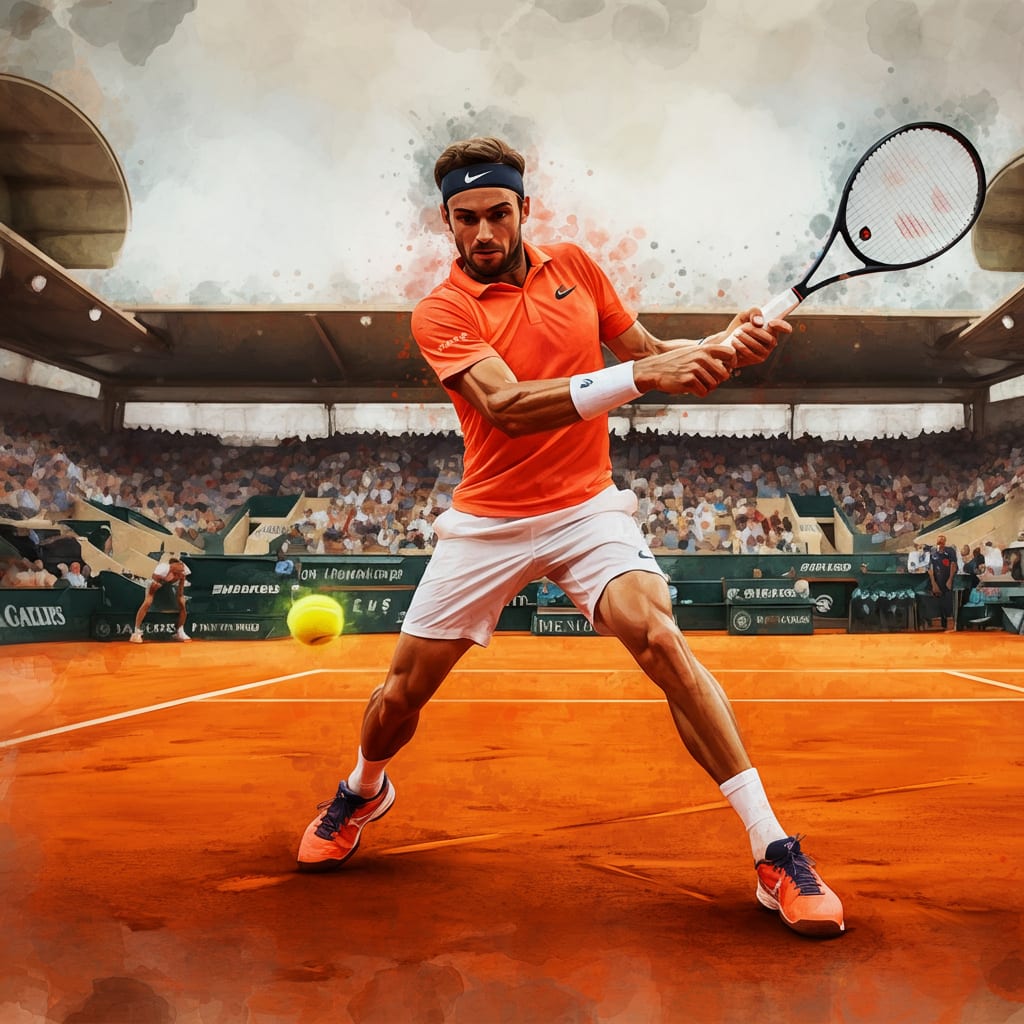
Tennis, at its most elemental, is an exercise in trajectory and friction. As the ATP Tour descends onto the European clay, we are witnessing a subtle, almost tectonic shift in the hierarchy of the sport. Jannik Sinner’s recent victory over Ugo Humbert at the Monte Carlo Masters is not merely a data point in a tournament draw; it is a manifestation of a player leaning into the unique physics of crushed brick. The surface demands a specialized dialogue between the sole of the shoe and the earth—a sliding, reactive game where movement must be as precise as the stroke itself.
Listen to the Second Serve Podcast
Get our daily AI-synthesized audio briefings and match reviews on the go.
The Tactical Breakdown
To analyze the current state of play, one must look at the geometry of the court. Sinner’s ascent, characterized by the mechanical efficiency of his baseline groundstrokes, relies on high-velocity linear movement. By dispatching Humbert, Sinner demonstrated the ability to neutralize an opponent’s power through depth, forcing his adversary to make contact from a disadvantaged position behind the baseline.
Conversely, Carlos Alcaraz presents a more expansive tactical problem. His game is defined by aggressive court positioning and an almost defiant ability to generate topspin from acute angles. While he enters the Barcelona Open as the top seed, the ghosts of the 2025 final—where Holger Rune systematically dismantled his rhythm—remain relevant. Alcaraz’s reliance on the 'heavy' forehand requires a specific physical buoyancy; when he loses that verticality, he becomes vulnerable to players who can disrupt his timing with pace changes, a maneuver Tommy Robredo, in his current capacity as sporting director, surely notes as he curates the field for the Barcelona event.
The Bigger Picture
The historical weight of the Barcelona Open cannot be overstated. With Alcaraz having hoisted the trophy in 2022 and 2023, he understands the gravitational pull of this specific venue. However, the trajectory of a professional career is rarely a straight line. The race for the world number one ranking has transformed from a static pursuit into a kinetic struggle. Sinner’s momentum, coupled with the lingering presence of legends like Novak Djokovic and the historical shadow cast by Rafael Nadal, suggests that the traditional guard is facing a generation that treats the court not as a stage for tradition, but as a laboratory for physics.
As we observe these developments, we must consider the following:
- The Sinner-Humbert outcome: A testament to Sinner's current form on the European red clay.
- Alcaraz’s Barcelona Defense: After the 2025 loss to Rune, the pressure to reclaim this specific tournament is immense.
- The Ranking Implications: Every match point in Monte Carlo and Barcelona now functions as a direct coefficient in the race for the top ATP ranking.
What Jannik Sinner Plays With
Head Speed MP 2024
Head Hawk Touch 1.25
Head Prime Tour (12-Pack)
Nike GP Challenge 1
Analyze Jannik Sinner vs. Carlos Alcaraz
Predict tactical adjustments, momentum swings, and serve strategy options for this match-up using our AI simulator.
The Aces Tactical Panel
This report was curated and edited by Bhaskar Goel. Tactical analysis and technical insights were provided by our specialized panel of expert correspondents.
Julian Price
Senior Tactical Correspondent
Stuffy, pedantic British academic and historian specializing in match momentum and historical context.
Elena Cruz
Director of Analytical Research
Data scientist specializing in court surface physics and movement patterns.
Bhaskar
The Editor & Fan
Passionate tennis player and site editor bringing everyday amateur insights and relatable fan commentary.
Arthur Vance
Senior Existential Analyst
Deep, eccentric, and DFW-inspired. Models court metaphysics, kinetic beauty, and player psychology.
Leo Sterling
High-Performance Consultant
Hard-nosed ex-trainer from Melbourne with a no-nonsense view on tour fitness.