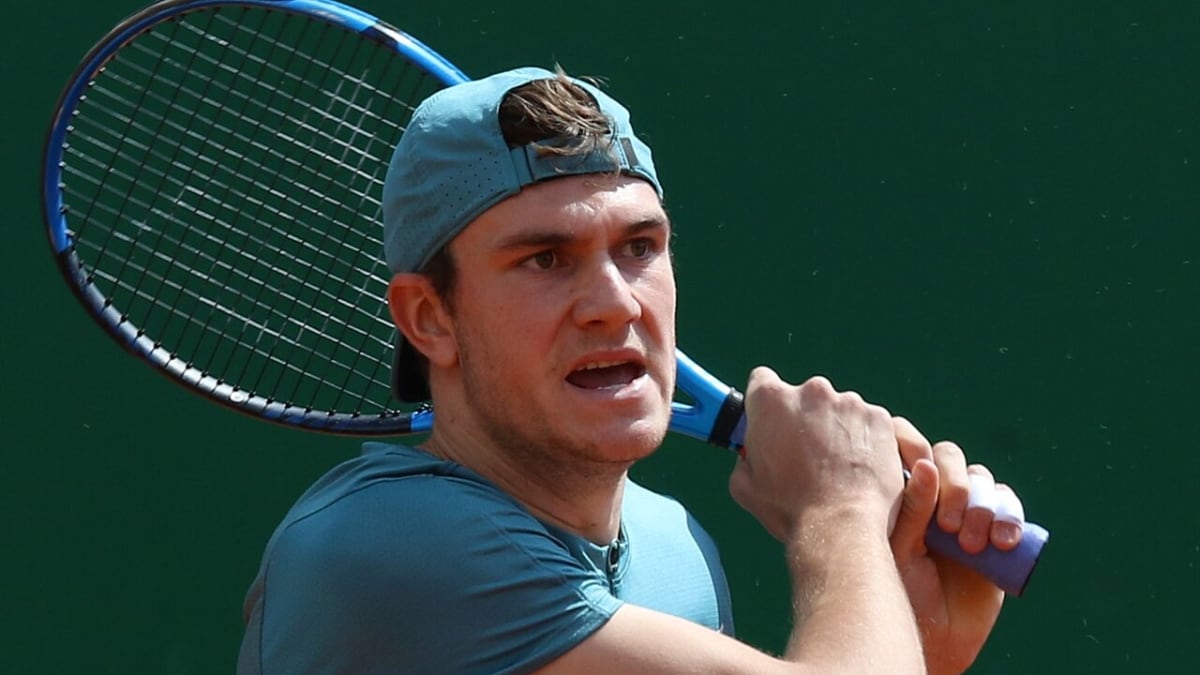
The physical reality of professional tennis is a brutal, unyielding equation of kinetic force and joint tolerance. For Jack Draper, the promising British lefthander, that equation has yielded a temporary deficit. Draper has officially withdrawn from the upcoming Queen's Club Championships, delaying his highly anticipated return to the lawns by at least a week as he continues to nurse a lingering tendon issue in his right knee. The decision marks another cautious chapter in a career currently defined as much by its immense potential as by its physical fragility.
Listen to the Second Serve Podcast
Get our daily AI-synthesized audio briefings and match reviews on the go.
The Kinetic Toll of the Slide in Barcelona
Draper's current physical hiatus began not on the slick, low-bouncing lawns of England, but on the taxing red clay of Spain. It was on April 13, during a grueling match in Barcelona, that Draper was forced to retire due to a tendon issue in his right knee. The modern clay-court game demands a violent, sliding deceleration that places immense shear stress on the patellar tendon—a fibrous structure designed to transmit the explosive force of the quadriceps to the tibia. When that system is overloaded, the microscopic tearing of tendon fibers requires an agonizingly slow healing process.
For a player of Draper's physical dimensions—standing over six feet tall and possessing a kinetic chain that relies heavily on explosive lateral lunges—the knee joint acts as a high-stress fulcrum. When that fulcrum is compromised, the entire geometry of his game collapses. Bypassing the Queen's Club Championships is a sober acknowledgment that the micro-tears in that right knee require more than just rest; they demand a complete recalibration of his movement patterns before he subjects his body to the unique stresses of grass-court tennis.
Tennis on grass is an entirely different physical proposition than clay. Where clay allows for a long, decelerating slide that disperses kinetic energy over several feet, grass demands immediate, high-friction stops and low-to-the-ground recovery steps. For a healing knee tendon, the low bounces of grass represent a constant threat of re-injury. By delaying his return, Draper is prioritizing long-term structural integrity over immediate competitive gratification, aiming instead for a return at the Eastbourne Open, which runs from June 22 to June 27.
A Tactical Shift in the Player Box After Jamie Delgado
In the midst of this physical rehabilitation, a significant tectonic shift has occurred in Draper's coaching camp. The parting of ways with coach Jamie Delgado marked the end of a structured, highly professional partnership, but the subsequent addition of three-time Grand Slam champion Andy Murray to his coaching team for the grass-court swing introduces a fascinating psychological and tactical dynamic. Murray, a master of grass-court geometry and defensive redirection, understands the physical toll of joint injuries better than almost any active player on the tour.
The integration of Murray into the coaching box is more than just a high-profile alignment; it is a tactical pivot. Murray's historic mastery of the low-bounce slice and his peerless defensive positioning on grass offer Draper a blueprint for efficiency. Instead of relying on raw, explosive muscle power—which puts immense strain on his recovering right knee—Draper can learn to utilize court positioning, slice depth, and anticipation to shorten points and minimize physical wear.
This coaching transition signals a desire to evolve from a player who wins through sheer physical attrition to one who wins through intellectual manipulation of the court. We have seen similar strategic pivots in tennis history, where injured players must adapt their mechanical output to survive; as we detailed in our analysis of secret grass-court preparations, adjusting the technical load on weight-bearing joints is often the difference between a sustained career and chronic physical decline.
The Mathematical Reality of Falling Outside the Top 100
The consequence of Draper's prolonged absence since April is laid bare in the cold, unyielding mathematics of the official ATP rankings. Having once scaled the heights of world number four last summer, his inability to defend points has seen him tumble outside the top 100. This ranking drop is not merely a blow to prestige; it is a logistical nightmare that strips him of direct entry into major draws, forcing him to rely on wildcards or the grueling gauntlet of qualifying rounds.
The psychological weight of this descent cannot be overstated. A player who was recently trading blows with the game's elite, including Novak Djokovic, now finds himself in a position where every match is a high-stakes battle for survival. The transition from seeded protection to unseeded vulnerability alters the entire competitive landscape, meaning Draper could face top-tier opponents in the very first round of any event he enters.
Yet, this statistical reset also offers a clean slate. Free from the immediate pressure of defending a massive cache of ranking points, Draper can focus entirely on the mechanical integrity of his game. According to his historical profile on Jack Draper's professional trajectory, his talent has never been in question; it has always been a matter of whether his physical frame can withstand the relentless, week-in, week-out demands of the professional tour.
Re-Engineering the Low-Bounce Mechanics for Eastbourne
With Queen's Club officially off the schedule, the focus shifts entirely to the Eastbourne Open, scheduled to run from June 22 to June 27. This one-week delay is a tactical pause, giving Draper seven additional days of targeted strength and conditioning to ensure his right knee can handle the extreme knee-flexion required on grass. The courts at Eastbourne, while similar to Queen's, will serve as a critical testing ground for his competitive readiness ahead of Wimbledon.
To succeed in Eastbourne without re-injuring the knee, Draper must adjust his biomechanical setup. He must avoid deep, lunging squats on his right leg when defending out wide, instead opting for shorter, more controlled steps. His first-serve percentage will also need to be exceptionally high to avoid long, grueling baseline rallies that test his physical threshold. The serve must become his primary weapon, allowing him to dictate play from the first strike.
Ultimately, the grass-court season is a test of economy. If Draper can integrate Andy Murray's tactical wisdom, protect his vulnerable right knee through smart movement, and navigate the low-bouncing lawns of Eastbourne, he can begin the slow climb back up the rankings. The tennis world will be watching closely to see if this highly anticipated partnership can translate into physical resilience on the court.
What Novak Djokovic Plays With
Head Speed Pro
Luxilon ALU Power 125
Head Prime Tour (12-Pack)
Asics Court FF 3 Novak
Analyze Jack Draper vs. Andy Murray
Predict tactical adjustments, momentum swings, and serve strategy options for this match-up using our AI simulator.
The Aces Tactical Panel
This report was curated and edited by Bhaskar Goel. Tactical analysis and technical insights were provided by our specialized panel of expert correspondents.
Julian Price
Senior Tactical Correspondent
Stuffy, pedantic British academic and historian specializing in match momentum and historical context.
Elena Cruz
Director of Analytical Research
Data scientist specializing in court surface physics and movement patterns.
Bhaskar
The Editor & Fan
Passionate tennis player and site editor bringing everyday amateur insights and relatable fan commentary.
Arthur Vance
Senior Existential Analyst
Deep, eccentric, and DFW-inspired. Models court metaphysics, kinetic beauty, and player psychology.
Leo Sterling
High-Performance Consultant
Hard-nosed ex-trainer from Melbourne with a no-nonsense view on tour fitness.
Related Reports


Quick Answers
Why did Jack Draper withdraw from the Queen's Club Championships?+
Jack Draper withdrew from the Queen's Club Championships to allow more recovery time for a tendon injury in his right knee, which has kept him out of action since April 13.
Who has Jack Draper added to his coaching team for the grass-court season?+
Draper has added three-time Grand Slam champion Andy Murray to his coaching team for the grass-court season after parting ways with Jamie Delgado.
When and where does Jack Draper plan to make his competitive return?+
Draper aims to make his return to competitive play at the Eastbourne Open, which is scheduled to run from June 22 to June 27.