
The right wrist of Carlos Alcaraz has become tennis’s most scrutinized anatomical mystery, a joint whose delicate tendons dictate the violent, whipping RPMs of modern baseline warfare. Since injuring himself at the Barcelona Open in April, the Spaniard has spent nearly four months in a state of competitive hibernation, bypassing both the French Open and Wimbledon. When spotted at the FIFA World Cup final in Berlin—watching Spain defeat Argentina 1-0—his right wrist was encased in a restrictive black brace. This sight prompted former world No. 1 Kim Clijsters to note how "secretive" Alcaraz's recovery has been, with his social media footprint limited to brief, heavily curated clips of light drills and controlled shadow swings.
Listen to the Second Serve Podcast
Get our daily AI-synthesized audio briefings and match reviews on the go.
The Secretive Rehabilitation and the Wrist-Lag Dilemma
This secrecy raises immediate technical questions regarding his racket-face preparation. To generate his signature topspin, Alcaraz relies on extreme wrist lag, letting the racket head drop below his hand before snapping it upward through the hitting zone. If his wrist cannot tolerate that shearing force, his entire baseline identity must adapt. As we previously discussed when examining how Andy Roddick decoded Carlos Alcaraz's wrist guard strategy, any alteration to his wrist support could subtly delay his takeback, forcing him to strike the ball later and compromising his aggressive court positioning.
By keeping his rehabilitation behind closed doors, Alcaraz has left rivals and analysts guessing about his range of motion. Clijsters' public curiosity highlights a broader anxiety in the paddock: a wrist injury for an aggressive baseliner is not merely a temporary setback, but a structural challenge that can permanently alter a player's swing path.
The Mathematical Cost of Silence in the ATP Rankings
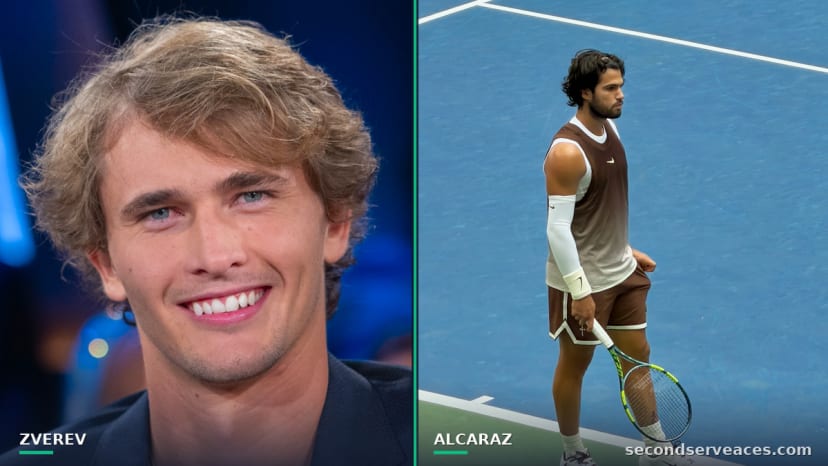
The physical cost of this hiatus is matched only by its mathematical severity. By sitting out two consecutive Grand Slams, Alcaraz surrendered a staggering 4,800 ranking points, a massive erosion of equity that allowed Alexander Zverev to leapfrog him into the world No. 2 spot. According to the official ATP rankings, Alcaraz now sits at No. 3, a position that complicates his seeding and draw pathways for the upcoming hard-court swing. As Patrick Mouratoglou noted when comparing the elite tier, the margins at the top are razor-thin, a point we explored in our analysis of Mouratoglou's assessment of Zverev, Sinner, and Alcaraz.
His projected return at the Cincinnati Open is not merely a fitness test, but a kinetic reclamation project. If Alcaraz cannot defend his points in Ohio, he risks falling further behind, potentially sliding into a seeding tier that would force early-round encounters with top-tier rivals. For a player whose game is built on explosive movement and uninhibited ball-striking, the transition back to the high-friction hard courts of the Midwest will demand absolute structural integrity from his rebuilt wrist.
Rivalry Matchup & Player Profiles
| Metric | Carlos Alcaraz Garfia | Kim Antonie Lode Clijsters |
|---|---|---|
| Rank | Current World No. 3 | Former World No. 1 |
| Age | 23 (born May 5, 2003) | 43 (born June 8, 1983) |
| Country | Spain | Belgium |
| Height | 1.83 m (6 ft 0 in) | 1.74 m (5 ft 8½ in) |
| Handedness | Right-handed (two-handed backhand) | Right-handed (two-handed backhand) |
| Play Style | All-court, aggressive baseliner | Aggressive baseliner, all-court game |
| Career Titles | 26 (including 7 Grand Slams) | 41 (including 4 Grand Slams) |
Carlos Alcaraz and Kim Clijsters have no head-to-head match history, given their disparate eras. Clijsters finalized her retirement from professional tennis in 2022, while Alcaraz was in the early stages of his rapid ascent after turning professional in 2018.
Despite the lack of competitive history, Clijsters' insights into Alcaraz's recovery highlight the shared understanding of elite champions who have navigated career-threatening joint injuries. Her observations on his secretive training regime underscore the psychological warfare of injury management on the modern tour.
What Carlos Alcaraz Plays With
Babolat Pure Aero 98
Babolat RPM Blast 1.30
Babolat VS Original (12-Pack)
Nike Vapor Pro 2
Analyze Carlos Alcaraz vs. Kim Clijsters
Predict tactical adjustments, momentum swings, and serve strategy options for this match-up using our AI simulator.
The Aces Tactical Panel
This report was curated and edited by Bhaskar Goel. Tactical analysis and technical insights were provided by our specialized panel of expert correspondents.
Julian Price
Senior Tactical Correspondent
Stuffy, pedantic British academic and historian specializing in match momentum and historical context.
Elena Cruz
Director of Analytical Research
Data scientist specializing in court surface physics and movement patterns.
Bhaskar
The Editor & Fan
Passionate tennis player and site editor bringing everyday amateur insights and relatable fan commentary.
Arthur Vance
Senior Existential Analyst
Deep, eccentric, and DFW-inspired. Models court metaphysics, kinetic beauty, and player psychology.
Leo Sterling
High-Performance Consultant
Hard-nosed ex-trainer from Melbourne with a no-nonsense view on tour fitness.
Related Reports


Quick Answers
How many ranking points did Carlos Alcaraz lose during his injury absence?+
Carlos Alcaraz lost 4,800 ranking points during his four-month absence, which allowed Alexander Zverev to surpass him as the world No. 2.
What did Kim Clijsters say about Carlos Alcaraz's wrist injury?+
Kim Clijsters remarked that Alcaraz has been 'secretive' about the extent of his recovery, only sharing brief clips of light practice drills.
Where was Carlos Alcaraz seen wearing a wrist brace?+
Alcaraz was seen wearing a black brace on his right wrist while attending the FIFA World Cup final, where Spain defeated Argentina 1-0.