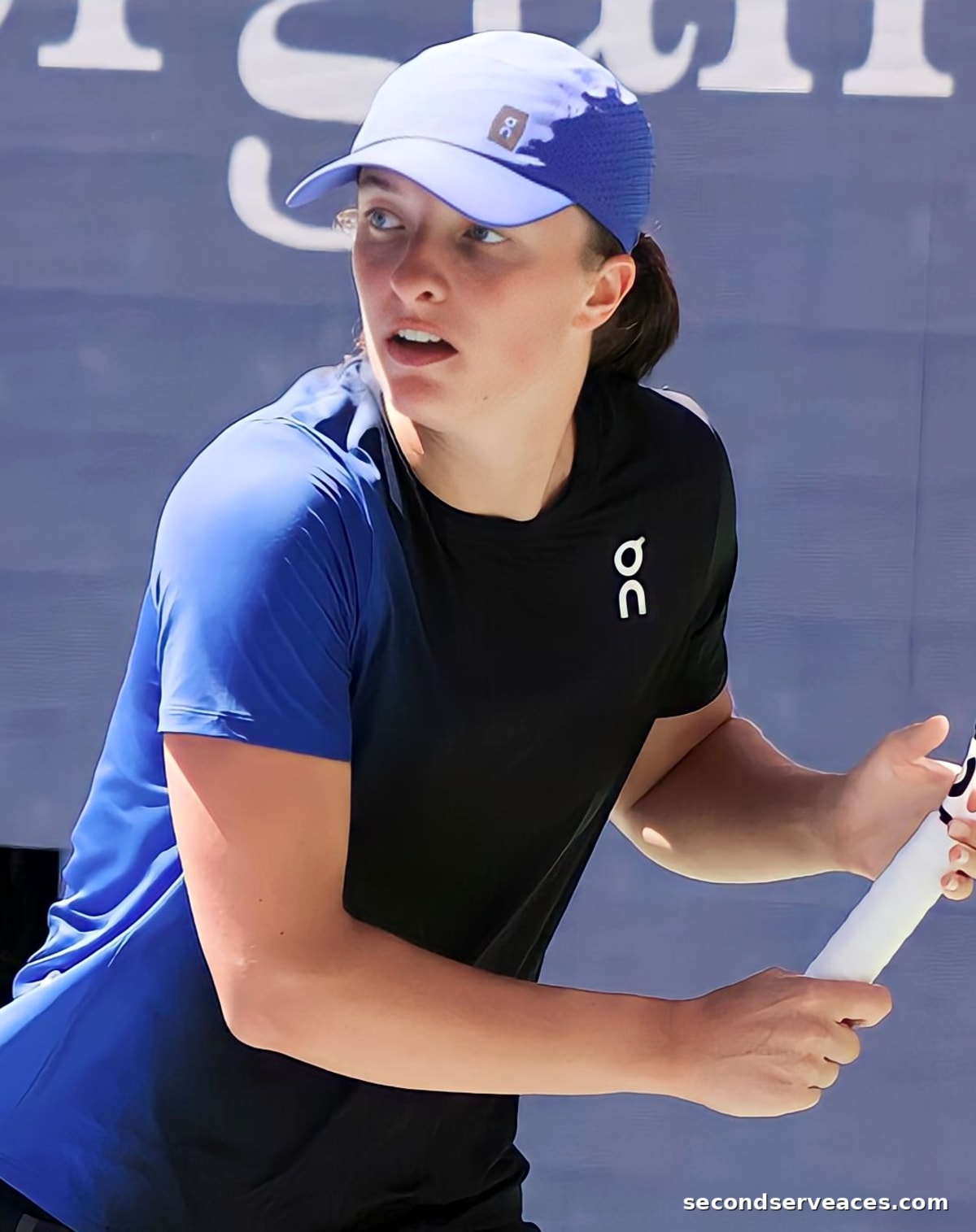
The yellow felt sphere does not care about your feelings, but the internet most certainly does. When Iga Świątek fell 7-5, 6-1 to Marta Kostyuk in the fourth round of the French Open, the collective gasp of the tennis commentariat was less an expression of shock than a sudden, predatory inhalation. It was a match wherein Świątek’s usually impeccable geometric patterns on the red clay of Roland-Garros dissolved into a series of uncharacteristic errors, a kinetic breakdown that Kostyuk exploited with ruthless, flat-hitting efficiency.
Listen to the Second Serve Podcast
Get our daily AI-synthesized audio briefings and match reviews on the go.
For a player whose identity has been forged in the crucible of clay-court dominance, the 7-5, 6-1 scoreline felt less like a standard sporting defeat and more like a brief, terrifying tear in the fabric of her reality. The topspin that usually behaves like an obedient pet suddenly turned feral, flying long or dying in the net. To watch Świątek during that second set was to watch a virtuoso violinist realize mid-concerto that her instrument had gone desperately out of tune, yet she was structurally obligated to keep bowing.
The aftermath of such a public unraveling is rarely confined to the locker room. In our current hyper-connected epoch, a top-tier athlete's defeat is instantly commodified into content, dissected by a legion of digital spectators who view the complex physics of professional tennis through the highly distorted lens of social media feeds. This loss did not just mark an early exit; it catalyzed a dormant strain of public skepticism that has been building around the Pole's current season.
The Digital Coliseum and the Pseudo-Expert Class
In the quiet spaces between tournaments, Świątek has chosen to speak with a striking, almost painful candor about the psychological tax of modern sporting celebrity. The six-time major champion has publicly targeted the "pseudo-experts" and the broader ecosystem of online vitriol that has trailed her over the past two seasons. It is a world where every tactical adjustment is treated as a moral failing and every dropped set is parsed for signs of existential decay.
The modern tennis professional exists in a strange dual state: they are elite kinetic performers on court, yet off it, they are expected to be resilient digital monoliths, impervious to the endless scrolling scroll of human negativity. Świątek’s decision to address this hate head-on is a rare departure from the sterile, media-trained norm. She described the intense social media abuse not as a mere distraction, but as a persistent, low-frequency hum of hostility that seeks to devalue the immense labor of her craft.
This struggle with the digital panopticon is not unique to Świątek, but it is amplified by her status as a standard-bearer for the WTA Tour. The psychological weight of carrying a sport's narrative expectations while dodging the vitriol of anonymous accounts is a balancing act that requires more than just a reliable second serve. It demands a kind of emotional armor that we, as spectators, rarely appreciate until we see it begin to crack under the strain.
The Search for Equilibrium in the 2026 Campaign
To understand the intensity of the current discourse, one must look at the cold, hard numbers of the 2026 calendar. Despite her towering pedigree and half-dozen major trophies, Świątek enters the summer still searching for her first singles title of the 2026 season. For a player who has spent the better part of the last three years treating tournament trophies as routine administrative acquisitions, this fallow period has created a palpable sense of urgency.
It is a bizarre paradox of elite sport that a season without a title by mid-year can be classified as a crisis for a player of Świątek’s caliber. The expectations are so absurdly elevated that normal human variance is viewed as a systemic failure. The tennis public, spoiled by her previous streaks of unbroken dominance, has struggled to reconcile this version of Świątek—vulnerable, human, searching—with the mechanical force that once ran off 37 consecutive match victories.
Yet, this fallow stretch also offers a fascinating study in character. As we saw in our coverage of other young champions navigating sudden shifts—such as the dramatic rise of Mirra Andreeva, whom we profiled after her triumph over Maja Chwalinska—the path back to the winner's circle is rarely a straight line. For Świątek, the challenge is not merely technical; it is about reclaiming the joy of the fight amidst the relentless noise of her own success.
The Verdant Shift to Bad Homburg's Lawn
The antidote to clay-court hangover and digital noise is, quite literally, a change of scenery. Świątek is scheduled to make her return to action at the Bad Homburg Open, a WTA 500 event that offers the lush, low-bouncing sanctuary of grass. Grass is a surface that demands a completely different kinetic vocabulary—shorter backswings, lower centers of gravity, and an acceptance of the surface's inherent, chaotic micro-bounces.
The field in Bad Homburg will offer no easy path to redemption. Świątek will find herself sharing the draw with a formidable cohort of grass-court specialists and heavy hitters, including Elena Rybakina, the teenage phenom Mirra Andreeva, the resilient Elina Svitolina, and the returning force of Naomi Osaka. According to the official WTA rankings, this represents one of the most competitive non-major grass draws of the summer, a veritable pressure cooker designed to test Świątek’s adaptation.
To transition from the sliding, sliding-door clay of Paris to the slick lawns of Germany is to undergo a profound physical and mental recalibration. It is a fresh start in the truest sense, a chance to mute the pseudo-experts and let the racquet do the talking. Whether Świątek can find her footing on the grass remains to be seen, but the journey itself—eccentric, painful, and deeply human—is precisely why we continue to watch.
Analyze Iga Świątek vs. Marta Kostyuk
Predict tactical adjustments, momentum swings, and serve strategy options for this match-up using our AI simulator.
The Aces Tactical Panel
This report was curated and edited by Bhaskar Goel. Tactical analysis and technical insights were provided by our specialized panel of expert correspondents.
Julian Price
Senior Tactical Correspondent
Stuffy, pedantic British academic and historian specializing in match momentum and historical context.
Elena Cruz
Director of Analytical Research
Data scientist specializing in court surface physics and movement patterns.
Bhaskar
The Editor & Fan
Passionate tennis player and site editor bringing everyday amateur insights and relatable fan commentary.
Arthur Vance
Senior Existential Analyst
Deep, eccentric, and DFW-inspired. Models court metaphysics, kinetic beauty, and player psychology.
Leo Sterling
High-Performance Consultant
Hard-nosed ex-trainer from Melbourne with a no-nonsense view on tour fitness.
Related Reports
Quick Answers
What was the score of Iga Świątek's match against Marta Kostyuk at the French Open?+
Iga Świątek lost 7-5, 6-1 to Marta Kostyuk in the fourth round of the French Open.
Has Iga Świątek won any singles titles in the 2026 season?+
No, the six-time major champion has yet to win a singles title in the 2026 season.
Who are the notable players scheduled to play alongside Świątek at the Bad Homburg Open?+
The Bad Homburg Open field includes Elena Rybakina, Mirra Andreeva, Elina Svitolina, and Naomi Osaka.