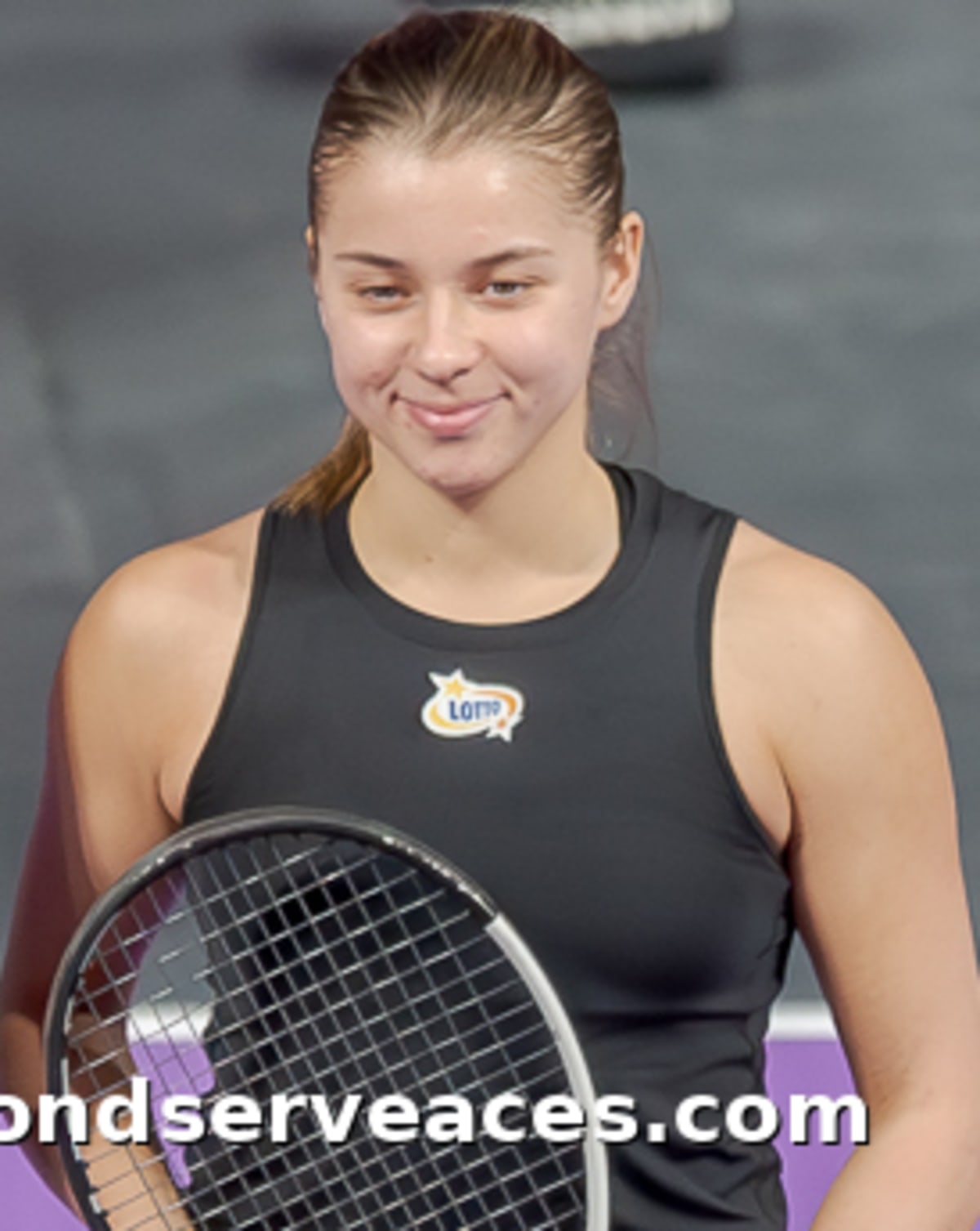
To understand the sheer scale of what Maja Chwalinska accomplished on the red clay of Paris before her 6-3, 6-2 final defeat to Mirra Andreeva, you have to look at where she started. The 24-year-old entered the tournament ranked 114th in the world, forced to battle through three grueling rounds of qualifying just to earn a spot in the main draw. On clay, that means extra miles on the legs, sliding through heavy conditions, and fighting for survival before the tournament proper even begins.
Listen to the Second Serve Podcast
Get our daily AI-synthesized audio briefings and match reviews on the go.
Yet, Chwalinska did not just survive; she thrived. Her court positioning throughout the fortnight was a masterclass in baseline discipline, hugging the baseline to take the ball on the rise and deny her opponents the time to wind up their heavy topspin. By the time she reached the championship match, she had captured the attention of the tennis world, transforming from a qualifier into a Grand Slam finalist at Roland-Garros.
Her journey highlights the brutal physical demands of clay-court tennis, where tactical execution must be flawless over seven consecutive matches. Chwalinska's run is a testament to what can happen when a player finds their rhythm, using short-angled slices to pull opponents off the court and opening up the open stance crosscourt forehand. It was a masterclass in clay-court geometry that kept her opponents off-balance.
The Qualifying Grind at Porte d'Auteuil
Entering the qualifying draw of a Grand Slam is one of the most mentally taxing endeavors in professional tennis. Players face opponents who have nothing to lose, playing in front of sparse crowds on the outer courts where the wind blows harder and the clay is less manicured. For Chwalinska, every single match was a battle of attrition, requiring her to manage her physical reserves while maintaining a high first-serve percentage to avoid being broken.
Her tactical blueprint during the qualifying rounds relied heavily on changing the height and depth of her groundstrokes. Instead of trading flat, heavy blows from the back of the court, she utilized heavy topspin to push her opponents deep behind the baseline, before executing delicate drop shots that died in the damp Parisian clay. This variety prevented her opponents from finding any rhythm, allowing Chwalinska to dictate the terms of engagement from the center of the court.
By the time she won her third qualifying match to enter the main draw, she had already spent hours on court. Yet, rather than showing signs of fatigue, Chwalinska seemed to grow stronger with each passing round. The confidence gained from those early victories acted as a springboard, allowing her to swing freely against seeded opponents who underestimated her court coverage and defensive tenacity.
Deep Clay Tactics Against Andreeva's Flat Depth
In the final, however, Chwalinska ran into a tactical brick wall in eighth seed Mirra Andreeva. The match score of 6-3, 6-2 does not fully reflect the intense baseline chess that unfolded, but it does show Andreeva's superior ability to control the center of the court. Andreeva consistently targeted Chwalinska's backhand wing, using deep, flat groundstrokes that didn't allow the Polish player to generate her preferred low-bounce angles.
Chwalinska struggled to establish match momentum early, facing constant pressure on her second serve. Andreeva stood inside the baseline on returns, taking the ball early to rob Chwalinska of recovery time. When Chwalinska tried to break the rhythm with drop shots, Andreeva's exceptional forward movement allowed her to track them down and reply with angled re-drops, leaving Chwalinska stranded in no-man's-land.
As we discussed in our analysis of how Andreeva's Clay Crown Ignites Jovic, Tagger, and Mboko, the young eighth seed possesses a rare tactical maturity. She neutralized Chwalinska's topspin by hitting flat through the court, keeping her groundstrokes deep in the clay. This forced Chwalinska to defend from ten feet behind the baseline, a position from which it is nearly impossible to dictate play.
A €1.4 Million Surge to World No. 21
Despite the final hurdle proving too high, Chwalinska’s performance across the fortnight represents a massive career milestone. For her runner-up finish, she takes home a life-changing €1.4 million in prize money, providing the financial stability required to build a dedicated traveling team. More importantly, her ranking undergoes a seismic shift, catapulting her from world No. 114 all the way to No. 21.
This ranking surge completely changes the trajectory of Chwalinska's career. According to the official WTA Rankings, she will now receive direct entry into all future Grand Slam main draws, avoiding the exhausting qualifying rounds that drain a player's physical reserves. She will also be seeded at smaller tour events, giving her more favorable draws as she seeks to build on this breakthrough.
For a player who has spent years grinding on the lower tiers of the professional circuit, this transition is monumental. The physical toll of playing qualifying matches can wear down even the most resilient athletes. Now, with her spot secured among the world's elite, Chwalinska can structure her schedule around peak performance at the biggest events on the calendar.
The Broader Roland Garros Landscape
Chwalinska's dream run occurred during a tournament of absolute chaos on the women's side. World number one Aryna Sabalenka was eliminated in the quarterfinals, opening up the draw for a new champion to emerge. Andreeva seized the opportunity with both hands, clinical in her execution to capture her maiden Grand Slam title.
The men's draw saw similar disruptions, with early exits from top favorites Jannik Sinner and Novak Djokovic. Ultimately, Alexander Zverev claimed the men's singles title, navigating a draw that was wide open from the second week onward. The clay of Paris once again proved to be the ultimate test of physical endurance and tactical adaptability.
As the tour transitions away from the red dirt, Chwalinska's performance will be remembered as one of the most compelling stories of the clay season. Her ability to transition from qualifying to a Grand Slam final shows that the gap between the top 100 and the top 20 is narrower than ever, decided by a few key break points and tactical adjustments under pressure. For more on her career journey, you can view her profile on Wikipedia.
What Jannik Sinner Plays With
Head Speed MP 2024
Head Hawk Touch 1.25
Nike GP Challenge 1
Analyze Maja Chwalinska vs. Mirra Andreeva
Predict tactical adjustments, momentum swings, and serve strategy options for this match-up using our AI simulator.
The Aces Tactical Panel
This report was curated and edited by Bhaskar Goel. Tactical analysis and technical insights were provided by our specialized panel of expert correspondents.
Julian Price
Senior Tactical Correspondent
Stuffy, pedantic British academic and historian specializing in match momentum and historical context.
Elena Cruz
Director of Analytical Research
Data scientist specializing in court surface physics and movement patterns.
Bhaskar
The Editor & Fan
Passionate tennis player and site editor bringing everyday amateur insights and relatable fan commentary.
Arthur Vance
Senior Existential Analyst
Deep, eccentric, and DFW-inspired. Models court metaphysics, kinetic beauty, and player psychology.
Leo Sterling
High-Performance Consultant
Hard-nosed ex-trainer from Melbourne with a no-nonsense view on tour fitness.
Related Reports

Quick Answers
What was the score of the French Open final between Mirra Andreeva and Maja Chwalinska?+
Mirra Andreeva defeated Maja Chwalinska 6-3, 6-2 to win her first Grand Slam title.
How much prize money did Maja Chwalinska earn at the French Open?+
Maja Chwalinska earned €1.4 million in prize money for her runner-up finish.
What is Maja Chwalinska's new singles ranking after the French Open?+
Following her run to the final, Chwalinska's ranking surged from world No. 114 to world No. 21.