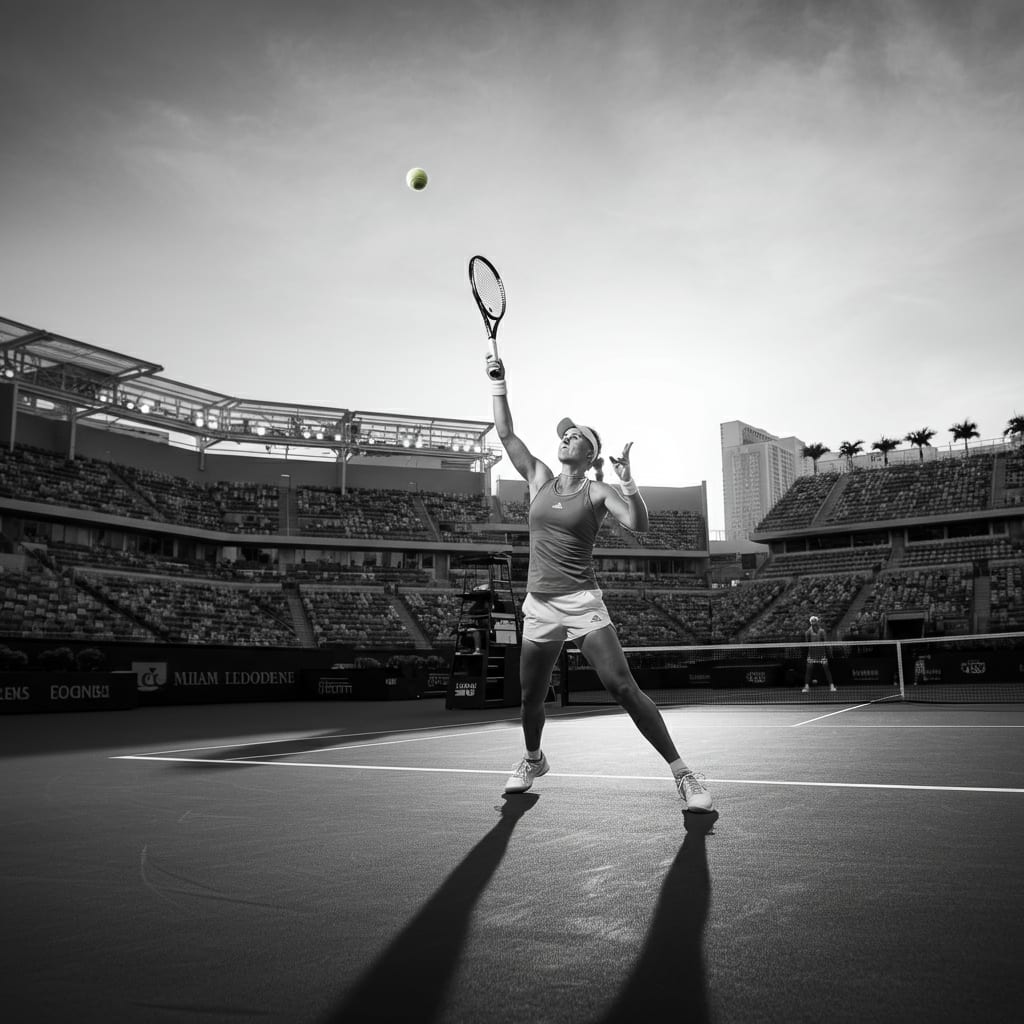
The tennis court is a 78-foot mirror. It reflects every ounce of self-doubt you carry in your bag, forcing you to confront your internal narrative under the glare of stadium lights. Coco Gauff knows this mirror intimately. Advancing past Belinda Bencic into the Miami Open semifinals, the American star isn’t just battling the elite athletes across the net; she is actively confronting the phantom weight of imposter syndrome.
Listen to the Second Serve Podcast
Get our daily AI-synthesized audio briefings and match reviews on the go.
To admit vulnerability in a sport built on projecting invincibility is a profound act of courage. Gauff’s transparency about feeling like she doesn't belong—despite holding a Grand Slam title and standing firmly at the top of the game—strips away the robotic veneer we often assign to prodigies. It is a reminder that the grind is as psychological as it is physical.
The Tactical Breakdown
Overcoming internal resistance requires tangible, external action. For Gauff, that action meant dismantling the most crucial shot in her arsenal. Mid-career technical adjustments are a brutal undertaking. It is akin to rebuilding an airplane engine while still in flight. Yet, Gauff has hired biomechanist Gavin MacMillan specifically to overhaul her serve.
Historically, Gauff's service motion possessed a slight hitch, leading to erratic toss placements and a vulnerable second serve that aggressive returners exploited to seize match momentum. MacMillan’s approach is rooted entirely in the kinetic chain. By smoothing out the racquet drop and optimizing her shoulder rotation, the goal is to create a repeatable, bio-mechanically sound motion that holds up during high-stress break point scenarios.
Against Bencic, the tactical dividends of this labor were apparent. Bencic thrives on taking the ball incredibly early, robbing her opponent of recovery time. To neutralize that flat, aggressive baseline positioning, Gauff had to execute a specific blueprint:
- Rally Tolerance: Gauff extended the physical duration of the points, forcing Bencic to hit three or four extra balls to earn a winner.
- Heavy Topspin: By dialing up the RPMs on her forehand, Gauff pushed the ball deep into the corners, effectively altering the court geometry and pushing Bencic off the baseline.
- First Strike Precision: The adjustments under MacMillan allowed Gauff to land first serves with better location variety, preventing Bencic from stepping inside the baseline on the return.
The Bigger Picture
Holding a 15-5 win-loss record so far in the 2026 season, Gauff is navigating the grueling reality of tour-level consistency. To the casual observer, 15-5 is a stellar ledger. But in the locker room, those five losses echo. Every defeat is scrutinized, making the battle against imposter syndrome an everyday reality. You have to wake up and convince yourself, repeatedly, that you belong in the champion's circle.
Next up in the semifinals is Karolína Muchová. On paper, Gauff enters with a commanding psychological advantage, holding a flawless 5-0 career record against the Czech player. Muchová is a classic shot-maker, utilizing elegant slices, sudden net approaches, and off-pace variations to disrupt rhythm. Historically, players who rely on baseline rhythm struggle against Muchová's chaotic variety. However, Gauff’s supreme footwork allows her to chase down drop shots and pass accurately on the run, effectively shrinking Muchová's offensive margins.
If Gauff can maintain her unyielding court coverage, Muchová will be forced to over-hit, leading to unforced errors.
The Unforgiving Nature of Hard Courts
The Miami hard courts are extracting a heavy toll this fortnight, reminding everyone that past accolades offer zero protection on any given afternoon. Look no further than the men’s draw, where Carlos Alcaraz suffered an abrupt third-round exit to Sebastian Korda. Korda successfully rushed the Spaniard, taking away the time Alcaraz usually requires to set up his massive groundstrokes.
That result is a stark reminder for Gauff. The margins in modern tennis are microscopic. Talent gets you on the court, but biomechanical efficiency and psychological resilience keep you there. As Gauff prepares for the semifinals, she isn't just trying to beat Muchová; she is out there executing a physical and mental rebuild, one meticulously struck tennis ball at a time.
What Coco Gauff Plays With
Head Boom MP 2024
Head Lynx Tour 1.25
Head Prime Tour (12-Pack)
Analyze Coco Gauff vs. Belinda Bencic
Predict tactical adjustments, momentum swings, and serve strategy options for this match-up using our AI simulator.
The Aces Tactical Panel
This report was curated and edited by Bhaskar Goel. Tactical analysis and technical insights were provided by our specialized panel of expert correspondents.
Julian Price
Senior Tactical Correspondent
Stuffy, pedantic British academic and historian specializing in match momentum and historical context.
Elena Cruz
Director of Analytical Research
Data scientist specializing in court surface physics and movement patterns.
Bhaskar
The Editor & Fan
Passionate tennis player and site editor bringing everyday amateur insights and relatable fan commentary.
Arthur Vance
Senior Existential Analyst
Deep, eccentric, and DFW-inspired. Models court metaphysics, kinetic beauty, and player psychology.
Leo Sterling
High-Performance Consultant
Hard-nosed ex-trainer from Melbourne with a no-nonsense view on tour fitness.