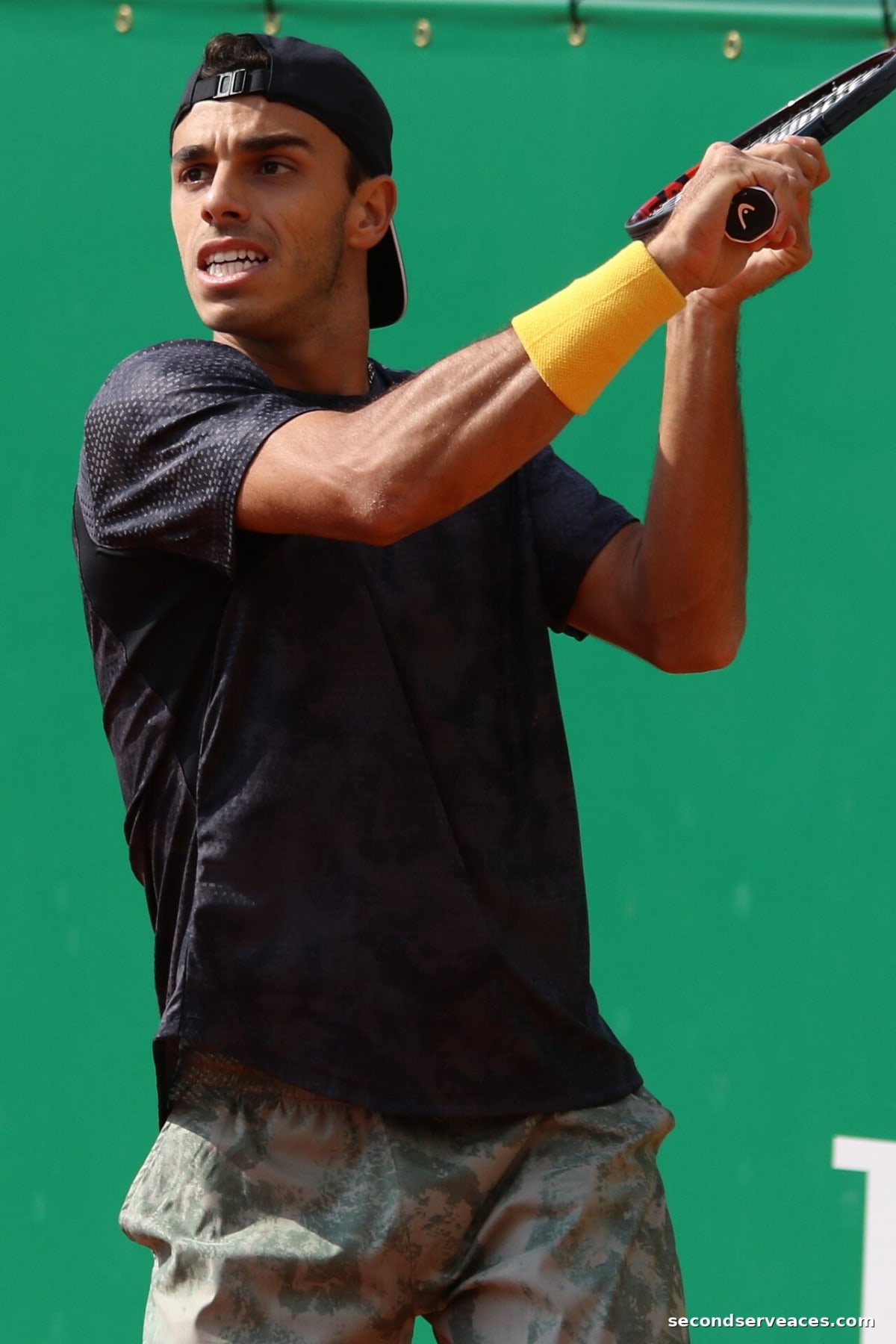
In a grueling physical battle that redefined the limits of grass-court tennis, Francisco Cerúndolo defeated Tommy Paul 6-7 (4), 6-4, 6-3 to claim the prestigious Queen's Club title. The match lasted three hours and two minutes, making it the longest final in Queen's Club history. It was a tactical war of attrition where baseline depth and court positioning ultimately triumphed over net-rushing aggression, marking the biggest trophy of Cerúndolo's career.
Listen to the Second Serve Podcast
Get our daily AI-synthesized audio briefings and match reviews on the go.
The First-Set Tiebreak: Paul's Low-Skidding Slice vs. Cerúndolo's Extreme Topspin
Tommy Paul entered the final displaying the same hyper-aggressive transition game that we analyzed in our previous coverage of his semifinal run. On the quick lawns of West Kensington, Paul utilized his low-skidding backhand slice to keep the ball out of the strike zone of Francisco Cerúndolo. By executing this pattern, Paul forced the Argentine to generate his own pace from below the net cord, neutralizing Cerúndolo’s heavy topspin forehand.
The opening set culminated in a highly tactical tiebreak where Paul’s superior court geometry proved decisive. The American repeatedly pulled Cerúndolo wide of the doubles alley before hitting behind him into the open court. Winning the tiebreak 7-4, Paul seemed to have established a firm grip on the match momentum, especially after securing an early break in the second set to put himself on the brink of another grass-court triumph.
The Mid-Second Set Adjustments: Shifting Baseline Depth and Court Geometry
Down a set and a break, Cerúndolo was forced to abandon his passive defensive positioning. According to tracking data on the ATP Tour, Cerúndolo moved his average return position nearly a meter closer to the baseline, refusing to let Paul dictate terms with his serve-and-volley variations. This structural adjustment allowed Cerúndolo to strike the ball on the rise, taking away the time Paul needed to transition forward.
By flattening out his forehand and targeting the deep deuce-court corner, Cerúndolo forced Tommy Paul into defensive, end-range running forehands. The tactical friction was evident: while Paul struggled to maintain his first-serve win rate under increased return pressure, Cerúndolo raised his return-points-won percentage significantly, breaking back and eventually taking the second set 6-4 to level this historic encounter.
The Deciding Set Grind: Physicality in the Longest Queen's Club Final
As the match clock ticked past the two-and-a-half-hour mark, the physical toll of the baseline exchanges became the defining narrative. This was no longer a standard grass-court shootout; it had devolved into a brutal war of attrition played on turf. Sitting in the player box was Alejandro Cerúndolo, the champion’s father, who had flown outside of Argentina for the first time to watch his son compete, adding immense emotional stakes to the physical battle.
Cerúndolo’s superior physical conditioning began to tilt the baseline rallies in his favor. He consistently targeted Paul's backhand wing with heavy, looping topspin that bounced awkwardly high on the worn grass near the baseline. Paul’s legs began to tire, leading to mistimed slices and short balls that Cerúndolo ruthlessly punished with inside-out forehand winners, securing a crucial break of serve in the third set.
The Dramatic Sixth Match Point: Sealing the Biggest Victory in London
Serving for the biggest title of his career at 5-3 in the decider, Cerúndolo faced a monumental mental test. The final game became a micro-drama of its own, encapsulating the sheer tension of a match that would ultimately register as the longest final in Queen's Club history at three hours and two minutes. Paul fought desperately, saving five match points with brave, net-rushing play and precise passing shots.
But on his sixth match point, Cerúndolo refused to let the opportunity slip away. He executed a perfect wide serve to the ad-court, drawing a weak return from Paul, and followed it up with a decisive mid-court forehand drive volley. The 6-7 (4), 6-4, 6-3 victory not only secured the biggest trophy of Cerúndolo's career but also proved that his heavy baseline game can be translated effectively to the fastest surface in tennis.
Essential Matchday Add-Ons
Tournament-tested accessories and high-frequency consumables every competitive player keeps in their bag.
Tourna Grip Original Dry Feel Overgrip (10-Pack)
4.8 ★ (12,000+ reviews)
The gold standard for sweaty hands. Proprietary dry feel absorbs moisture better as play intensifies.
Luxilon ALU Power 125 Silver String Set
4.9 ★ (3,500+ reviews)
Unrivaled control and spin potential used by over 50% of the ATP Top 100 players.
Babolat Custom Damp Vibration Dampener (2-Pack)
4.7 ★ (4,200+ reviews)
Customizable dampening with removable central O-ring for fine-tuning court feedback and sound.
Penn Championship Extra Duty Tennis Balls (4-Can Pack)
4.7 ★ (8,900+ reviews)
Official ball of USTA League Tennis with extra-duty felt designed for abrasive hard courts.
Analyze Francisco Cerúndolo vs. Tommy Paul
Predict tactical adjustments, momentum swings, and serve strategy options for this match-up using our AI simulator.
The Aces Tactical Panel
This report was curated and edited by Bhaskar Goel. Tactical analysis and technical insights were provided by our specialized panel of expert correspondents.
Julian Price
Senior Tactical Correspondent
Stuffy, pedantic British academic and historian specializing in match momentum and historical context.
Elena Cruz
Director of Analytical Research
Data scientist specializing in court surface physics and movement patterns.
Bhaskar
The Editor & Fan
Passionate tennis player and site editor bringing everyday amateur insights and relatable fan commentary.
Arthur Vance
Senior Existential Analyst
Deep, eccentric, and DFW-inspired. Models court metaphysics, kinetic beauty, and player psychology.
Leo Sterling
High-Performance Consultant
Hard-nosed ex-trainer from Melbourne with a no-nonsense view on tour fitness.
Related Reports
Quick Answers
What was the final score of the match between Francisco Cerúndolo and Tommy Paul at Queen's Club?+
Francisco Cerúndolo defeated Tommy Paul with a final score of 6-7 (4), 6-4, 6-3.
How long did the Queen's Club final between Cerúndolo and Paul last?+
The final lasted three hours and two minutes, making it the longest final in Queen's Club history.
On which match point did Francisco Cerúndolo secure his victory?+
Francisco Cerúndolo secured the victory on his sixth match point in the final game of the third set.