
Analyzing the 100% Set-Win Rate and Tie-Break Efficiency in Vienna
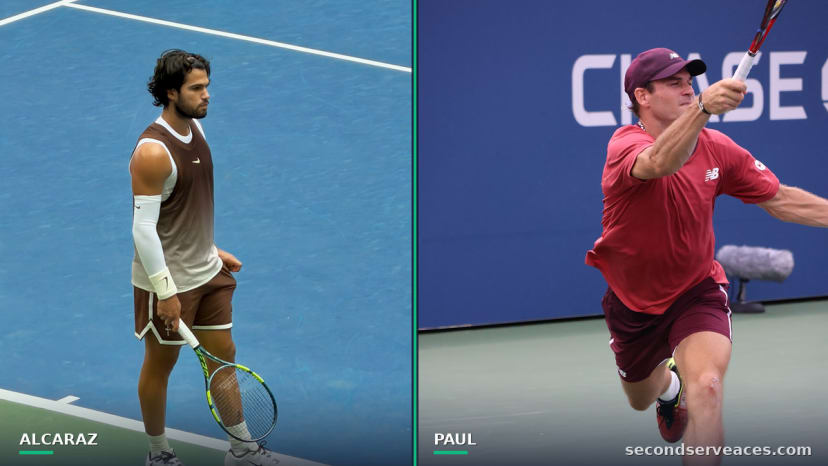
Carlos Alcaraz's campaign at the Vienna Open presents a fascinating statistical anomaly for gear analysts and tactical observers alike. The Spaniard has progressed deep into the tournament without dropping a single set, yet he has been pushed to a tie-break in every single round. This pattern continued during his quarterfinal victory over Tommy Paul, where Alcaraz demonstrated exceptional clutch performance under pressure but struggled to find early break points during baseline exchanges. From a physical perspective, playing continuous tie-breaks increases the overall load on a player's equipment, accelerating string tension loss and demanding peak physical durability on the indoor hard court.
On these fast indoor surfaces, Alcaraz's aggressive court positioning requires highly precise timing. When his first-serve percentage fluctuates, his service games become significantly more labor-intensive, forcing him to rely on defensive baseline patterns. For an in-depth look at how these patterns played out in his previous match, see our previous tactical coverage of his quarterfinal victory, which highlights how these narrow physical margins are shaping his late-season indoor campaign.
The Microsecond Decision Window: Decisional Friction in Shot Selection
In his post-match press conference, Alcaraz candidly diagnosed a recurring technical flaw in his current game: decision-making paralysis. Despite possessing an incredibly versatile toolkit—including a devastating heavy topspin forehand and a disguised drop shot—the Spaniard admitted that he frequently struggles to make split-second decisions on court. In high-pressure moments, Alcaraz revealed that he occasionally selects the worst possible shot for a given scenario, prioritizing spectacular winners over high-percentage baseline play.
Listen to the Second Serve Podcast
Get our daily AI-synthesized audio briefings and match reviews on the go.
According to the official ATP rankings, Alcaraz remains firmly positioned as the World No. 3, but minimizing these unforced errors is crucial for his long-term consistency. When a player has an abundance of options, the brain's processing time naturally increases. In fast indoor conditions, even a microsecond of hesitation can ruin a player's contact point, leading to frame hits and loss of control over the ball's trajectory.
String Tension and Physical Load Management Ahead of Paris
Alcaraz's next test in Vienna is a highly anticipated semifinal matchup against Daniil Medvedev, a player who specializes in exploiting opponent errors through deep court positioning and relentless consistency. Medvedev's ability to absorb pace will force Alcaraz to show extreme discipline during transition play. If Alcaraz continues to suffer from shot-selection lapses, Medvedev's low-skidding backhand slice will punish him. We previously analyzed Medvedev's pursuit of elite form in our analysis of the Russian's tactical adjustments.
Following his campaign at the Vienna Open, Alcaraz is scheduled to transition immediately to the Paris Masters. Managing his physical durability during this consecutive indoor stretch is paramount. For an explosive player who relies on rapid direction changes, optimizing racket specs and maintaining mental discipline during high-stress tie-breaks will determine his success in these final tournaments of the season.
Rivalry Matchup & Player Profiles
To understand the technical foundation of Carlos Alcaraz's game, we examine his official player specifications. These metrics highlight the physical and tactical tools he brings to fast indoor hard courts.
| Metric | Carlos Alcaraz |
|---|---|
| Rank | World No. 3 |
| Country | Spain |
| Age | 23 |
| Height | 6'0" (183 cm) |
| Handedness | Right-handed |
| Play Style | Aggressive baseliner / All-court player |
| Career Titles | 27 |
As detailed on his official Wikipedia profile, Alcaraz relies on explosive lateral movement and high-velocity forehands to dominate from the baseline. However, his aggressive style requires precise execution. When his decision-making falters under pressure, his unforced error count rises, neutralizing his physical advantages. His upcoming semifinal clash against Daniil Medvedev will serve as a key test of his ability to recalibrate his shot selection under pressure.
What Carlos Alcaraz Plays With
Babolat Pure Aero 98
Babolat RPM Blast 1.30
Babolat VS Original (12-Pack)
Nike Vapor Pro 2
Simulate Carlos Alcaraz Match Scenarios
Simulate high-pressure scenarios, score leverage points, and tactical responses for ATP and WTA players.
The Aces Tactical Panel
This report was curated and edited by Bhaskar Goel. Tactical analysis and technical insights were provided by our specialized panel of expert correspondents.
Julian Price
Senior Tactical Correspondent
Stuffy, pedantic British academic and historian specializing in match momentum and historical context.
Elena Cruz
Director of Analytical Research
Data scientist specializing in court surface physics and movement patterns.
Bhaskar
The Editor & Fan
Passionate tennis player and site editor bringing everyday amateur insights and relatable fan commentary.
Arthur Vance
Senior Existential Analyst
Deep, eccentric, and DFW-inspired. Models court metaphysics, kinetic beauty, and player psychology.
Leo Sterling
High-Performance Consultant
Hard-nosed ex-trainer from Melbourne with a no-nonsense view on tour fitness.
Related Reports
Quick Answers
Did Carlos Alcaraz drop a set during his run to the Vienna Open semifinals?+
No, Carlos Alcaraz did not drop a set on his way to the semifinals, although he had to play a tie-break in every single round of the tournament.
Who did Carlos Alcaraz defeat in the quarterfinals of the Vienna Open?+
Alcaraz defeated American Tommy Paul in the quarterfinals to advance to the semifinals.
What technical weakness did Carlos Alcaraz discuss during his press conference?+
Alcaraz admitted he struggles with split-second decision-making on court, occasionally choosing the worst shot for a specific situation.