
The transition from the high, clay-court bounce to the slick, subterranean skid of grass is a sensory shock. In Den Bosch, this transition begins with a veteran whose career is etched in the heavy thud of flat groundstrokes. Marin Cilic, now 37, brings his imposing frame to the lawns of the Netherlands, carrying with him the memory of a victory over Denis Shapovalov at the Australian Open earlier this season. That victory broke a temporary silence in their competitive history, but on grass, the ledger resets to zero.
Listen to the Second Serve Podcast
Get our daily AI-synthesized audio briefings and match reviews on the go.
Their head-to-head record stands at an agonizingly balanced 3-3. When they meet on Day 1, it will not merely be a test of physical endurance, but a collision of distinct geometries. Shapovalov, with his explosive, single-handed backhand, represents the high-variance school of modern tennis—a style that can look like pure genius when the ball meets the sweet spot, but quickly dissolves into unforced errors when the low bounce of the grass disrupts his timing. Cilic, by contrast, relies on the relentless economy of his serve and the flat, linear trajectory of his strokes, which find a natural home on this surface.
According to the latest ATP rankings, both players are fighting to reclaim their former stature after various physical setbacks. For Cilic, the challenge is purely kinetic: can a 37-year-old body bend low enough, consistently enough, to handle the micro-adjustments required by grass? The ball does not bounce here; it slides, requiring a deep knee bend and a shortened backswing. Shapovalov will try to exploit this by injecting sudden pace, but if Cilic can protect his serve, the pressure will shift entirely to the Canadian's volatile baseline game.
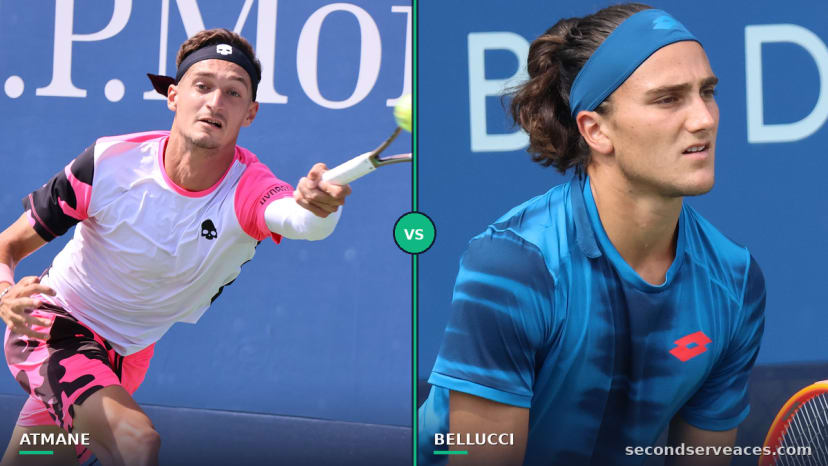
The Kinetic Challenge Facing Terence Atmane and Nuno Borges
Elsewhere on the Den Bosch schedule, Nuno Borges faces the mercurial French talent Terence Atmane. This matchup presents a fascinating study in contrast. Borges is a player of methodical construction, a technician who relies on percentage tennis and physical endurance. Atmane, conversely, is a left-handed disruptor whose game is built on sudden, violent accelerations. On grass, where point construction is often truncated by the speed of the court, Atmane’s ability to find absurd angles off his forehand could prove decisive.
The physics of the grass court favor those who can take the ball on the rise, a skill that Atmane has demonstrated in flashes on the Challenger tour. However, Borges possesses a disciplined return game that could neutralize the Frenchman's slice serve. As we noted in our previous strategic breakdown of transition play, the ability to transition from defense to offense in a single stride is the defining characteristic of successful grass-court players.
For Atmane, the key will be managing his emotional variance. Grass is an unforgiving surface for players who lose their focus even for a single service game; a break of serve here is often a death sentence for the set. Borges will look to play the role of the steady accumulator, waiting for the inevitable dip in Atmane's first-serve percentage to make his move. It is a classic battle of patience versus raw, unguided velocity.
The Weight of Expectations on Teenage Shoulders
The Dutch crowd will have their eyes firmly fixed on 18-year-old wild card Mees Rottgering. To step onto a professional grass court at such a tender age is to be initiated into a very exclusive, very brutal club. Grass-court tennis is an acquired taste, requiring years of footwork calibration that junior players rarely have the opportunity to develop. Rottgering’s inclusion is a nod to the future of Dutch tennis, but his immediate task is monumental.
The teenage wildcard must navigate not only the physical demands of the low bounce but also the psychological weight of playing in front of a home crowd. Every slice that floats wide, every double fault that echoes in the quiet of the stadium, will be magnified. Yet, there is a liberating freedom in having absolutely nothing to lose. If Rottgering can embrace the chaos of the grass and play with aggressive abandon, he might just disrupt the rhythm of his more experienced opponent.
His opponent will undoubtedly try to make the match as physical as possible, testing the youngster's movement in the corners. On grass, the traction is never entirely secure, and an inexperienced player can easily find themselves off-balance. Rottgering must rely on short, explosive steps and absolute commitment to his shots if he wishes to make this a competitive outing rather than a harsh learning experience.
Elias Ymer’s Quest to Break the Main Draw Drought
For Elias Ymer, the grass of Den Bosch represents a chance to rewrite a difficult narrative. Ymer enters the tournament without a single main draw victory to his name this year. Such a drought can become a heavy mental anchor, dragging down a player's decision-making in crucial moments. When the score reaches 30-30 or deuce, the ghost of previous losses often dictates a conservative, fearful style of play.
To break this cycle, Ymer must find a way to impose himself early in his matches. The draw has not been kind, but on grass, the margins are so thin that a single hot streak of serving can turn a match around. He will need to look to players like Benjamin Bonzi or top seed Ugo Humbert, who have historically used their flat groundstrokes to great effect on this surface, as templates for how to navigate these fast conditions.
Ultimately, Day 1 at the ATP Tour event in Den Bosch is about survival. Whether it is a 37-year-old veteran like Cilic managing his physical reserves, or Ymer fighting to end a dry spell, the grass demands instant adaptation. There is no time to ease into the swing; those who cannot find their footing immediately will find themselves packing their bags before the tournament has truly begun.
Essential Matchday Add-Ons
Tournament-tested accessories and high-frequency consumables every competitive player keeps in their bag.
Tourna Grip Original Dry Feel Overgrip (10-Pack)
4.8 ★ (12,000+ reviews)
The gold standard for sweaty hands. Proprietary dry feel absorbs moisture better as play intensifies.
Luxilon ALU Power 125 Silver String Set
4.9 ★ (3,500+ reviews)
Unrivaled control and spin potential used by over 50% of the ATP Top 100 players.
Babolat Custom Damp Vibration Dampener (2-Pack)
4.7 ★ (4,200+ reviews)
Customizable dampening with removable central O-ring for fine-tuning court feedback and sound.
Penn Championship Extra Duty Tennis Balls (4-Can Pack)
4.7 ★ (8,900+ reviews)
Official ball of USTA League Tennis with extra-duty felt designed for abrasive hard courts.
Analyze Terence Atmane vs. Nuno Borges
Predict tactical adjustments, momentum swings, and serve strategy options for this match-up using our AI simulator.
The Aces Tactical Panel
This report was curated and edited by Bhaskar Goel. Tactical analysis and technical insights were provided by our specialized panel of expert correspondents.
Julian Price
Senior Tactical Correspondent
Stuffy, pedantic British academic and historian specializing in match momentum and historical context.
Elena Cruz
Director of Analytical Research
Data scientist specializing in court surface physics and movement patterns.
Bhaskar
The Editor & Fan
Passionate tennis player and site editor bringing everyday amateur insights and relatable fan commentary.
Arthur Vance
Senior Existential Analyst
Deep, eccentric, and DFW-inspired. Models court metaphysics, kinetic beauty, and player psychology.
Leo Sterling
High-Performance Consultant
Hard-nosed ex-trainer from Melbourne with a no-nonsense view on tour fitness.
Related Reports


Quick Answers
What is the head-to-head record between Marin Cilic and Denis Shapovalov?+
Marin Cilic and Denis Shapovalov are currently tied with an even 3-3 head-to-head record.
How old is Marin Cilic competing at the ATP Den Bosch event?+
Marin Cilic is competing at the age of 37.
Who is the young Dutch wild card playing in the main draw?+
The 18-year-old Dutch wild card competing in the tournament is Mees Rottgering.