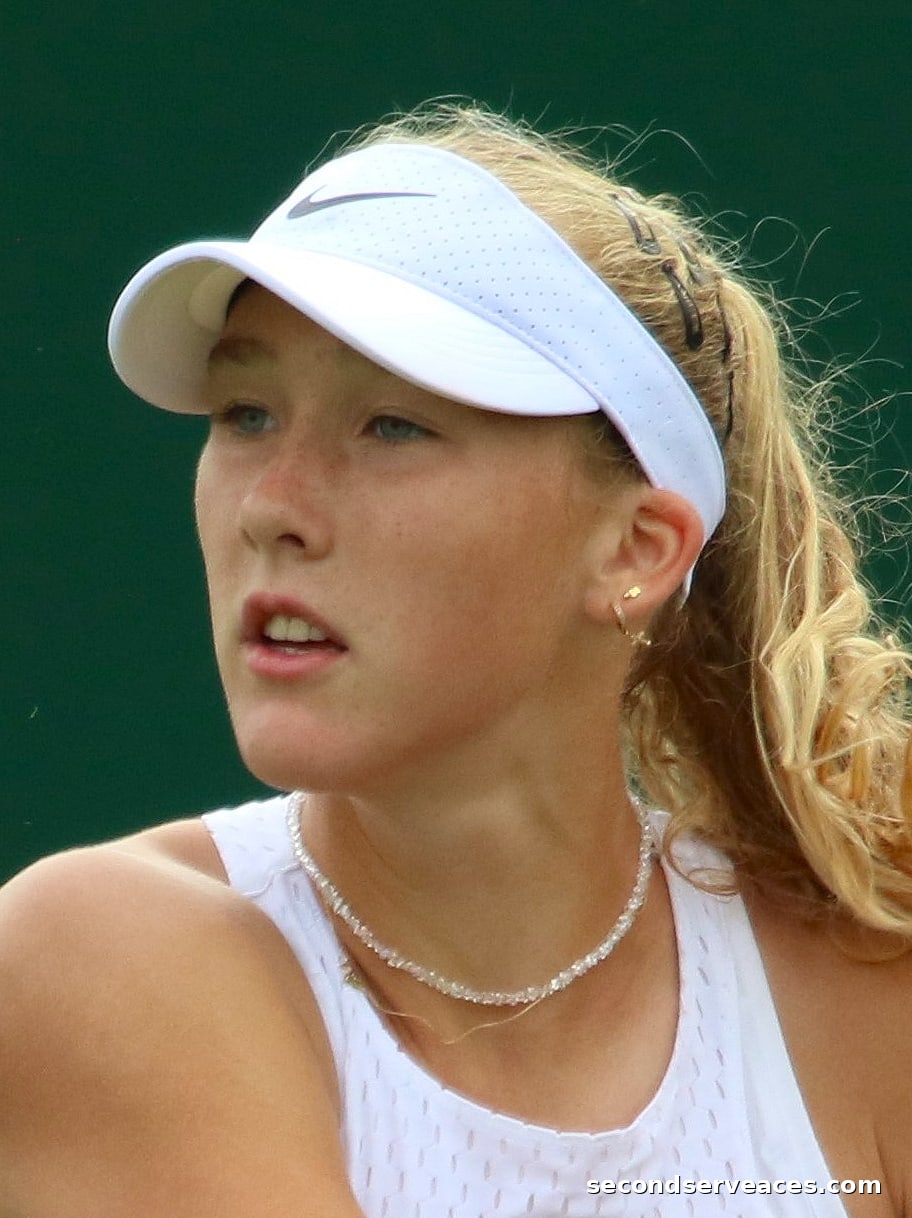
Ekaterina Alexandrova dismantled the defensive baseline patterns of Mirra Andreeva, securing a 6-3, 6-4 victory on the slick lawns of Bad Homburg. Alexandrova, a player whose flat, linear strokes are tailor-made for this surface, consistently denied Andreeva the time required to loop her heavy topspin. By striking the ball early and taking it on the rise, Alexandrova kept the ball low in the court, forcing her teenage opponent to constantly hit from a defensive crouch.
Listen to the Second Serve Podcast
Get our daily AI-synthesized audio briefings and match reviews on the go.
Low-Skidding Flat Strikes Neutralize the High-Topspin Defense
From the very first game, the tactical blueprint was clear. Alexandrova targeted Andreeva's backhand wing with deep, penetrating drives that skidded off the grass. On this surface, the high-bouncing topspin that served Andreeva so well during her clay campaign lost its bite, sitting up perfectly in Alexandrova's strike zone. According to the official WTA rankings data, players who rely on extreme western grips often struggle to find their timing during these quick transitions from clay to grass.
Andreeva tried to adjust by dropping her average court positioning deeper behind the baseline, but this only invited more pressure. Alexandrova ruthlessly stepped inside the baseline to redirect the ball into the open court, keeping her unforced errors to a minimum while maintaining a high first-serve percentage. The 6-3, 6-4 scoreline accurately reflects a match where tactical clarity and aggressive court positioning completely overwhelmed defensive resilience.
For Andreeva, the defeat highlights the steep learning curve of the grass-court swing. The teenage sensation, whose career trajectory is detailed on her Wikipedia profile, must learn to flatten out her groundstrokes to remain competitive on faster surfaces where defense alone is rarely enough to secure victory.
Inside the Baseline Tactics and the Swiatek Grass Dilemma
The shockwaves in Bad Homburg did not end with Andreeva's departure. Emma Navarro engineered a stunning tactical victory over top seed Iga Swiatek, securing a 7-5, 2-6, 6-3 decision. Navarro's game plan was a masterclass in grass-court geometry, as she consistently sliced the ball short and low to Swiatek's forehand. This forced the World No. 1 to bend her knees deeply and lift the ball over the net, neutralizing her signature aggressive topspin.
Swiatek's struggles on grass are well-documented, primarily stemming from the extreme semi-western grip on her forehand which requires clean, high bounces to generate maximum racket head speed. When Navarro kept the ball below net height, Swiatek’s timing broke down, leading to a flurry of unforced errors off that wing. In the deciding third set, Navarro won the battle of court positioning by taking the ball early on the return, preventing Swiatek from dictating play with her first strike.
For those tracking the lead-up to SW19, this result exposes the vulnerabilities of clay-court specialists who fail to adjust their footwork on slicker surfaces. As we discussed in our Eastbourne WTA analysis, the transition to grass requires shorter backswings and a lower center of gravity. Navarro executed these adjustments flawlessly, while Swiatek looked uncomfortable moving laterally on the damp turf.
Physical Toll of the Turf and Svitolina’s Preemptive Exit
Adding to the tournament's dramatic turn of events, third seed Elina Svitolina withdrew from the tournament ahead of her quarterfinal match, citing fitness issues. The physical demands of grass-court tennis are unique; the low, unpredictable bounces require players to stay in a constant semi-squat, putting immense pressure on the knees, lower back, and hamstrings. Svitolina's withdrawal highlights the razor-thin margin between peak performance and physical breakdown during this brief grass swing.
Unlike clay, where players can slide into their shots to decelerate, grass demands abrupt stops and explosive directional changes. This lateral stress often triggers microscopic tears in the patellar tendon if a player is not fully acclimated to the surface. Svitolina’s team likely chose caution over risk, recognizing that pushing through minor knee stiffness could jeopardize her upcoming campaign at Wimbledon.
This rash of withdrawals and upsets underscores the chaotic nature of the pre-major warm-up events. When top competitors are forced to choose between match play and physical preservation, the tournament draws frequently open up for lower-ranked grass court specialists. Svitolina's absence, combined with the exits of Swiatek and Andreeva, means the top three seeded players have all been eliminated before the semifinal stage.
Structural Adjustments and the Looming Major Campaign
The tactical lessons from Bad Homburg will reverberate all the way to London. For young talents, this week was a harsh lesson in the necessity of a backup plan. When your primary weapon—heavy, looping topspin—is neutralized by a low-skidding surface, you must be able to flatten out your groundstrokes and step forward into the court.
Alexandrova and Navarro proved that success on this surface is dictated by who controls the baseline. By refusing to give ground and striking the ball on the rise, both players showed how to take time away from opponents who prefer long, grinding rallies. It is a style of play that is best described as first-strike tennis—unapologetic, direct, and technically precise.
As the tour shifts its focus to the main event, the Bad Homburg results serve as a stark reminder that seeding means very little on grass. Players who can adapt their footwork, shorten their swings, and maintain aggressive court positioning will always have the upper hand over those who rely on defensive baseline grinding. The grass-court season is short, but its tactical demands are unforgiving.
What Iga Swiatek Plays With
Tecnifibre Tempo 298 Iga
Tecnifibre Razor Code 1.25
Tecnifibre Pro Contact Overgrip
Analyze Mirra Andreeva vs. Ekaterina Alexandrova
Predict tactical adjustments, momentum swings, and serve strategy options for this match-up using our AI simulator.
The Aces Tactical Panel
This report was curated and edited by Bhaskar Goel. Tactical analysis and technical insights were provided by our specialized panel of expert correspondents.
Julian Price
Senior Tactical Correspondent
Stuffy, pedantic British academic and historian specializing in match momentum and historical context.
Elena Cruz
Director of Analytical Research
Data scientist specializing in court surface physics and movement patterns.
Bhaskar
The Editor & Fan
Passionate tennis player and site editor bringing everyday amateur insights and relatable fan commentary.
Arthur Vance
Senior Existential Analyst
Deep, eccentric, and DFW-inspired. Models court metaphysics, kinetic beauty, and player psychology.
Leo Sterling
High-Performance Consultant
Hard-nosed ex-trainer from Melbourne with a no-nonsense view on tour fitness.
Related Reports



Quick Answers
What was the final score of the match between Ekaterina Alexandrova and Mirra Andreeva?+
Ekaterina Alexandrova defeated Mirra Andreeva with a score of 6-3, 6-4 to advance to the quarterfinals.
Who defeated the top seed Iga Swiatek at the Bad Homburg Open?+
Emma Navarro upset the top seed Iga Swiatek, winning their match 7-5, 2-6, 6-3.
Why did Elina Svitolina withdraw from the Bad Homburg Open?+
Third seed Elina Svitolina withdrew from the tournament prior to the quarterfinals due to fitness concerns.