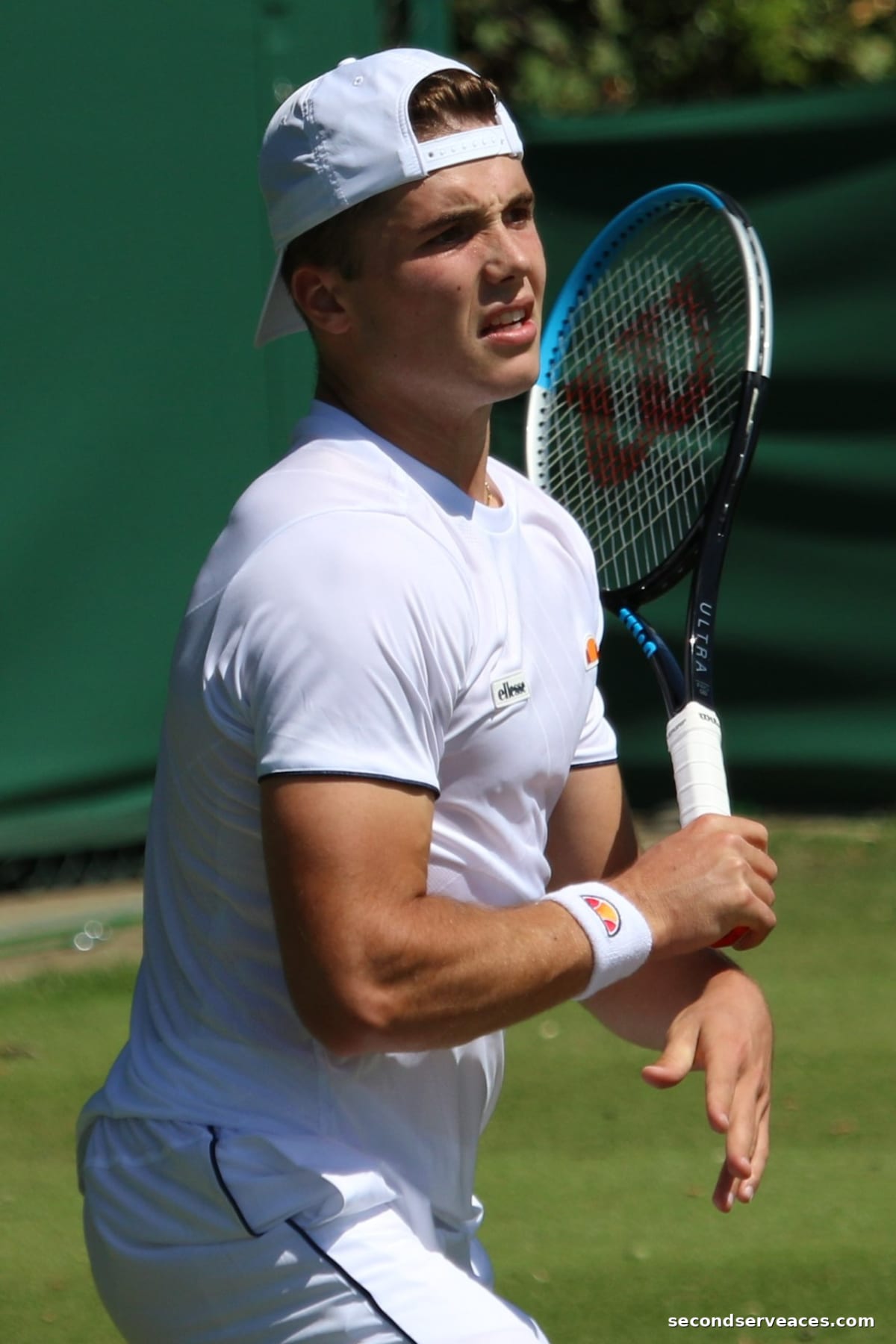
There is a certain kind of madness that takes hold of the All England Club during the second week of July, a collective suspension of disbelief that turns the manicured lawns of SW19 into a theater of the absurd. This year, that madness wears a British passport. When Arthur Fery steps onto Centre Court on Friday, July 10, 2026, he will do so not merely as a local hope, but as the first wildcard recipient to reach the Wimbledon semifinals since Goran Ivanišević’s mythical, rain-delayed odyssey back in 2001. It is a narrative so steeped in romanticism that it threatens to obscure the cold, hard, kinetic realities of the tennis match itself.
Listen to the Second Serve Podcast
Get our daily AI-synthesized audio briefings and match reviews on the go.
To understand the sheer scale of Fery’s accomplishment, one must look past the flag-waving hysteria and examine the mechanical blueprint of his grass-court campaign. This is not a run built on luck or favorable draws. As we detailed in our analysis of his five-set triumph over Grigor Dimitrov, Fery has resurrected a style of play many assumed was extinct on modern, heavy lawns. He is a forward-moving disruptor, a player who treats the baseline not as a home, but as a launching pad for relentless, vertical pressure.
The Grass-Court Geometry of Arthur Fery’s Net-Rushing Revival
The statistical backbone of Fery’s fortnight is almost jarring in its efficiency. Over the course of five matches, the young Briton has won a staggering 76% of his net points. This is not casual serve-and-volleying; it is a highly calculated, suffocating squeeze. By taking the ball early and refusing to allow his opponents to establish a baseline rhythm, Fery has turned the natural slickness of the grass into an active ally. He does not wait for the perfect approach shot; he forces the issue, daring those on the other side of the net to hit precise passing shots under extreme time pressure.
Complementing this front-court aggression is a serve that has punched well above its weight class. Fery’s first-serve win rate during this fortnight stands at an elite 81%, a metric that has allowed him to hold serve with minimal fuss and keep his opponents constantly on the defensive. He has also recorded 78 aces throughout the tournament, proving that precision and spot-serving on grass can be just as lethal as raw, triple-digit velocity. For a detailed look at how these serving patterns compare across the tour, fans can consult the official ATP rankings and statistics database.
This commitment to forward movement will be tested to its absolute limit against his semifinal opponent. Alexander Zverev, the tournament's No. 2 seed, represents the ultimate baseline test. The German possesses one of the most formidable backhands in the modern game, a wing capable of producing laser-like passing shots from deep behind the baseline. If Fery’s approach shots lack depth or bite, Zverev will exploit those fractions of a second with ruthless, mechanical precision.
Alexander Zverev’s Baseline Resistance and the Return Game Battle
While Zverev enters the match as the heavy favorite on paper, his journey through the draw has been far from flawless. According to official tournament data hosted on the Wimbledon portal, the German giant has conceded 36 break points during the event. This vulnerability on serve suggests a slight drop in focus during crucial service games, a crack in the armor that Fery must exploit if he hopes to pull off the ultimate upset. Zverev’s movement on grass, while vastly improved, can still look labored when he is forced to move forward or defend low, skidding slices.
As we noted in our preview of Zverev’s tactical adjustments earlier in the tournament, his primary struggle on this surface remains his court positioning. When pushed deep, he tends to play too far behind the baseline, giving aggressive opponents the time they need to dictate play. If Fery can utilize his slice to keep the ball low and draw Zverev into the forecourt, he can neutralize the German’s reach and force him into uncomfortable, low-margin half-volleys.
The match will ultimately be decided by who can control the tempo of the rallies. Zverev wants long, physical exchanges where he can wear Fery down with heavy topspin and depth. Fery, conversely, must keep the points short, sharp, and chaotic. He cannot afford to get locked into crosscourt backhand exchanges with the No. 2 seed. Every return of serve must be hit with intent, looking to transition forward at the earliest opportunity.
The Weight of History on the Lawns of Centre Court
To find a wildcard in the semifinals of the world’s most prestigious tournament is to witness a rare alignment of competitive grit and sporting destiny. The pressure on Fery will be immense, amplified by a partisan home crowd that expects nothing less than a miracle. Yet, there is a distinct tactical advantage in being the underdog with nothing to lose. Fery can play with a level of freedom and creative risk that Zverev, burdened by the expectations of his seeding, simply cannot afford.
Zverev’s relationship with grass has always been complex, a surface where his long swings and high ball toss can occasionally be disrupted by the elements and bad bounces. While he has reached the final four, his play has often been more functional than fluid. If Fery can win the opening set and get the crowd fully behind him, the mental pressure on the German will multiply exponentially, testing his resolve in the high-stakes environment of a Grand Slam semifinal.
Ultimately, this semifinal is a clash of tennis philosophies. It is the modern, baseline-centric power of Zverev against the classical, intuitive, net-rushing instincts of Fery. Whether the wildcard’s dream run continues into Sunday or ends at the hands of the No. 2 seed, this match promises to be a fascinating study in contrast, strategy, and the unpredictable nature of grass-court tennis.
What Alexander Zverev Plays With
Head Gravity Pro
Head Hawk Touch 1.25
Head Prime Tour (12-Pack)
Analyze Arthur Fery vs. Alexander Zverev
Predict tactical adjustments, momentum swings, and serve strategy options for this match-up using our AI simulator.
The Aces Tactical Panel
This report was curated and edited by Bhaskar Goel. Tactical analysis and technical insights were provided by our specialized panel of expert correspondents.
Julian Price
Senior Tactical Correspondent
Stuffy, pedantic British academic and historian specializing in match momentum and historical context.
Elena Cruz
Director of Analytical Research
Data scientist specializing in court surface physics and movement patterns.
Bhaskar
The Editor & Fan
Passionate tennis player and site editor bringing everyday amateur insights and relatable fan commentary.
Arthur Vance
Senior Existential Analyst
Deep, eccentric, and DFW-inspired. Models court metaphysics, kinetic beauty, and player psychology.
Leo Sterling
High-Performance Consultant
Hard-nosed ex-trainer from Melbourne with a no-nonsense view on tour fitness.
Related Reports
Quick Answers
When is the Wimbledon semifinal match between Arthur Fery and Alexander Zverev?+
The semifinal match is scheduled for Friday, July 10, 2026, on Centre Court.
How many aces has Arthur Fery recorded during this Wimbledon tournament?+
Arthur Fery has recorded 78 aces during his impressive run to the semifinals.
How many break points has Alexander Zverev conceded during the tournament?+
Alexander Zverev has conceded 36 break points over the course of the fortnight.