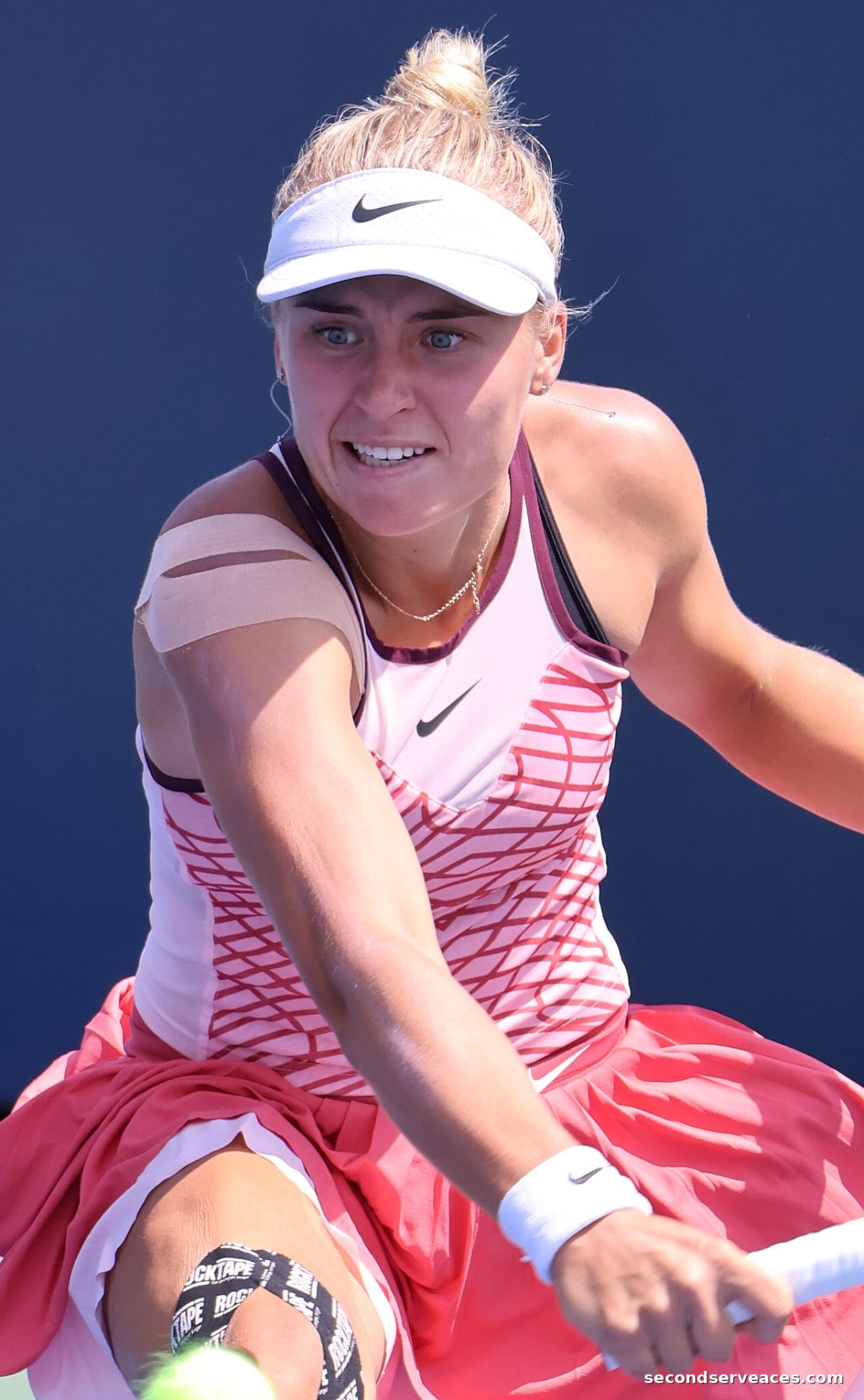
Day two of the WTA Toronto tournament features a highly dense slate of 16 matches on the fast Canadian hard courts. From a technical perspective, these courts reward low-interval ball-striking and high-efficiency serving. As players transition back to the hard-court surface, physical durability and historical matchups offer critical indicators for projected performance metrics.
Listen to the Second Serve Podcast
Get our daily AI-synthesized audio briefings and match reviews on the go.
Among the key storylines is Canadian veteran Carol Zhao, who received a main draw wildcard to play her home tournament in what is expected to be her final season on tour. Zhao will look to maximize her court positioning and home crowd support to offset her opponent's raw power. Meanwhile, several highly contested rivalries will dictate the flow of the early draw.
Analyzing Starodubtseva's Baseline Leverage and Return Metrics Against Joint
Yuliia Starodubtseva enters this opening-round match holding a distinct tactical edge, supported by the official WTA rankings where she currently sits at No. 62. Her aggressive baseline play relies on deep, heavy groundstrokes that consistently push opponents behind the baseline. By taking the ball early, Starodubtseva limits her opponent's recovery time, a crucial asset on the quick Toronto courts where court friction is minimal.
At just 20 years old, Maya Joint (No. 77) possesses immense talent, but her high-risk style occasionally suffers from unforced error clusters when forced into long rallies. In our previous analysis of emerging baseliners in the WTA Memphis analysis, we highlighted how defensive depth and variation in spin can disrupt young, flat-hitting prospects. Starodubtseva will likely deploy heavy topspin to Joint's backhand wing to break down the young Australian's rhythm and force errors.
Breaking Down the Hard-Court Matchup Dynamics
In other key matchups across the day-two schedule, Wang Xinyu holds a 2-1 head-to-head lead over Daria Kasatkina. Wang's flat groundstrokes allow her to penetrate Kasatkina's heavy topspin, especially on fast hard courts where the ball stays low. Kasatkina will need to elevate her first-serve percentage to prevent Wang from attacking the second serve and controlling the center of the court.
Additionally, Renata Zarazua holds a 1-0 head-to-head advantage over Tamara Korpatsch. Zarazua's counter-punching style and high-percentage court coverage match up exceptionally well against Korpatsch's aggressive but high-variance play. Zarazua's ability to extend rallies and force Korpatsch into extra shots will be the key metric to watch as this match progresses.
Rivalry Matchup & Player Profiles
The physical profiles of these two athletes are remarkably similar, with Starodubtseva standing at 5'6" and Joint at 5'5". However, the four-year age gap translates to a significant experience advantage for the 26-year-old Ukrainian, who has navigated deep draws across the ITF circuit before cementing her place on the main WTA Tour. Joint's rapid rise to No. 77 shows her immense raw talent, but Starodubtseva's tactical discipline has previously proven to be the deciding factor.
Joint's aggressive baseline style translates to immense kinetic energy on her forehand wing, but her defensive transition remains a work in progress. Starodubtseva's ability to absorb pace and redirect the ball down the line will test Joint's lateral movement and footwork efficiency over a best-of-three-set distance.
| Metric | Yuliia Starodubtseva | Maya Joint |
|---|---|---|
| Rank | No. 62 | No. 77 |
| Age | 26 | 20 |
| Country | Ukraine | Australia |
| Height | 5' 6" (1.72m) | 5' 5" (1.67m) |
| Handedness | Right-handed | Right-handed |
| Play Style | Aggressive baseliner | Aggressive baseliner |
| Career Titles | 4 ITF Singles, 3 ITF Doubles | 2 WTA Singles, 2 WTA Doubles |
Their only previous professional encounter took place on June 15, 2026, at the Lexus Nottingham Open. In that grass-court clash, Starodubtseva exhibited superior physical endurance to secure a 6-7(8), 7-5, 6-4 victory. While the surface in Toronto is hard court, the underlying tactical dynamics remain highly similar: Joint will look to dictate with her serve, while Starodubtseva will rely on her superior return depth to extend rallies and find the break point opportunities.
Analyze Yuliia Starodubtseva vs. Maya Joint
Predict tactical adjustments, momentum swings, and serve strategy options for this match-up using our AI simulator.
The Aces Tactical Panel
This report was curated and edited by Bhaskar Goel. Tactical analysis and technical insights were provided by our specialized panel of expert correspondents.
Julian Price
Senior Tactical Correspondent
Stuffy, pedantic British academic and historian specializing in match momentum and historical context.
Elena Cruz
Director of Analytical Research
Data scientist specializing in court surface physics and movement patterns.
Bhaskar
The Editor & Fan
Passionate tennis player and site editor bringing everyday amateur insights and relatable fan commentary.
Arthur Vance
Senior Existential Analyst
Deep, eccentric, and DFW-inspired. Models court metaphysics, kinetic beauty, and player psychology.
Leo Sterling
High-Performance Consultant
Hard-nosed ex-trainer from Melbourne with a no-nonsense view on tour fitness.
Related Reports
Quick Answers
Who leads the head-to-head record between Yuliia Starodubtseva and Maya Joint?+
Yuliia Starodubtseva leads the head-to-head series 1-0, following her three-set victory at Nottingham in 2026.
Which player received a main draw wildcard for the WTA Toronto tournament?+
Canadian player Carol Zhao received a main draw wildcard to compete in her home tournament during what is expected to be her final season on tour.
What is the head-to-head record between Wang Xinyu and Daria Kasatkina?+
Wang Xinyu leads her head-to-head matchup against Daria Kasatkina 2-1 entering their day two encounter.