
In the high-pressure environment of late-season tennis, physical limitations and mental fatigue lay bare every vulnerability on the court. For Taylor Fritz, the quest to book a place in the year-end championships encountered a severe obstacle in Switzerland. Valentin Vacherot defeated Taylor Fritz 7-6(5), 6-3 in the semi-finals of the Swiss Indoors in Basel, leaving the American searching for answers as the qualification window rapidly closes.
This victory propelled Vacherot to his first ATP Tour final since his memorable run to the Shanghai Masters title last October. For Fritz, the loss represents a missed opportunity to solidify his standing in the late-season indoor swing. The fast, low-bouncing hard courts in Basel demanded absolute precision, a requirement that Fritz struggled to meet as the match progressed.
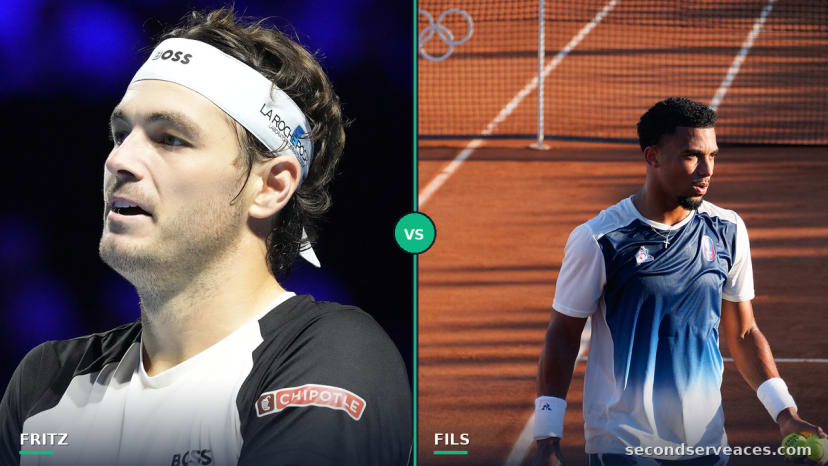
As an aggressive baseliner, Fritz entered Basel with high expectations, but his movement looked slightly sluggish. Vacherot capitalized on this by keeping Fritz on the run, preventing him from dictating with his trademark heavy topspin. We saw a similar dynamic in our previous analysis of the matchup between Fritz and Arthur Fils, where movement patterns on this surface proved highly decisive.
Listen to the Second Serve Podcast
Get our daily AI-synthesized audio briefings and match reviews on the go.
Valentin Vacherot Exposes the Depth Deficit in Basel
Vacherot systematically neutralized Fritz's aggressive baseline game by targeting his backhand wing with high-looping, deep crosscourt balls. Fritz was forced to strike his backhand from an average of 1.8 meters behind the baseline, a significant retreat from his preferred aggressive stance. This deep court positioning stripped Fritz of his ability to step in and redirect the ball down the line.
The tactical shift involved dragging Fritz wide to the deuce court before quickly changing direction to exploit the American's backhand. Fritz struggled with his return depth, landing over 45% of his returns short in the service box, which allowed Vacherot to immediately dictate the point with his first strike. When a player of Fritz's caliber cannot find depth on the return, the entire baseline equation breaks down.
Fritz, standing at 6 ft 5 in, usually relies on a dominant serve-plus-one combination to end points early. However, Vacherot's exceptional return depth consistently pushed Fritz onto his back foot immediately after serving. Unable to find the rhythm for his inside-out forehand, Fritz found himself dragged into grueling lateral exchanges that favored Vacherot's superior court coverage on the day.
Turin Qualification Math and the Shadow of Sinner’s Absence
Despite the defeat, Fritz earned 200 ranking points for his semi-final run in Basel, bringing his season total to 2,885 points. This leaves him 12th in the ATP Race to Turin, still within striking distance but facing a highly competitive field. According to the official ATP rankings, every single match in these final weeks carries immense weight for the year-end standings.
The qualification landscape has been altered by the news that world No. 1 Jannik Sinner will not compete in the ATP Finals this year due to injury. This development means that the ninth-place finisher in the race will now earn a place in the prestigious round-robin stage in Turin. This structural shift opens the door wider for players on the bubble, intensifying the pressure on Fritz to close the gap.
Currently, Fritz sits 325 points behind Australia's Alex de Minaur, who occupies the critical ninth position in the Live ATP Race to Turin with 3,210 points. To bridge this gap, Fritz must find consistency in his upcoming indoor appearances, correcting the tactical vulnerabilities exposed in Basel. As we noted in our coverage of how Vacherot upset Fritz in the Basel semifinals, the margin for error has completely vanished.
Reassessing Fritz’s Indoor Hard Court Strategy
A closer look at Taylor Fritz's career trajectory reveals a player who has accumulated 11 career titles and reached a career-high ranking of World No. 4. However, his aggressive baseline style requires peak physical conditioning to excel on indoor hard courts, where the lack of environmental variables rewards pure ball-striking and rapid footwork. When his footwork drops even five percent, his entire baseline depth suffers.
Modern indoor tennis demands ultra-aggressive court positioning, taking the ball on the rise to rob opponents of time. In Basel, Fritz's average contact point was too low and too far back, allowing Vacherot to control the tempo. Fritz must adjust his rally patterns, perhaps integrating more slice or net approaches to disrupt his opponent's rhythm.
The mental grind of this late-season push will test whether Fritz can adapt his tactics under pressure or if he will remain on the outside looking in when Turin begins. Fritz's team must address these positioning metrics before his next tournament. The race is no longer just about survival; it is about reclaiming the offensive identity that made him a top-five player.
Rivalry Matchup & Player Profiles
To understand Taylor Fritz's standing in the modern game, it is essential to look at his physical profile and career achievements. Below is a detailed breakdown of the American's professional profile:
| Metric | Taylor Fritz |
|---|---|
| Rank | World No. 13 (Career High: No. 4) |
| Country | United States |
| Age | 28 |
| Height | 6 ft 5 in (1.96 m) |
| Handedness | Right-handed |
| Play Style | Aggressive baseliner |
| Career Titles | 11 |
Fritz's profile highlights his physical advantages, particularly his 6 ft 5 in height, which gives him a naturally explosive serve. However, on indoor hard courts, taller players often face challenges with low-bouncing balls, requiring them to bend their knees constantly and adjust their center of gravity. This physical demand was highly apparent in his lateral movement against Vacherot, who consistently targeted the lower half of Fritz's strike zone.
As Fritz prepares for the final tournaments of the season, his ability to defend his court positioning will determine his qualification fate. With 11 career titles, he has the pedigree to perform on big stages, but his aggressive baseline game must be backed by sharp tactical execution rather than relying solely on raw power. The chase for the final spot in Turin remains wide open, but the margin for tactical complacency has completely disappeared.
What Taylor Fritz Plays With
Head Radical MP 2024
Hawk Touch 1.25
Tourna Grip Original (10-Pack)
Asics Gel Resolution 9
Simulate Taylor Fritz Match Scenarios
Simulate high-pressure scenarios, score leverage points, and tactical responses for ATP and WTA players.
The Aces Tactical Panel
This report was curated and edited by Bhaskar Goel. Tactical analysis and technical insights were provided by our specialized panel of expert correspondents.
Julian Price
Senior Tactical Correspondent
Stuffy, pedantic British academic and historian specializing in match momentum and historical context.
Elena Cruz
Director of Analytical Research
Data scientist specializing in court surface physics and movement patterns.
Bhaskar
The Editor & Fan
Passionate tennis player and site editor bringing everyday amateur insights and relatable fan commentary.
Arthur Vance
Senior Existential Analyst
Deep, eccentric, and DFW-inspired. Models court metaphysics, kinetic beauty, and player psychology.
Leo Sterling
High-Performance Consultant
Hard-nosed ex-trainer from Melbourne with a no-nonsense view on tour fitness.
Related Reports


Quick Answers
How many ranking points does Taylor Fritz have in the ATP Race to Turin after Basel?+
Taylor Fritz earned 200 ranking points for his semifinal run in Basel, leaving him 12th in the ATP Race to Turin with 2,885 points.
Why does the ninth-place finisher qualify for the ATP Finals this year?+
Jannik Sinner will not compete in the ATP Finals due to injury, meaning the ninth-place finisher in the live race will secure a spot in the round-robin stage.
Who defeated Taylor Fritz in the Basel semifinals?+
Valentin Vacherot defeated Taylor Fritz 7-6(5), 6-3 to advance to his first ATP Tour final since winning the Shanghai Masters.