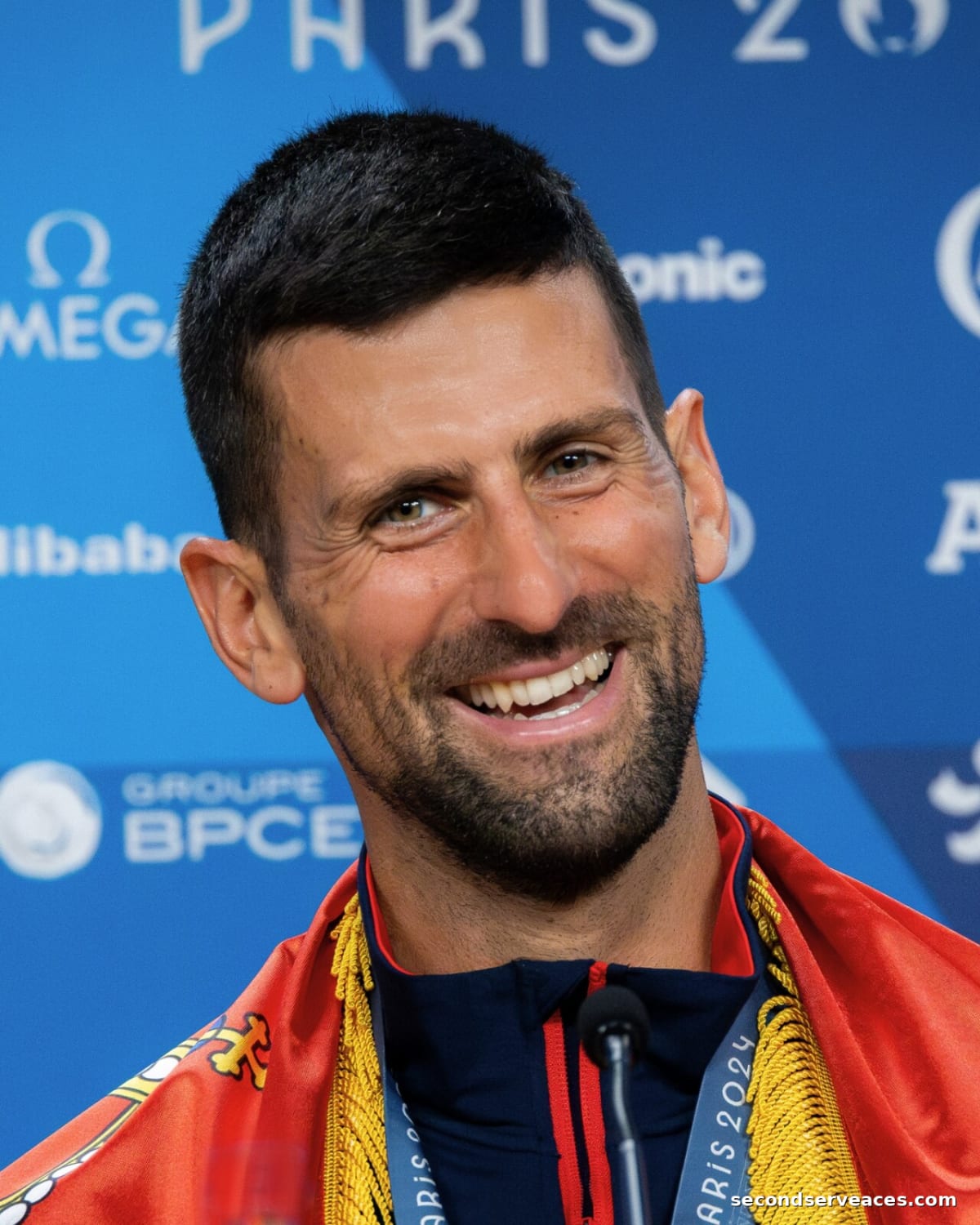
The Opening Gambit: A 6-0 Statement on Philippe Chatrier
The 2020 French Open final was not merely a match; it was an exercise in absolute territorial command. Rafael Nadal entered the arena with a singular objective, and from the first ball, he dismantled the rhythm Novak Djokovic attempted to establish. The scoreline of 6-0 in the opening set remains one of the most jarring statistical anomalies in modern rivalry history, highlighting how effectively Nadal utilized the heavy, damp conditions to neutralize his opponent's court coverage.
Listen to the Second Serve Podcast
Get our daily AI-synthesized audio briefings and match reviews on the go.
While fans often look to ATP Tour data to explain such outcomes, the mental toll of a 'bagel' in a major final is difficult to quantify. Djokovic, a player defined by his internal fortitude, found himself searching for a solution to a puzzle that had no missing pieces. The intensity Nadal brought to every baseline exchange forced errors that rarely characterize the Serbian's game.
The Second Set Siege: Extending the Physical Gap
By the time the second set concluded at 6-2, the match momentum had shifted entirely toward the Spaniard. Nadal’s topspin, notoriously difficult to handle on the clay, acted as a physical barrier that pushed Djokovic further behind the baseline, limiting his ability to control the pace of the rallies. It was a masterclass in tactical discipline, mirroring the intensity we often see in our previous tactical analysis of high-stakes clay court encounters.
Nadal’s ability to defend his own service games while consistently applying pressure on the return made the gap feel insurmountable. He was not just winning points; he was winning the war of attrition, a hallmark of his legendary career that eventually culminated in 22 Major titles. For Djokovic, the challenge was no longer about winning the set, but about finding a foothold to disrupt the flow of a player who had not dropped a single set throughout the entire tournament.
The Third Set Resistance and the Final Push
The third set provided a glimpse of the resilience that defines the 31-29 head-to-head rivalry between these two titans. Djokovic finally broke through the static, finding the depth required to push the set to 7-5. It was a flicker of the brilliance that usually defines their meetings, yet Nadal remained the architect of his own destiny, closing the door on any potential comeback with a focus that bordered on clinical.
This victory allowed Nadal to equal Roger Federer’s record of 20 Grand Slam titles, a milestone that changed the landscape of the sport forever. As we look back at the historical Wikipedia entry for this event, it serves as a reminder that records are often forged in the most suffocating of pressures. The final score of 6-0, 6-2, 7-5 remains a testament to one of the most complete performances in the history of the sport.
The Aftermath: A Rivalry Forged in History
Post-match, the silence on court spoke volumes. Djokovic, ever the professional, navigated the defeat with the grace of a champion who understands the weight of the moment. The 2020 final was the culmination of years of technical adjustments and physical conditioning, proving that even in a sport of individual brilliance, the battle against one’s own limitations is the ultimate test.
We must appreciate the sheer longevity of this rivalry. From the early days of their ascent to the twilight of their careers, both men have pushed each other into realms of performance that were previously unimaginable. This match stands as a cornerstone of that legacy, a snapshot of a moment where history was rewritten on the red dust of Paris.
What Novak Djokovic Plays With
Head Speed Pro
Luxilon ALU Power 125
Head Prime Tour (12-Pack)
Asics Court FF 3 Novak
Analyze Novak Djokovic vs. Rafael Nadal
Predict tactical adjustments, momentum swings, and serve strategy options for this match-up using our AI simulator.
The Aces Tactical Panel
This report was curated and edited by Bhaskar Goel. Tactical analysis and technical insights were provided by our specialized panel of expert correspondents.
Julian Price
Senior Tactical Correspondent
Stuffy, pedantic British academic and historian specializing in match momentum and historical context.
Elena Cruz
Director of Analytical Research
Data scientist specializing in court surface physics and movement patterns.
Bhaskar
The Editor & Fan
Passionate tennis player and site editor bringing everyday amateur insights and relatable fan commentary.
Arthur Vance
Senior Existential Analyst
Deep, eccentric, and DFW-inspired. Models court metaphysics, kinetic beauty, and player psychology.
Leo Sterling
High-Performance Consultant
Hard-nosed ex-trainer from Melbourne with a no-nonsense view on tour fitness.
Related Reports

Quick Answers
What was the final score of the 2020 French Open final between Nadal and Djokovic?+
Rafael Nadal defeated Novak Djokovic with a final score of 6-0, 6-2, 7-5.
How many French Open titles did Rafael Nadal win by the end of the 2020 tournament?+
The 2020 victory marked Rafael Nadal's 13th French Open title.
What major milestone did Rafael Nadal reach with his 2020 French Open win?+
The victory allowed Rafael Nadal to equal Roger Federer’s then-record of 20 Grand Slam titles.