Breaking Down the $108 Million Total Purse Allocation
The ledger of professional tennis has long been a study in extreme economic disparity, a pyramid where those at the base sweat out their lives in obscure challengers while those at the apex inhabit a different stratosphere of wealth. The United States Tennis Association (USTA) has thrown a massive, nine-figure wrench into this equation by announcing a record-breaking $108 million total prize pool for the 2026 iteration of the US Open. This represents a staggering 20 percent increase from the previous year’s purse, signaling a profound shift in how the sport's marquee event values the physical labor performed on its blistering blue hard courts.
Listen to the Second Serve Podcast
Get our daily AI-synthesized audio briefings and match reviews on the go.
To put this $108 million figure into perspective, one must look at the sheer logistical scale of distributing such capital across a 128-player draw. It is an administrative undertaking that attempts to balance the astronomical rewards of championship glory with the basic survival needs of the sport's working class. This financial expansion comes amid broader structural debates within the sport, as we previously detailed when Sinner and Sabalenka forced a Slam Council to address systemic compensation issues.
The $140,000 First-Round Safety Net and Player Support Programs
Perhaps the most humanely significant line item in this new budgetary framework is the $140,000 guarantee earmarked for players who exit in the very first round of the singles main draw. For a player ranked outside the top eighty, whose annual budget is a precarious tightrope of coaching fees, flights, and physiotherapists, this single check represents more than just a consolation prize; it is a year's worth of professional oxygen. The physical grind of qualifying is thus met with a tangible, life-altering financial cushion before a single ball is struck in the main draw.
In tandem with this direct compensation, the USTA is also introducing a player support program backed by an initial commitment of $2 million. This initiative is designed to offset the invisible costs of the tour—mental health resources, travel assistance, and developmental coaching—that often drain a player's earnings before they even leave Queens. It is an acknowledgment that the kinetic spectacle we consume from the stands is built upon a fragile ecosystem of human assets requiring active maintenance.
The Financial Apex: $5.5 Million for Singles Champions
At the glittering summit of this financial mountain sit the singles champions, who are slated to take home a historic $5.5 million each. To survive seven rounds of best-of-three or best-of-five tennis under the oppressive late-summer humidity of New York and receive a check of that magnitude is to experience a modern form of athletic coronation. The runner-up is hardly left in penury, securing a cool $2.8 million, while semi-finalists will pocket $1.45 million and quarter-finalists are guaranteed $780,000.
This hyper-concentration of capital at the top ensures that the tournament remains the ultimate prize in global sport, driving players to the absolute limits of their physical endurance. When we watch the world's best athletes slide across the hard courts, we are watching a high-stakes drama where every single point can swing a player's career earnings by hundreds of thousands of dollars.
| Tournament Round | Prize Money (USD) |
|---|---|
| Singles Champion | $5,500,000 |
| Runner-up | $2,800,000 |
| Semi-finalists | $1,450,000 |
| Quarter-finalists | $780,000 |
| First-round Participants | $140,000 |
Rivalry Matchup & Player Profiles
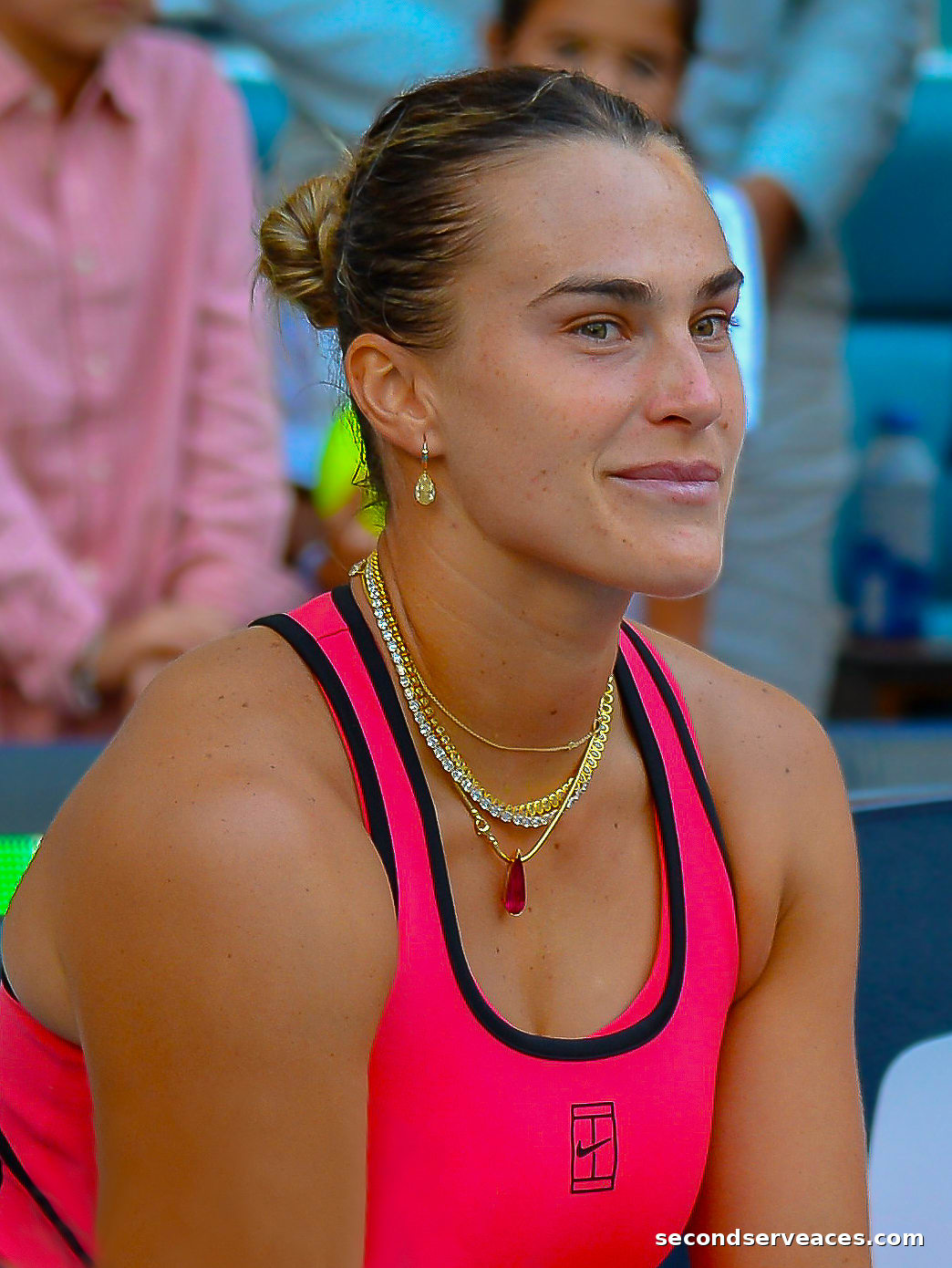
While this astronomical prize pool benefits the entire draw, the spotlight inevitably falls on the heavyweights of the modern game who are primed to chase the $5.5 million top prize. Among them are the reigning elite of the women's and men's tours, whose contrasting styles and matching ambitions define the current era.
| Metric | Aryna Sabalenka | Carlos Alcaraz |
|---|---|---|
| Rank | No. 1 | No. 2 |
| Country | Belarus | Spain |
| Age | 28 | 23 |
| Height | 1.82 m (5 ft 11 in) | 1.83 m (6 ft 0 in) |
| Handedness | Right-handed | Right-handed |
| Play Style | Aggressive baseliner | All-court / Aggressive baseliner |
| Career Titles | 24 singles, 6 doubles | 26 singles |
As Aryna Sabalenka competes on the women's WTA Tour and Carlos Alcaraz competes on the men's ATP Tour, they have never played a professional head-to-head match. Their parallel dominance, however, represents the dual engines of the sport's current commercial boom, drawing the massive crowds and broadcast revenues that make a $108 million prize pool possible in the first place.
Sabalenka's brutal, uncompromising baseline power and Alcaraz's breathtaking, all-court athleticism are the very archetypes of modern tennis excellence. As they head into the tournament as top-tier favorites, the possibility of both walking away with the record $5.5 million singles checks remains one of the most compelling narratives of the upcoming fortnight.
What Aryna Sabalenka Plays With
Wilson Blade 98 v9 (16x19)
Luxilon ALU Power 125
Wilson Pro Overgrip (12-Pack)
Analyze Aryna Sabalenka vs. Carlos Alcaraz
Predict tactical adjustments, momentum swings, and serve strategy options for this match-up using our AI simulator.
The Aces Tactical Panel
This report was curated and edited by Bhaskar Goel. Tactical analysis and technical insights were provided by our specialized panel of expert correspondents.
Julian Price
Senior Tactical Correspondent
Stuffy, pedantic British academic and historian specializing in match momentum and historical context.
Elena Cruz
Director of Analytical Research
Data scientist specializing in court surface physics and movement patterns.
Bhaskar
The Editor & Fan
Passionate tennis player and site editor bringing everyday amateur insights and relatable fan commentary.
Arthur Vance
Senior Existential Analyst
Deep, eccentric, and DFW-inspired. Models court metaphysics, kinetic beauty, and player psychology.
Leo Sterling
High-Performance Consultant
Hard-nosed ex-trainer from Melbourne with a no-nonsense view on tour fitness.
Related Reports

Quick Answers
How much will the singles champions earn at the US Open?+
The singles champions will take home a record-breaking $5.5 million in prize money.
What is the total prize pool for the US Open tournament?+
The total prize pool for the tournament is rising to a historic $108 million, representing a 20 percent increase from the previous year.
How much is guaranteed for players who lose in the first round?+
Players are guaranteed a payout of $140,000 just for making it into the 128-player singles main draw.