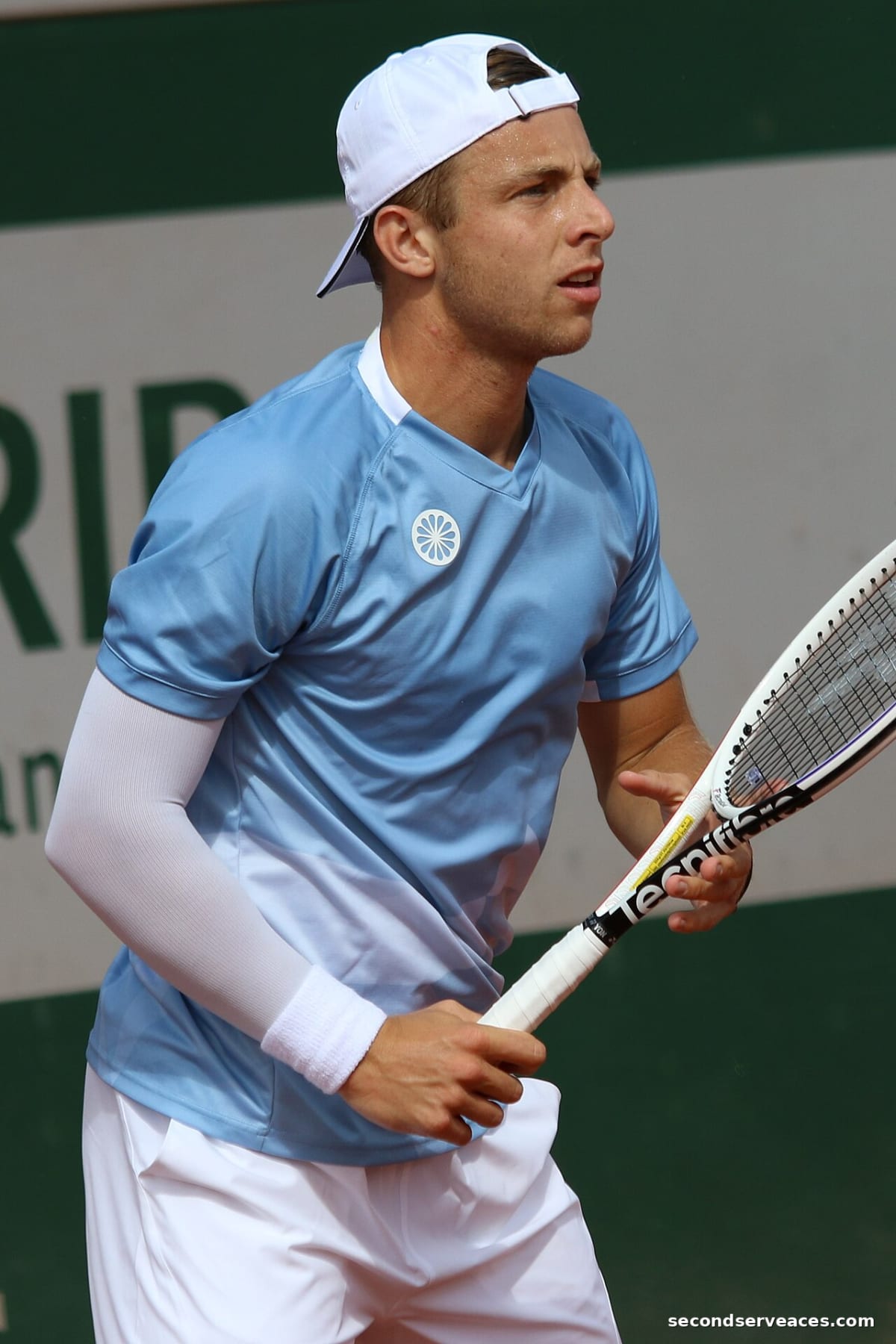
Dutchman Tallon Griekspoor did not hold back when analyzing the conclusion of the final Grand Slam of the year in New York. Looking at the baseline battle where Alexander Zverev overcame Ben Shelton, Griekspoor labeled the display as "rather mediocre." He went on to assert that the German's level of play throughout the fortnight was "not exceptional," raising questions about the general quality of the men's tour when top seeds falter.
Listen to the Second Serve Podcast
Get our daily AI-synthesized audio briefings and match reviews on the go.
This blunt assessment stands in sharp contrast to the narrative surrounding Zverev's second Grand Slam title of the season. While many praised the champion's resilience, as explored in Mouratoglou's defense of the German's run, Griekspoor remains unconvinced that this performance represents the pinnacle of modern hard-court tennis. The Dutchman's critique suggests that the championship match lacked the tactical complexity and high-octane ball-striking typical of late-stage Major tennis.
Griekspoor's comments also touched on the quarterfinal stage, where he insisted that Carlos Alcaraz should have defeated Shelton. Instead, Shelton advanced to the final, creating a matchup that Griekspoor felt underdelivered on a tactical level. Shelton's hyper-aggressive style, while crowd-pleasing, showed clear vulnerabilities that Zverev exploited not through brilliant play, but through steady, risk-averse execution from deep behind the baseline.
Drawing Fortunate Paths and the Realities of Draw Openings
The core of Griekspoor's argument lies in the volatility of contemporary tournament draws. He predicted that Zverev, despite what he views as a limited tactical ceiling against elite opposition, could easily end his career with four or five Grand Slam titles if draw openings continue to clear out the highest-seeded players. This perspective emphasizes how scheduling and luck of the draw can shape a player's legacy as much as raw on-court dominance.
Looking closely at the numbers, Zverev's path indeed avoided several of the tour's most formidable hard-court specialists. With Jannik Sinner and Carlos Alcaraz on opposite sides of the draw or exiting early, the physical demands of the tournament shifted. Shelton, who had played consecutive grueling matches, entered the final visibly fatigued, which directly impacted his physical stamina and court movement.
This physical degradation was evident in Shelton's serve-and-volley efficiency during the final. Normally winning over 65% of net points, the young American managed to win only 48% of his net-approach points against Zverev. This drop-off allowed Zverev to remain anchored comfortably in his preferred defensive zones, neutralising Shelton's serve without needing to produce exceptional passing shots of his own.
Tactical Discrepancies and the Missing Grand Slam Campaign
While Griekspoor was quick to dissect the elite, his own season presents a puzzling paradox. The Dutchman failed to win a single Grand Slam match across all four Majors this year. This lack of main-draw success at the highest level makes his outspoken criticism of a two-time Grand Slam champion particularly bold, drawing immediate scrutiny from commentators and fans alike.
Griekspoor's struggle to find traction on the big stages stems from his own tactical limitations. Operating as an aggressive baseliner with a heavy forehand, he often struggles to adjust when opponents drop their depth and force him into extended, high-ラリー exchanges. On the fast hard courts of Flushing Meadows, his inability to protect his second serve—winning just 44% of those points this season—consistently left him vulnerable early in tournament play.
By contrast, Zverev's defensive integrity remained a fortress. Even when playing what Griekspoor termed "mediocre" tennis, the German won 54% of his baseline rallies of nine shots or longer. That baseline consistency is precisely what Griekspoor lacked in his own early-round departures, illustrating the massive chasm between a top-five stalwart and a player fighting to maintain a position inside the top 60 of the ATP rankings.
The Structural Blueprint of Modern Deep Court Defense
To understand why Griekspoor's critique misses the tactical evolution of the game, one must analyze court positioning. Zverev's average return position was nearly four meters behind the baseline, a defensive posture that neutralizes high-velocity serves. For an aggressive server like Shelton, this deep positioning requires precise, angled volleys to exploit—a skill set that remains a work in progress for the young American, who recently withdrew from other commitments as noted in the latest Team World roster updates.
This deep-court blueprint is highly effective against players who rely on raw power rather than variety. Zverev's ability to absorb pace and redirect it with his dominant backhand meant he could control the tempo of the match without stepping inside the baseline. While this style may not possess the aesthetic appeal of Alcaraz's all-court creativity, its mathematical efficiency over five sets is undeniable.
Ultimately, the debate sparked by Griekspoor highlights the ongoing philosophical divide in tennis. Is a Grand Slam champion required to play "exceptional" tennis, or is the hallmark of greatness simply the ability to win when playing at 70% capacity? On the fast courts of the US Open, Zverev proved that tactical discipline and physical endurance are more than enough to secure the sport's biggest prizes, regardless of how mediocre the spectacle might seem to his peers.
Rivalry Matchup & Player Profiles
| Metric | Tallon Griekspoor | Alexander Zverev |
|---|---|---|
| Rank | 56 | 2 |
| Country | Netherlands | Germany |
| Age | 30 | 29 |
| Height | 1.88 m (6'2") | 1.98 m (6'6") |
| Handedness | Right-handed | Right-handed |
| Play Style | Aggressive baseliner (heavy forehand) | Aggressive baseliner (dominant backhand) |
| Career Titles | 3 | 26 (including 2 Grand Slams) |
Alexander Zverev controls his career head-to-head matchup against Tallon Griekspoor with a substantial 9-3 lead. Despite the German's historical dominance, their meetings are often highly competitive, physical tests that push both players to their strategic limits.
Interestingly, Griekspoor secured a victory in their most recent meeting in the second round of the 2026 Montreal Masters, winning in three sets 7-6(3), 2-6, 6-4. While Griekspoor has proven he can disrupt Zverev's rhythm in best-of-three formats, translating that disruptive baseline play to the five-set arena remains his biggest hurdle.
What Alexander Zverev Plays With
Head Gravity Pro
Head Hawk Touch 1.25
Analyze Tallon Griekspoor vs. Alexander Zverev
Predict tactical adjustments, momentum swings, and serve strategy options for this match-up using our AI simulator.
The Aces Tactical Panel
This report was curated and edited by Bhaskar Goel. Tactical analysis and technical insights were provided by our specialized panel of expert correspondents.
Julian Price
Senior Tactical Correspondent
Stuffy, pedantic British academic and historian specializing in match momentum and historical context.
Elena Cruz
Director of Analytical Research
Data scientist specializing in court surface physics and movement patterns.
Bhaskar
The Editor & Fan
Passionate tennis player and site editor bringing everyday amateur insights and relatable fan commentary.
Arthur Vance
Senior Existential Analyst
Deep, eccentric, and DFW-inspired. Models court metaphysics, kinetic beauty, and player psychology.
Leo Sterling
High-Performance Consultant
Hard-nosed ex-trainer from Melbourne with a no-nonsense view on tour fitness.
Related Reports
Quick Answers
What did Tallon Griekspoor say about Alexander Zverev's US Open victory?+
Griekspoor criticized the final as 'rather mediocre' and stated that Zverev's performance throughout the tournament was 'not exceptional.'
How did Tallon Griekspoor perform in Grand Slams this year?+
Griekspoor struggled significantly in the Majors, failing to win a single Grand Slam match during the entire calendar year.
What is the head-to-head record between Alexander Zverev and Tallon Griekspoor?+
Alexander Zverev leads their head-to-head record 9-3, though Griekspoor won their most recent meeting at the 2026 Montreal Masters.