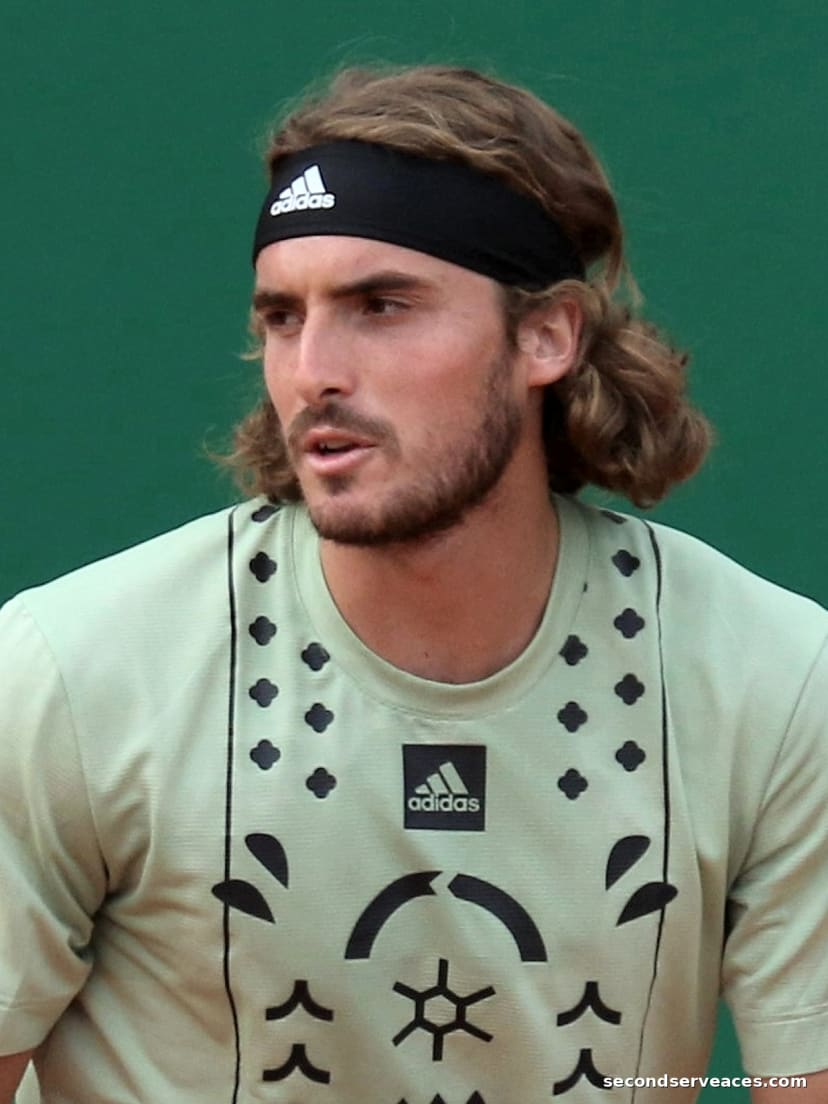
Professional tennis, when observed closely, is essentially a high-speed argument about physics. On the sweltering, medium-paced hard courts of South Florida, that argument becomes an exercise in fluid dynamics and friction. The heavy, humid air of the Miami Open slows the ball just enough to reward players who can artificially inject life into the felt through rotational force. It is within this atmospheric pressure cooker that Stefanos Tsitsipas orchestrated a striking second-round upset, dismissing fifth seed Alex de Minaur in straight sets with a resolute 6-3, 7-6 victory.
Listen to the Second Serve Podcast
Get our daily AI-synthesized audio briefings and match reviews on the go.
What transpired on the stadium court was not merely a physical contest, but a highly sophisticated tactical dialogue. Tsitsipas, whose tournament began with a straightforward opening-round victory over Britain's Arthur Fery, stepped onto the court against the Australian armed with a highly specific spatial game plan. De Minaur is an entirely different biomechanical puzzle compared to Fery; he is a player who treats the court like a geometric grid, relentlessly running down balls that possess no business being retrieved.
Beating the fifth seed requires more than merely hitting through the court—it demands a sort of trigonometric patience. It requires a willingness to engage in the grind and an understanding of when to pull the trigger. The Greek navigated this intricate balance perfectly, securing the first set with assertive baseline positioning before surviving a second-set crucible that demanded total psychological clarity.
The Tactical Breakdown
Historically, analyzing a match involving a fleet-footed counter-puncher like De Minaur reveals a predictable pattern: opponents often beat themselves. The Australian thrives on absorbing pace, redirecting flat strikes, and forcing his adversary to hit three or four extra balls per rally until their lungs burn and their discipline fractures. To dismantle this human backboard, Tsitsipas had to rely on the weight of his shot rather than pure, linear velocity.
There is a specific kinetic reality to the Tsitsipas forehand. It is less of a traditional strike and more of an event—a sweeping, parabolic swing path that generates vicious RPMs. This was the primary weapon utilized to deconstruct the De Minaur defense.
- The Friction of Topspin: By imparting massive topspin on his forehand, Tsitsipas forced the ball to kick viciously off the Miami hard court, consistently pushing De Minaur out of his comfort zone. The Australian prefers the ball waist-high, where he can punch through it flatly; Tsitsipas ensured the ball lived up near his opponent's shoulders.
- Controlling Match Momentum: Tennis is uniquely cruel in its scoring structure, where momentum can pivot on a single, seemingly innocuous rally. During the critical junctures of the second set, Tsitsipas utilized his heavy spin to dictate the tempo, actively refusing to let De Minaur groove his preferred, rhythmic baseline patterns.
- Navigating the Break Point: Facing a break point against a top-tier retriever is a psychological minefield. The Greek player managed these high-stress variables by executing precise serve-plus-one combinations, frequently targeting the De Minaur forehand out wide to open up the ad-court for a subsequent down-the-line put-away.
Furthermore, we must address the vulnerability and intermittent brilliance of the Tsitsipas one-handed backhand. Against a flat-hitter, a one-hander can easily be rushed, resulting in short, floating slices. Yet, in this matchup, Tsitsipas utilized his backhand slice not as a defensive bailout, but as a tactical change-up. By feeding De Minaur low, skidding balls, he denied the Australian the raw pace he so desperately craves to fuel his own counter-attacks.
The Bigger Picture
Looking at the broader landscape of the ATP Tour, this result carries significant existential weight. For a player of Tsitsipas's caliber—a former ATP Finals champion and multiple-time Grand Slam finalist—defeating the tournament's fifth seed is a critical recalibration. It serves as a stark reminder of his ceiling when his tactical execution aligns with his undeniable physical gifts.
Consider the trajectory of both men. Alex de Minaur has arguably been playing the most composed, high-level tennis of his career, earning that top-five seeding through sheer consistency and an evolved offensive mindset. Defeating him requires navigating a physical and mental gauntlet. For Tsitsipas to accomplish this in straight sets, particularly on a North American hard court rather than his preferred European red clay, indicates a supreme level of focus.
As the tennis calendar marches inevitably toward the European dirt, the Miami Open often serves as a transitional barometer. The heavy conditions in South Florida closely mimic the physical demands of the upcoming spring circuit. A victory of this magnitude—combining rotational dominance with baseline endurance—suggests that Tsitsipas is refining his physical conditioning and shot tolerance at exactly the right moment in the season.
Ultimately, the 6-3, 7-6 scoreline tells a story of two distinct halves. The first set was an exhibition of boundary-setting, with Tsitsipas establishing the heavy, spinning terms of engagement. The second set, culminating in the tiebreak, was an exercise in risk management and nerve. The Greek player refused to blink, executing his high-margin, heavy-spin blueprint all the way to the final handshake. In the humid theater of professional tennis, geometry and grit remain the ultimate arbiters of victory.
What Stefanos Tsitsipas Plays With
Wilson Blade 98 v9
Luxilon 4G 125
Wilson Pro Overgrip (12-Pack)
Analyze Stefanos Tsitsipas vs. Alex de Minaur
Predict tactical adjustments, momentum swings, and serve strategy options for this match-up using our AI simulator.
The Aces Tactical Panel
This report was curated and edited by Bhaskar Goel. Tactical analysis and technical insights were provided by our specialized panel of expert correspondents.
Julian Price
Senior Tactical Correspondent
Stuffy, pedantic British academic and historian specializing in match momentum and historical context.
Elena Cruz
Director of Analytical Research
Data scientist specializing in court surface physics and movement patterns.
Bhaskar
The Editor & Fan
Passionate tennis player and site editor bringing everyday amateur insights and relatable fan commentary.
Arthur Vance
Senior Existential Analyst
Deep, eccentric, and DFW-inspired. Models court metaphysics, kinetic beauty, and player psychology.
Leo Sterling
High-Performance Consultant
Hard-nosed ex-trainer from Melbourne with a no-nonsense view on tour fitness.