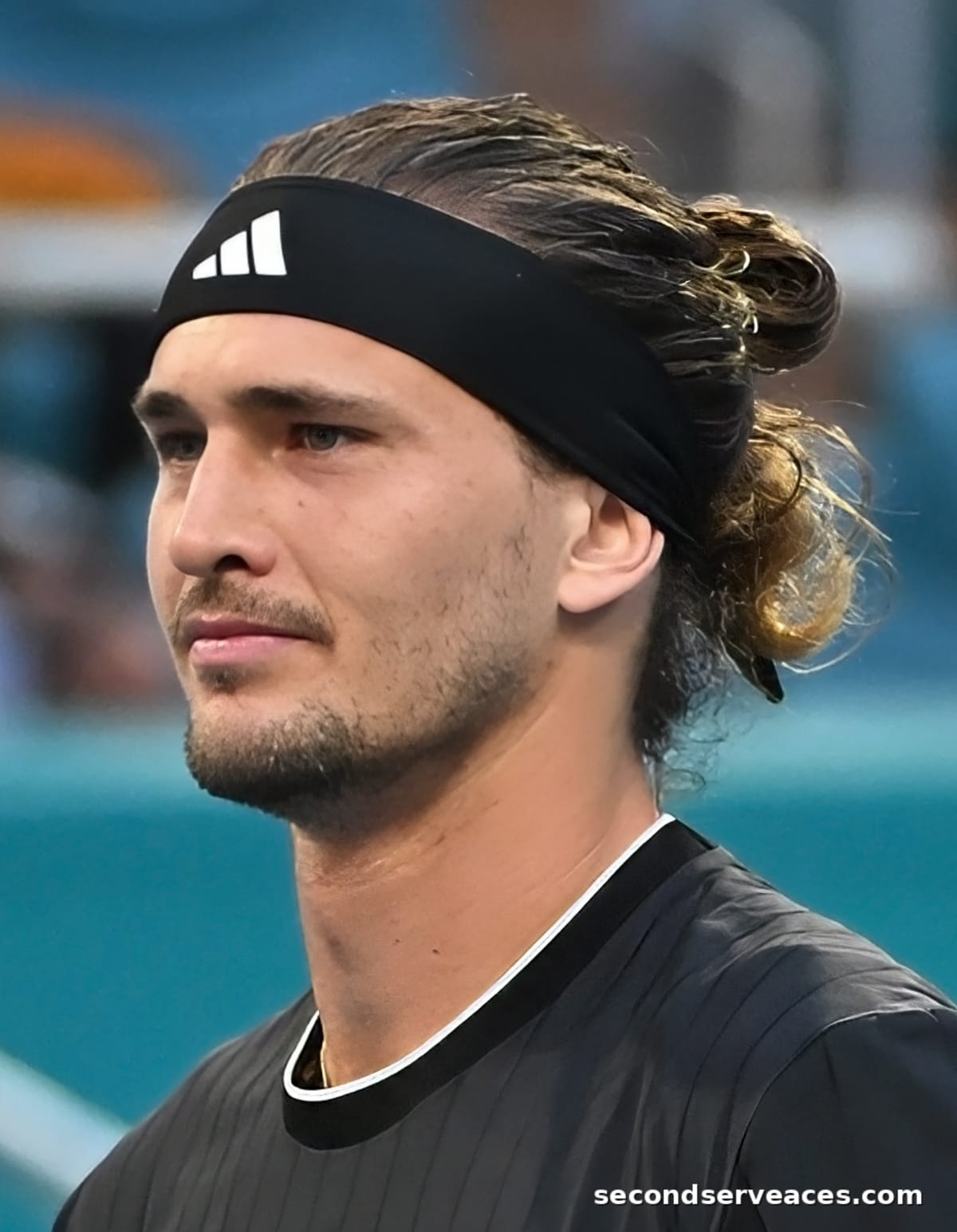
In the late-summer heat of 2024, Alexander Zverev stood on the blue concrete of Arthur Ashe Stadium, watching Taylor Fritz dictate play with flat, punishing groundstrokes. That quarter-final defeat—settled by a final, agonizing score of 7-6, 3-6, 6-4, 7-6—was more than a mere exit; it was a tactical indictment. Zverev’s tendency to retreat into a deep, defensive shell behind the baseline during critical moments was laid bare on the sport's biggest stage.
Listen to the Second Serve Podcast
Get our daily AI-synthesized audio briefings and match reviews on the go.
1. The Catalyst of the 2024 Flushing Meadows Collapse
The aftermath of that 2024 defeat became the framework for Zverev's modern evolution. For years, the knock on the towering German was not his physical talent, but his strategic passivity under pressure. Standing at 1.98 meters, possessing one of the most fearsome first serves in the game, he would inexplicably retreat five meters behind the baseline when the tension mounted, turning what should have been an offensive onslaught into a desperate defensive exercise.
This passive posture drew sharp criticism from the upper echelons of the sport. Ahead of the Laver Cup two years ago, none other than Roger Federer publicly dissected Zverev's structural flaws, pointing out that the German giant played far too defensively when the stakes were highest. Federer's critique was not born of malice, but of a purist's frustration at seeing such immense physical gifts underutilized in decisive moments.
2. Melburnian Roadblocks and the Search for Assertiveness
The quest to shed this defensive reputation faced further trial on the hard courts of the southern hemisphere. At the 2026 Australian Open, Zverev’s campaign ended in the semi-finals at the hands of Carlos Alcaraz. It was another match where the tactical balance tipped against him, as Alcaraz’s variety and forward movement exposed the lingering hesitation in Zverev’s transitional game, forcing him to re-evaluate his baseline positioning.
To understand Zverev’s evolution, one must look at the technical adjustments made under pressure. According to the latest ATP rankings, Zverev has consistently occupied the upper tier of the sport, yet translating those ranking points into major silverware required a fundamental shift. He had to learn to step in, use his massive frame to hug the baseline, and trust his flat backhand to dictate the tempo of the rally.
3. The 2026 US Open Redemption Arc
Returning to the US Open in 2026, Zverev presented a radically different tactical profile. The passive, deep-court positioning that defined his previous campaigns was replaced by a proactive, aggressive baseline strategy. He wasn't just absorbing pace; he was creating it, utilizing his thunderous first serve to set up short ball opportunities that he ruthlessly dispatched.
This newfound aggression was put to the ultimate test in the final against Ben Shelton. The young American lefty, known for his explosive, high-octane style, brought raw physical power to the court. Yet, Zverev refused to be pushed back. Rather than letting Shelton dictate with his heavy forehand, Zverev stood his ground, engaging in high-speed, flat-hitting exchanges that neutralized the American's kinetic energy.
4. Sealing the Crown and Silencing the Doubters
The climax of the 2026 final saw Zverev execute his tactical game plan to perfection, securing a 6-3, 7-6, 5-7, 6-2 victory over Shelton. This triumph marked Zverev's second Grand Slam title of the season, cementing his status as a two-time major champion. The defensive passivity that Federer had once lamented was nowhere to be seen as Zverev served out the match with clinical, forward-moving precision.
While some analysts, as discussed in Patrick McEnroe's refusal to grant Big Three recognition, still debate Zverev's ultimate legacy, this victory represents a clear technical breakthrough. By conquering the very court where he suffered his 2024 heartbreak, Zverev proved that tactical evolution is indeed possible, even for a veteran of the tour.
Rivalry Matchup & Player Profiles
| Metric | Alexander Zverev | Ben Shelton |
|---|---|---|
| Rank | 2 | 4 |
| Age | 29 | 23 |
| Country | Germany | United States |
| Height | 1.98 m (6 ft 6 in) | 1.93 m (6 ft 4 in) |
| Handedness | Right-handed | Left-handed |
| Play Style | Aggressive baseliner | Aggressive all-court player |
| Career Titles | 26 | 7 |
The head-to-head matchup between these two aggressive ball-strikers has historically swung in favor of the German. Alexander Zverev commands a dominant 6-0 lead in their head-to-head series, a rivalry highlighted by his hard-fought four-set victory (6-3, 7-6, 5-7, 6-2) over Shelton to win the 2026 US Open final.
While Shelton's explosive left-handed serve and heavy forehand have troubled many on the tour, Zverev's precise backhand and improved court positioning have consistently allowed him to neutralize the American's raw power, making him the definitive hurdle for Shelton's rising career.
What Alexander Zverev Plays With
Head Gravity Pro
Head Hawk Touch 1.25
Analyze Alexander Zverev vs. Ben Shelton
Predict tactical adjustments, momentum swings, and serve strategy options for this match-up using our AI simulator.
The Aces Tactical Panel
This report was curated and edited by Bhaskar Goel. Tactical analysis and technical insights were provided by our specialized panel of expert correspondents.
Julian Price
Senior Tactical Correspondent
Stuffy, pedantic British academic and historian specializing in match momentum and historical context.
Elena Cruz
Director of Analytical Research
Data scientist specializing in court surface physics and movement patterns.
Bhaskar
The Editor & Fan
Passionate tennis player and site editor bringing everyday amateur insights and relatable fan commentary.
Arthur Vance
Senior Existential Analyst
Deep, eccentric, and DFW-inspired. Models court metaphysics, kinetic beauty, and player psychology.
Leo Sterling
High-Performance Consultant
Hard-nosed ex-trainer from Melbourne with a no-nonsense view on tour fitness.
Related Reports
Quick Answers
Who did Alexander Zverev defeat to win the US Open final?+
Alexander Zverev defeated Ben Shelton in a four-set battle (6-3, 7-6, 5-7, 6-2) to win the US Open final.
What was the score of Zverev's painful quarter-final loss at the 2024 US Open?+
Taylor Fritz defeated Alexander Zverev 7-6, 3-6, 6-4, 7-6 in the quarter-finals of the 2024 US Open.
What is Alexander Zverev's head-to-head record against Ben Shelton?+
Alexander Zverev holds a dominant 6-0 head-to-head record against Ben Shelton, including their final match at the 2026 US Open.