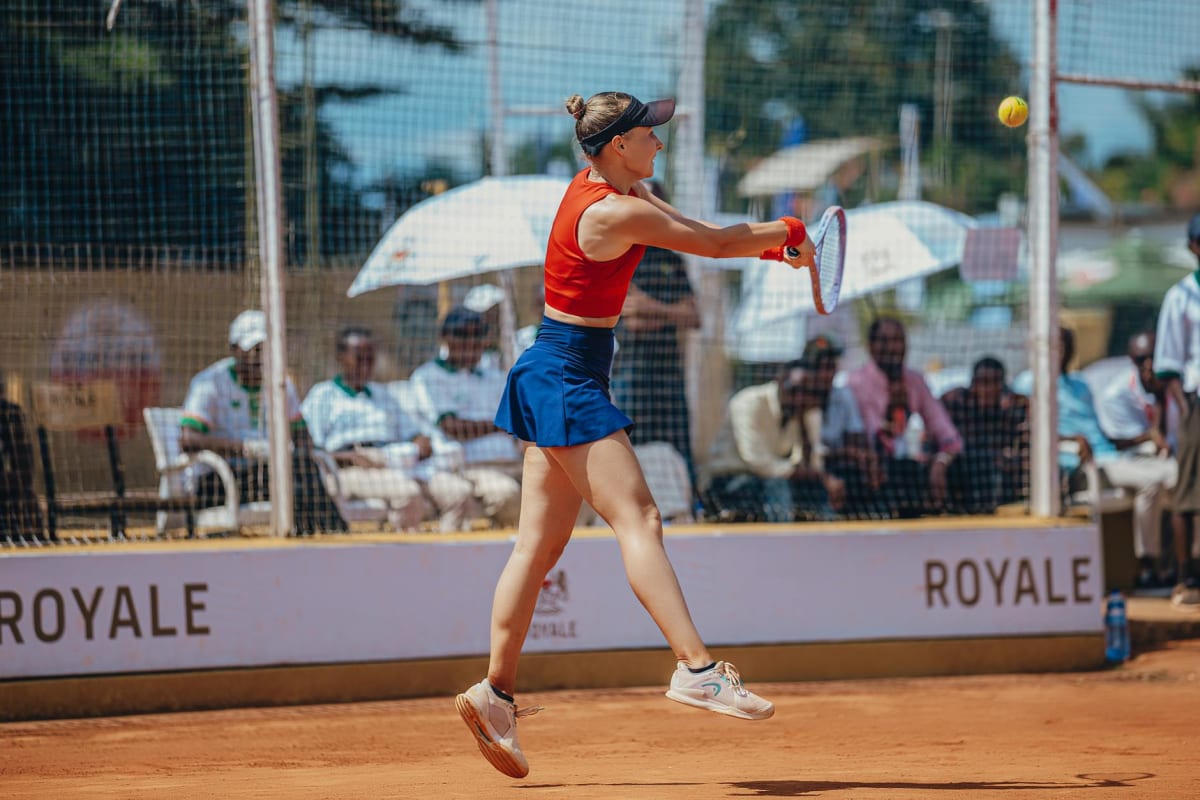
The Mirage of the Four-One Lead
There is a specific, suffocating quality to a lead in professional tennis—a sense that the outcome has been pre-written, provided one simply maintains the baseline rhythm. When Coco Gauff established a 4-1 advantage in the third set against Linda Noskova at the Madrid Open, the match appeared to be a mere formality of closure. Yet, the physical reality of clay—a surface that demands patience and precise geometric application—began to betray her.
Listen to the Second Serve Podcast
Get our daily AI-synthesized audio briefings and match reviews on the go.
The scoreline of 4-6, 6-1, 7-6(7-5) does not adequately convey the psychological migration that occurred once Gauff allowed the margin to narrow. The efficiency of her groundstrokes, typically calibrated to turn defense into offense with rapid topspin, began to lose its sharp edges. It is a peculiar phenomenon: leading by a double-break often encourages a player to play 'safe,' which on red clay is merely an invitation for an opponent like Noskova to reset the geometry.
In the wake of this defeat, observers like Rennae Stubbs have pointed toward the tactical rigidity Gauff displayed during the decisive moments. It was not a lack of output, but rather a lack of strategic flexibility that allowed the momentum to hemorrhage. When the WTA rankings update reflects her descent to the fourth position, it will be the empirical confirmation of a drift that began on the baseline in Madrid.
The Geometry of Clay and the Burden of Expectation
At 22 years old and holding 11 career titles, Gauff exists in a strange, elevated strata of the sport where every loss is scrutinized not as a tactical error, but as a crisis of identity. The WTA circuit is currently a theater of extreme volatility, where the difference between a championship run and a premature exit is often a matter of micro-adjustments in decision-making during high-leverage points.
Noskova’s ability to stabilize during the third-set tiebreak was a masterclass in controlled aggression. She forced Gauff into awkward court positions, removing the luxury of time that the American typically utilizes to reset her stance. When the ball hangs in the air on clay, it becomes an invitation for a winner; when it stays deep, it becomes a cage.
The exit from the Madrid draw represents a significant pivot point in the season. For a player who thrives on kinetic energy, the frustration visible during the latter stages of the match suggests that the mental labor of maintaining a top-tier ranking is beginning to weigh on the tactical execution. The transition to the Italian Open in Rome, where Gauff will benefit from a first-round bye, serves as a necessary, if urgent, reset.
A Necessary Re-calibration in Rome
The Italian Open offers a different set of atmospheric conditions—a slightly slower, more deliberate iteration of the clay-court game. For Gauff, the goal is not merely to win, but to reclaim the structural integrity of her service games, which were uncharacteristically porous under the pressure of Noskova's return game.
There is a dangerous tendency to view a loss as a singular failure of character, but the sport is far more mechanistic. It is about the friction of the string bed on the felt, the angle of the racquet head at impact, and the ability to ignore the scoreboard when the margins collapse. Gauff’s talent is undisputed, yet the tour remains indifferent to reputation.
As she enters the field in Rome, the silence of the bye week provides an opportunity for a technical deep-dive. One expects to see a return to the fundamentals—fewer erratic baseline exchanges and a more deliberate approach to managing the match momentum when the scoreline sits at that perilous 4-1 threshold.
The Architecture of the Next Serve
We are reminded, through the prism of this loss, that professional tennis is an endless iteration of the same movements, each slightly altered by the weight of previous points. The 4-6, 6-1, 7-6(7-5) result is merely a statistic, but the narrative remains: how does a player of Gauff's standing internalize the frustration of a surrendered lead?
The transition from Madrid to the broader European clay circuit requires a shift in focus. It is about the alchemy of transforming the frustration of a tiebreak defeat into a recalibrated baseline strategy. The game moves on, and with it, the necessity of forgetting the previous set while keeping the tactical lessons intact.
Looking ahead, the movement toward the later stages of the clay swing will demand a more ruthless application of court craft. If Gauff can translate her disappointment into a more precise, less reactive game plan, the current rankings drop may prove to be a localized atmospheric disturbance rather than a systemic trend.
What Coco Gauff Plays With
Head Boom MP 2024
Head Lynx Tour 1.25
Head Prime Tour (12-Pack)
Analyze Coco Gauff vs. Linda Noskova
Predict tactical adjustments, momentum swings, and serve strategy options for this match-up using our AI simulator.
The Aces Tactical Panel
This report was curated and edited by Bhaskar Goel. Tactical analysis and technical insights were provided by our specialized panel of expert correspondents.
Julian Price
Senior Tactical Correspondent
Stuffy, pedantic British academic and historian specializing in match momentum and historical context.
Elena Cruz
Director of Analytical Research
Data scientist specializing in court surface physics and movement patterns.
Bhaskar
The Editor & Fan
Passionate tennis player and site editor bringing everyday amateur insights and relatable fan commentary.
Arthur Vance
Senior Existential Analyst
Deep, eccentric, and DFW-inspired. Models court metaphysics, kinetic beauty, and player psychology.
Leo Sterling
High-Performance Consultant
Hard-nosed ex-trainer from Melbourne with a no-nonsense view on tour fitness.