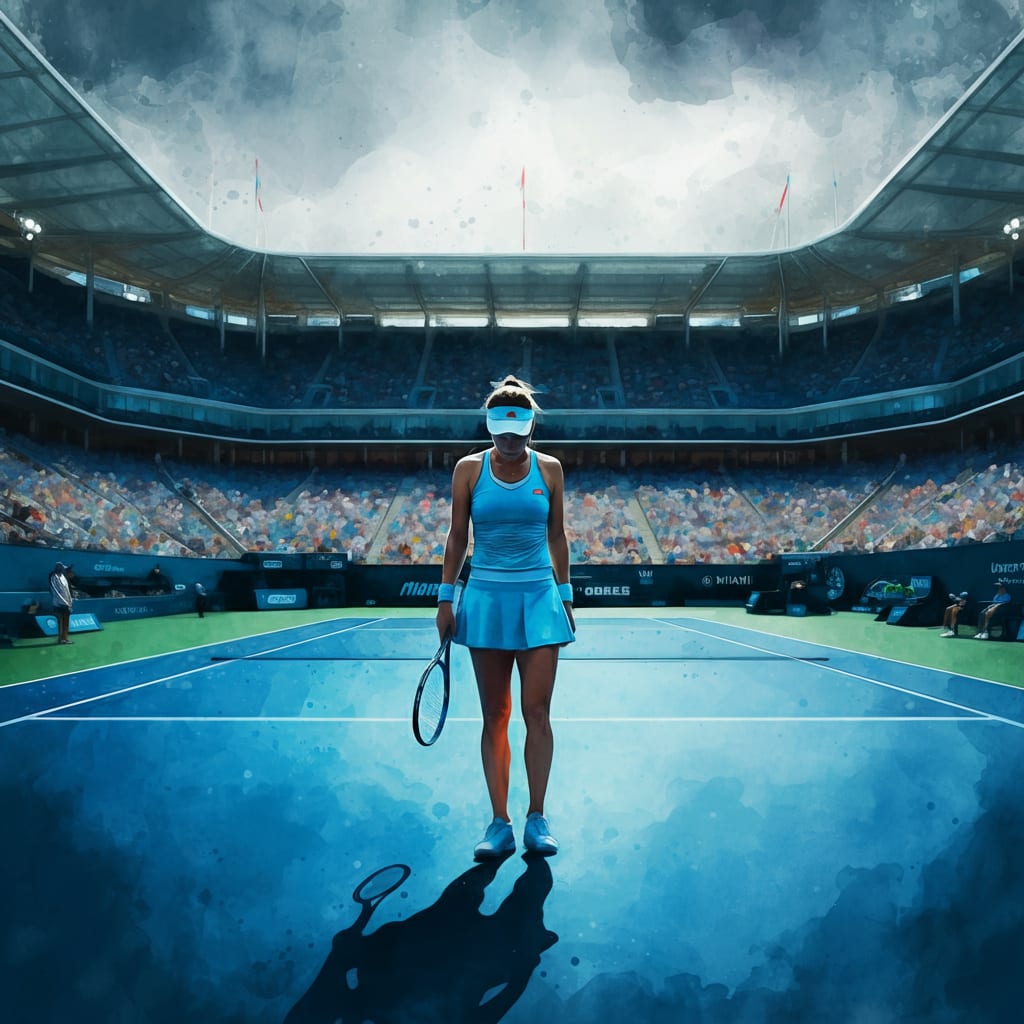
Beneath the suffocating, heavy humidity of South Florida, the geometry of a professional tennis court can suddenly feel less like a blank canvas and significantly more like a cage. This was the inescapable, claustrophobic reality for Naomi Osaka, who stepped onto the bright blue hardcourts of the Miami Open only to be summarily dismissed by 21-year-old Australian Talia Gibson, 7-5, 6-4. Entering the tournament as the 16th seed and enjoying the fleeting luxury of a first-round bye, Osaka’s opening foray was abruptly transformed into an uncomfortable meditation on her professional mortality.
Listen to the Second Serve Podcast
Get our daily AI-synthesized audio briefings and match reviews on the go.
A profound existential weight currently seems to be anchoring Osaka's racquet head. Following the straight-sets defeat, the four-time Grand Slam champion articulated a stark and deeply human "dilemma." With an almost startling candor, she plainly stated that she harbors no intention of continuing to compete if frequent first-round exits remain her kinetic reality. To hear an athlete of her historic caliber speak so openly of the psychic toll of losing is jarring, yet deeply emblematic of the modern game’s grueling psychological demands.
The melancholy, it should be noted, was not strictly confined to Osaka’s side of the draw on this particular afternoon. It proved to be a thoroughly bleak day for the British contingent as well, with Cameron Norrie, Katie Boulter, and Jones all seeing their Miami campaigns evaporate into the subtropical air. But while those exits represent the standard churn of the tour, Osaka’s defeat carries the distinct resonance of a paradigm shift.
The Tactical Breakdown
What precisely goes wrong when a generational ball-striker loses her moorings on a hardcourt? The architecture of Osaka’s game is built upon a foundation of overwhelming, first-strike baseline aggression—a philosophy of taking the ball breathtakingly early and removing oxygen from the opponent's side of the net. To strike a tennis ball with the sort of biblical violence that Osaka historically possesses requires an almost supernatural alignment of the kinetic chain, from the violent push-off of the foot to the whip of the wrist.
Facing an opponent with such devastating theoretical firepower, the tactical imperative for a rising talent like Gibson is not to out-hit, but to out-suffer. Historically, players who successfully dismantle hyper-aggressive baseliners do so by manipulating the Y-axis of the court—utilizing depth and heavy topspin to push the striker back, thereby extending the distance the ball must travel and elongating the reaction time. Gibson’s progression through this match likely hinged on a relentless commitment to rally tolerance. When a first-strike player is not finding the absolute, frictionless center of her stringbed, the opponent's job is simply to demand one extra shot.
By consistently absorbing pace and denying the static, hip-height strike zone that power players crave, one can engineer enough low-level frustration to extract critical unforced errors late in a set. The tight margins of a 7-5, 6-4 scoreline suggest a match decided in the agonizingly brief windows of break points, where hesitation is fatal. The young Australian executed the brief perfectly, advancing to face Iva Jovic in the next round while carrying the distinct tactical validation of having dismantled a modern titan.
The Bigger Picture
Professional tennis is a ruthlessly Darwinian ecosystem, particularly on the WTA Tour, where the turnover rate of top-tier talent is dizzying and the baseline for athleticism rises exponentially every half-decade. Osaka’s current hesitation is not entirely unprecedented in the annals of the sport; we have seen legends spanning eras grapple with the immense, isolating psychological tax required to maintain an elite ranking week in and week out.
The dilemma she speaks of is fundamentally one of identity and return on investment—not of capital, but of emotional bandwidth. If a champion whose entire brand and kinetic joy is predicated on explosive, late-weekend tournament triumphs finds herself mired in the early-round churn, the sport rapidly metabolizes from a passion into a profoundly taxing form of labor. The hard courts, unyielding and severe, offer no physical forgiveness for a player lacking the absolute certainty of their own footwork.
Whether this 7-5, 6-4 defeat in Miami marks a temporary, frustrating plateau or the closing stanza of a brilliant, complicated career remains to be seen. Osaka has proven remarkably resilient in the past, capable of summoning elite form seemingly out of the ether. But the physics of the game wait for no one, and the tour pushes relentlessly forward. For now, the sport watches and waits, acutely aware that the sheer sonic boom of Osaka striking a forehand winner is a sound tennis desperately needs, but one that she must ultimately desire to hit.
Essential Matchday Add-Ons
Tournament-tested accessories and high-frequency consumables every competitive player keeps in their bag.
Tourna Grip Original Dry Feel Overgrip (10-Pack)
4.8 ★ (12,000+ reviews)
The gold standard for sweaty hands. Proprietary dry feel absorbs moisture better as play intensifies.
Luxilon ALU Power 125 Silver String Set
4.9 ★ (3,500+ reviews)
Unrivaled control and spin potential used by over 50% of the ATP Top 100 players.
Babolat Custom Damp Vibration Dampener (2-Pack)
4.7 ★ (4,200+ reviews)
Customizable dampening with removable central O-ring for fine-tuning court feedback and sound.
Penn Championship Extra Duty Tennis Balls (4-Can Pack)
4.7 ★ (8,900+ reviews)
Official ball of USTA League Tennis with extra-duty felt designed for abrasive hard courts.
Analyze Naomi Osaka vs. Talia Gibson
Predict tactical adjustments, momentum swings, and serve strategy options for this match-up using our AI simulator.
The Aces Tactical Panel
This report was curated and edited by Bhaskar Goel. Tactical analysis and technical insights were provided by our specialized panel of expert correspondents.
Julian Price
Senior Tactical Correspondent
Stuffy, pedantic British academic and historian specializing in match momentum and historical context.
Elena Cruz
Director of Analytical Research
Data scientist specializing in court surface physics and movement patterns.
Bhaskar
The Editor & Fan
Passionate tennis player and site editor bringing everyday amateur insights and relatable fan commentary.
Arthur Vance
Senior Existential Analyst
Deep, eccentric, and DFW-inspired. Models court metaphysics, kinetic beauty, and player psychology.
Leo Sterling
High-Performance Consultant
Hard-nosed ex-trainer from Melbourne with a no-nonsense view on tour fitness.