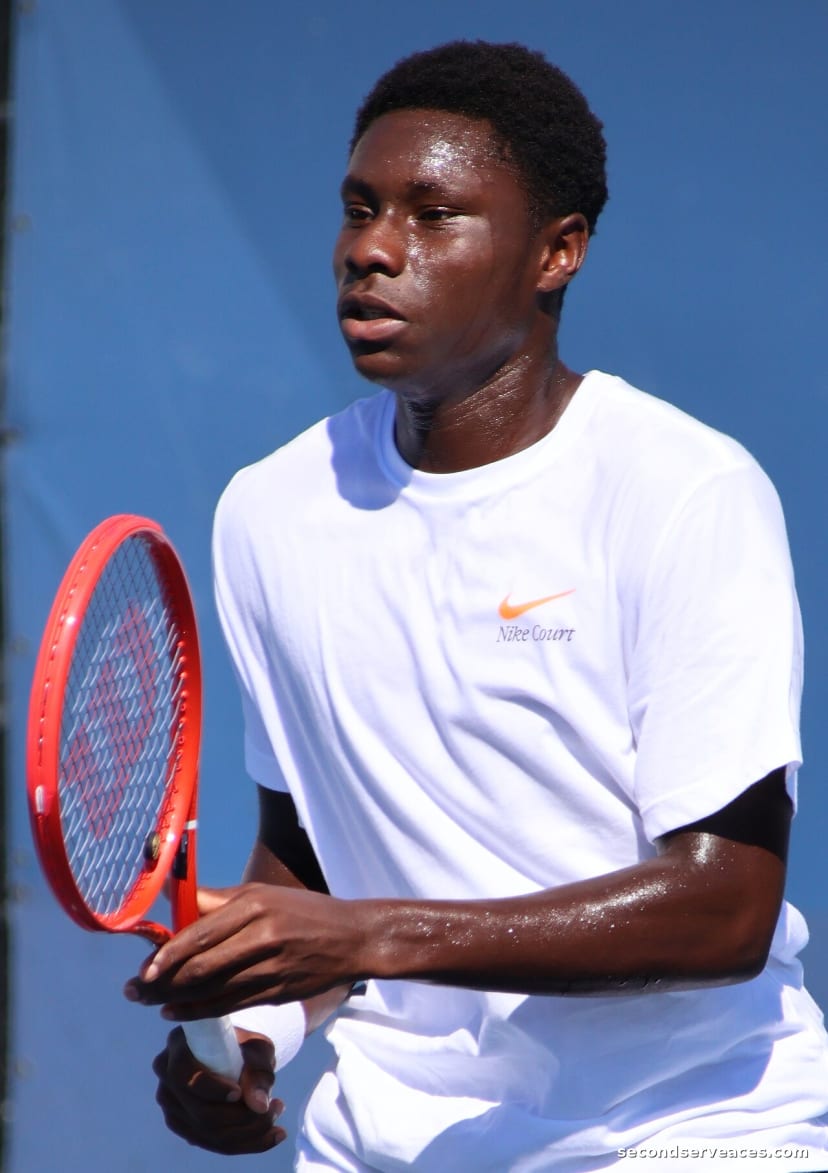
Hard courts in South Florida demand a specific kind of suffering. When the humidity climbs and the heavy Dunlop balls start fluffing up, raw talent alone is never enough; you need an iron will, burning lungs, and legs that refuse to quit. Seventeen-year-old Moise Kouame embraced that exact brand of physical suffering, securing his first career ATP Masters 1000 victory during his main-draw debut at the Miami Open. Dropping the opening frame to American qualifier Zachary Svajda, the teenager refused to fold, carving out a grueling 5-7, 6-4, 6-4 triumph to advance to the second round.
Listen to the Second Serve Podcast
Get our daily AI-synthesized audio briefings and match reviews on the go.
Dropping the first set in your Masters 1000 debut usually triggers an immediate psychological collapse. The stadium suddenly feels too massive, the opponent looks unplayable, and the baseline feels miles away from the net. Panic is the natural human reaction. Instead of surrendering to that anxiety, Kouame recalibrated his mind and leaned heavily into the physical grind. He recognized early on that this match would not be won with flashy winners, but through a brutal war of attrition.
The Tactical Breakdown
Surviving a three-set war against an in-form qualifier requires significantly more than just clean ball-striking. Svajda thrives on rhythm, using his nimble footwork to construct points and extend rallies until the opponent blinks. To dismantle that consistency, a player must actively disrupt the American's comfort zone, forcing him to hit from awkward heights and difficult court positions.
- Dictating with Topspin: Instead of hitting flat and giving Svajda a predictable pace to work with, Kouame likely utilized heavy topspin to push the American deep behind the baseline. In the unforgiving geometry of a tennis court, depth is your greatest defense. By forcing the ball to kick high, the teenager bought himself crucial fractions of a second to recover his positioning and dictate the center of the court.
- Managing Match Momentum: After losing a tight 5-7 opener, shifting the momentum requires a ruthless, singular focus on the early service games of the second set. By locking down his own serve immediately, Kouame forced the scoreboard pressure back onto the older player. Momentum in tennis is a fickle creature; it swings wildly unless you physically wrestle it back to your side of the net.
- Executing on Break Point Opportunities: You don't win back-to-back 6-4 sets without flawless execution on pivotal points. Staring down break opportunities, the teenager undoubtedly tightened his margin for error. He resisted the urge to pull the trigger too early, instead extending the rally tolerance and daring Svajda to hit through him.
Professional tennis is an intensely open book. Every strength is heavily scouted, and every glaring weakness is magnified under the stadium lights. Svajda walked onto the hard court knowing he was facing a rookie, likely aiming to test the teenager’s baseline endurance early and often. Kouame passed that demanding physical exam, answering the bell long after his legs should have filled with suffocating lactic acid. He understood that the only way out of the Miami heat was to run directly through the fire.
The Bigger Picture
Earning a main-draw win at an ATP Masters 1000 event at age 17 is a stark statistical anomaly in the modern, fiercely physical men's game. Players usually spend their late teens grinding on the Challenger circuit, learning how to suffer in obscurity before earning the right to compete on the premier tour. Stepping directly onto a Masters 1000 court and not just surviving, but actively winning, immediately draws comparisons to the sport's most legendary prodigies.
Rafael Nadal famously set the gold standard for teenage breakthroughs two decades ago, relying on a similar blend of relentless physicality, looping topspin, and an impenetrable mental baseline. While projecting Kouame to follow that exact, historic trajectory is incredibly premature, the foundational elements—grit, immense fitness, and tactical adaptability—are undeniably present in his game. You can teach a young player how to hit a cleaner backhand, but you cannot teach them how to relish the pain of a third set.
This triumphant result redefines the immediate expectations for Kouame's season and career arc. Advancing to the second round in Miami provides crucial ranking points, but more importantly, it injects a jolt of pure, unfiltered belief into a developing mind. The ATP Tour is an unforgiving, cannibalistic ecosystem that routinely eats unprepared teenagers alive. Today, Kouame proved he isn't prey. As he prepares his body and mind for his second-round opponent, the rest of the locker room is officially on notice: the new kid is willing to grind until the last ball bounces.
Essential Matchday Add-Ons
Tournament-tested accessories and high-frequency consumables every competitive player keeps in their bag.
Tourna Grip Original Dry Feel Overgrip (10-Pack)
4.8 ★ (12,000+ reviews)
The gold standard for sweaty hands. Proprietary dry feel absorbs moisture better as play intensifies.
Luxilon ALU Power 125 Silver String Set
4.9 ★ (3,500+ reviews)
Unrivaled control and spin potential used by over 50% of the ATP Top 100 players.
Babolat Custom Damp Vibration Dampener (2-Pack)
4.7 ★ (4,200+ reviews)
Customizable dampening with removable central O-ring for fine-tuning court feedback and sound.
Penn Championship Extra Duty Tennis Balls (4-Can Pack)
4.7 ★ (8,900+ reviews)
Official ball of USTA League Tennis with extra-duty felt designed for abrasive hard courts.
Analyze Rafael Nadal vs. Moise Kouame
Predict tactical adjustments, momentum swings, and serve strategy options for this match-up using our AI simulator.
The Aces Tactical Panel
This report was curated and edited by Bhaskar Goel. Tactical analysis and technical insights were provided by our specialized panel of expert correspondents.
Julian Price
Senior Tactical Correspondent
Stuffy, pedantic British academic and historian specializing in match momentum and historical context.
Elena Cruz
Director of Analytical Research
Data scientist specializing in court surface physics and movement patterns.
Bhaskar
The Editor & Fan
Passionate tennis player and site editor bringing everyday amateur insights and relatable fan commentary.
Arthur Vance
Senior Existential Analyst
Deep, eccentric, and DFW-inspired. Models court metaphysics, kinetic beauty, and player psychology.
Leo Sterling
High-Performance Consultant
Hard-nosed ex-trainer from Melbourne with a no-nonsense view on tour fitness.