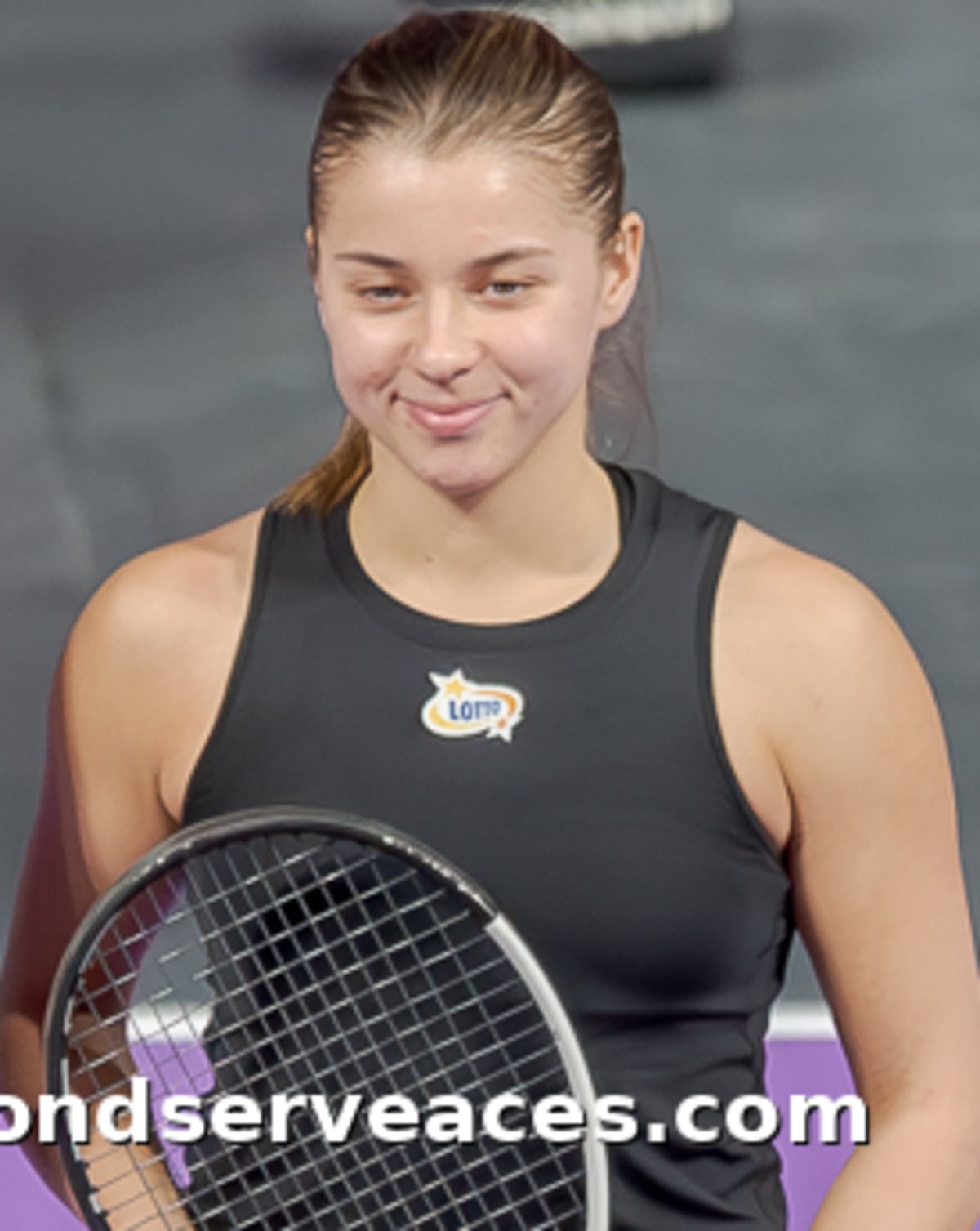
The Parisian Clay-to-Grass Metamorphosis
To observe Maja Chwalinska on a tennis court is to witness a quiet, almost subversive rebellion against the modern game’s obsession with raw, unadulterated velocity. Just weeks ago, on the grueling red clay of Paris, the 24-year-old Polish player orchestrated a run that defied the cynical mathematics of modern tennis. Emerging from the qualifying draw of Roland-Garros, she navigated the draw with a delicate, almost painterly touch, eventually falling in the final to eighth seed Mirra Andreeva.
Listen to the Second Serve Podcast
Get our daily AI-synthesized audio briefings and match reviews on the go.
It was a performance that felt less like a standard athletic run and more like an existential breakthrough. Her ranking, which had previously languished at a modest No. 114, underwent a violent, upward trajectory, settling at No. 21 in the world. This sudden ascension has forced the tennis establishment to reconsider its rigid paradigms of talent evaluation, thrusting Chwalinska into a spotlight that is as blinding as it is unexpected.
This transition from the slow, slide-heavy clay of Paris to the slick, unforgiving lawns of London represents a profound shift in kinetic demands. On grass, the ball stays low, the bounces are irregular, and the time for existential reflection is reduced to milliseconds. Yet, Chwalinska’s game, predicated on slice, spin variety, and acute angles, seems uniquely suited for this most traditional of surfaces.
The Unprecedented Seeded Wildcard Paradigm
The decision by the All England Club to award Chwalinska a wildcard is, in itself, a fascinating study in institutional bureaucracy. Typically, wildcards are reserved for local players trying to recapture past glory or promising domestic juniors. Indeed, Chwalinska stands as the solitary non-British player among the women's singles wildcards for this year's championships—sharing the wildcard list with local favorites like Katie Boulter—a distinction that carries both immense privilege and a subtle, isolating pressure.
But the true historical anomaly lies in the seeding. For the first time in the history of Wimbledon, and indeed the first time at any Grand Slam in the Open Era, a wildcard recipient will be seeded in the main draw. It is a decision that subverts the traditional, algorithmic rigidity of tournament entries, acknowledging that a player's current form and ranking trajectory can sometimes outpace the slow-moving gears of official entry deadlines.
This administrative curveball has sent shockwaves through the locker room. Traditionally, top-ranked players view wildcards as early-round speed bumps or, at worst, dangerous unseeded floaters. To have a wildcard occupying a seeded slot alters the entire mathematical geometry of the draw, creating a unique psychological dynamic where Chwalinska is simultaneously an interloper and a protected entity.
The Aesthetic Contrast of Chwalinska’s Geometry
In an era dominated by the heavy, baseline-hugging topspin of players like Iga Swiatek, Amanda Anisimova, and Coco Gauff, Chwalinska’s tactical lexicon feels deliciously archaic. She does not seek to overpower her opponents; rather, she seeks to unravel them. Her backhand slice is a masterpiece of kinetic deceleration, drawing opponents into uncomfortable forward movements and forcing them to generate their own pace from below the net cord.
This stylistic deviation recalls the tactical diversity of previous eras, a theme we explored when discussing the historic returns of established champions in our look at how the Williams Sisters' doubles synergy challenged the traditional power structures of SW19. Like those icons, Chwalinska brings an element of unpredictable theater to the court, using variety as a weapon of psychological disruption.
To watch her construct a point is to watch a chess grandmaster operating in three dimensions. She utilizes the drop shot not as a desperate escape hatch, but as a calculated probe, testing her opponent's forward movement and defensive court coverage. Against the relentless power of the modern baseline game, this commitment to variety is both a high-wire act and a beautiful aesthetic statement.
The Existential Weight of the SW19 Grass
As the tournament approaches, the question is no longer whether Chwalinska belongs on this stage, but how her body and mind will handle the immense weight of expectation. According to the official WTA rankings, she is now firmly established among the elite, yet she enters the tournament with the unique psychological burden of a historic pioneer.
The grass courts of SW19 have a way of magnifying a player's deepest anxieties. The slick footing, the hushed crowds, and the sheer weight of history can paralyze even the most seasoned veterans. For a player whose game relies so heavily on feel, touch, and precise micro-adjustments, any hint of tension or self-doubt can be fatal to her delicate court geometry.
Yet, there is a sense that Chwalinska is uniquely equipped to handle this existential pressure. Her journey through the qualifying rounds in Paris demonstrated a profound psychological resilience, a capacity to remain calm within the chaotic storm of Grand Slam competition. Whether she can translate that clay-court composure to the rapid-fire lawns of London remains the most compelling narrative of this upcoming fortnight.
What Iga Swiatek Plays With
Tecnifibre Tempo 298 Iga
Tecnifibre Razor Code 1.25
Analyze Maja Chwalinska vs. Mirra Andreeva
Predict tactical adjustments, momentum swings, and serve strategy options for this match-up using our AI simulator.
The Aces Tactical Panel
This report was curated and edited by Bhaskar Goel. Tactical analysis and technical insights were provided by our specialized panel of expert correspondents.
Julian Price
Senior Tactical Correspondent
Stuffy, pedantic British academic and historian specializing in match momentum and historical context.
Elena Cruz
Director of Analytical Research
Data scientist specializing in court surface physics and movement patterns.
Bhaskar
The Editor & Fan
Passionate tennis player and site editor bringing everyday amateur insights and relatable fan commentary.
Arthur Vance
Senior Existential Analyst
Deep, eccentric, and DFW-inspired. Models court metaphysics, kinetic beauty, and player psychology.
Leo Sterling
High-Performance Consultant
Hard-nosed ex-trainer from Melbourne with a no-nonsense view on tour fitness.
Related Reports
Quick Answers
Why is Maja Chwalinska's Wimbledon wildcard historic?+
She is the first wildcard in Wimbledon history, and the first at any Grand Slam in the Open Era, to be seeded in the main draw.
How did Maja Chwalinska perform at the French Open?+
Chwalinska reached the French Open final as a qualifier, where she put on a spectacular run before falling to eighth seed Mirra Andreeva.
How did her French Open run impact her WTA ranking?+
Her breakout performance in Paris raised her WTA ranking significantly from world No. 114 to No. 21.