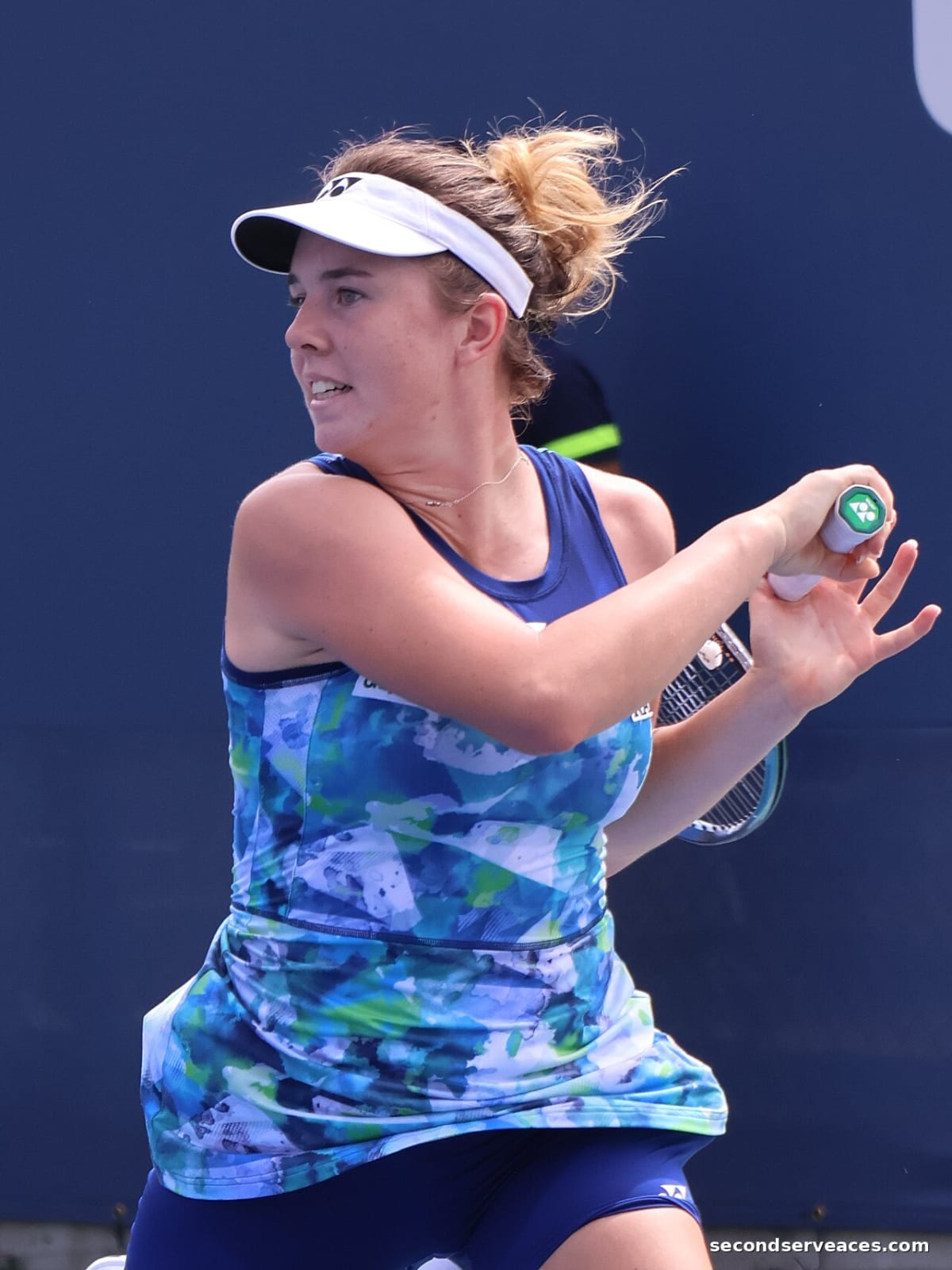
To watch professional tennis on grass is to witness a complex, highly volatile negotiation with gravity and friction. Unlike the predictable red clay of Paris, lawn tennis demands a lower center of gravity and an almost masochistic willingness to bend at the knees. In the final of the Berlin Open at the Rot-Weiss Tennis Club, 21-year-old Linda Nosková demonstrated this physical economy beautifully, defeating Jessica Pegula 6-4, 4-6, 6-3 to capture her second career singles title. It was a match defined not just by the kinetic violence of flat groundstrokes, but by an agonizing five-hour weather delay that tested the psychological boundaries of both competitors.
Listen to the Second Serve Podcast
Get our daily AI-synthesized audio briefings and match reviews on the go.
With this victory, Nosková does not merely collect a trophy; she officially enters the upper echelon of the sport. According to the latest WTA rankings, the young Czech will debut in the global top 10 for the first time in her career. Her performance in Berlin showcased a remarkable tactical maturity, particularly in how she managed her service games under heavy, humid conditions, maintaining a first-serve win percentage that kept Pegula constantly on the defensive.
The Early Exchange and the Low-Skidding Flat Strikes
From the opening game, the tactical geometry was clear. Nosková sought to exploit the low-skidding nature of the lawn by hitting flat, penetrating drives that rarely rose above Pegula’s hip level. The Czech’s ability to take the ball on the rise neutralized Pegula’s customary counter-punching depth. Nosková’s grass-court hold rate, which hovered at an impressive 81.3% throughout the week, was anchored by a wide slice serve in the deuce court that pulled Pegula far off the canvas, opening up the line for easy forehand winners.
Pegula, who reached the final after an exhausting semifinal performance that we detailed in our previous coverage of her win over Aryna Sabalenka, struggled early on to find her rhythm on the return. The American’s flat backhand, usually a highly reliable weapon on fast surfaces, repeatedly found the net tape in the first set as Nosková took the opening frame 6-4 with a single break of serve.
The Five-Hour Deluge and the Rot-Weiss Evacuations
Just as momentum seemed to crystallize in Nosková’s favor, the Berlin skies intervened. A severe storm front swept over the Rot-Weiss Tennis Club, forcing a complete halt to play. What followed was not a brief interlude, but a grueling five-hour delay that tested the players' mental stamina and drew sharp public criticism after tournament organizers evacuated the spectators from the grounds due to safety concerns.
For athletes tuned to a hyper-specific kinetic frequency, a five-hour delay is a form of sensory deprivation. The muscles cool, the mind wanders, and the competitive edge begins to dull. The challenge becomes entirely internal—how to maintain the delicate balance of adrenaline and relaxation while sitting in a locker room listening to rain pelt the roof.
Pegula’s Tactical Shift and the Second-Set Resurgence
When play finally resumed under heavy gray skies, the court conditions had altered dramatically. The grass was damp, the air was heavy, and the ball was carrying significantly less speed. Pegula adjusted to these environmental shifts far quicker than her younger opponent. She began taking her return of serve a step closer to the baseline, taking away Nosková's preparation time and forcing the Czech into awkward, rushed mechanical adjustments on her backhand wing.
This subtle shift allowed Pegula to break early in the second set. By mixing in low, short slices that forced Nosková to generate all of her own power from a stationary position, Pegula disrupted the rhythm of the Czech baseline machine. Pegula held her nerve to take the second set 6-4, sending this highly disrupted final into a deciding third set.
The Decisive Break and Nosková’s Ascent to the Top Ten
In the final set, the physical toll of the long day became the deciding factor. Nosková re-established her dominance by finding her first serve when it mattered most, saving two critical break points in her opening service game. At 3-2 in the decider, Nosková played a flawless return game, utilizing deep, heavy topspin returns that pushed Pegula behind the baseline and secured the crucial break. She served out the match with clinical efficiency, closing the 6-4, 4-6, 6-3 victory with an unreturnable serve out wide.
This victory in Berlin capped off an extraordinary week of grass-court tennis, mirroring the breakthrough of Marie Bouzková, who defeated Emma Navarro 7-6(5), 4-6, 6-2 at the Nottingham Open to claim her own maiden grass title, as noted on the official WTA Tour. For Nosková, this second career singles title is a definitive statement that her heavy, flat-hitting game is perfectly suited for the fastest surface in tennis, making her a formidable threat as the tour moves toward the lawns of SW19. You can read more about Bouzková's parallel run in our Nottingham semifinal analysis.
What Aryna Sabalenka Plays With
Wilson Blade 98 v9 (16x19)
Luxilon ALU Power 125
Analyze Linda Nosková vs. Jessica Pegula
Predict tactical adjustments, momentum swings, and serve strategy options for this match-up using our AI simulator.
The Aces Tactical Panel
This report was curated and edited by Bhaskar Goel. Tactical analysis and technical insights were provided by our specialized panel of expert correspondents.
Julian Price
Senior Tactical Correspondent
Stuffy, pedantic British academic and historian specializing in match momentum and historical context.
Elena Cruz
Director of Analytical Research
Data scientist specializing in court surface physics and movement patterns.
Bhaskar
The Editor & Fan
Passionate tennis player and site editor bringing everyday amateur insights and relatable fan commentary.
Arthur Vance
Senior Existential Analyst
Deep, eccentric, and DFW-inspired. Models court metaphysics, kinetic beauty, and player psychology.
Leo Sterling
High-Performance Consultant
Hard-nosed ex-trainer from Melbourne with a no-nonsense view on tour fitness.
Related Reports
Quick Answers
What was the final score of the Berlin Open final between Linda Nosková and Jessica Pegula?+
Linda Nosková defeated Jessica Pegula 6-4, 4-6, 6-3 in a hard-fought three-set match to capture the Berlin Open title.
How long was the weather delay during the Berlin Open final?+
The match was delayed for over five hours due to severe storms at the Rot-Weiss Tennis Club, which also led to spectator evacuations.
What milestone did Linda Nosková achieve with her victory in Berlin?+
By winning the Berlin Open, her second career singles title, the 21-year-old Linda Nosková secured her debut in the WTA top 10.