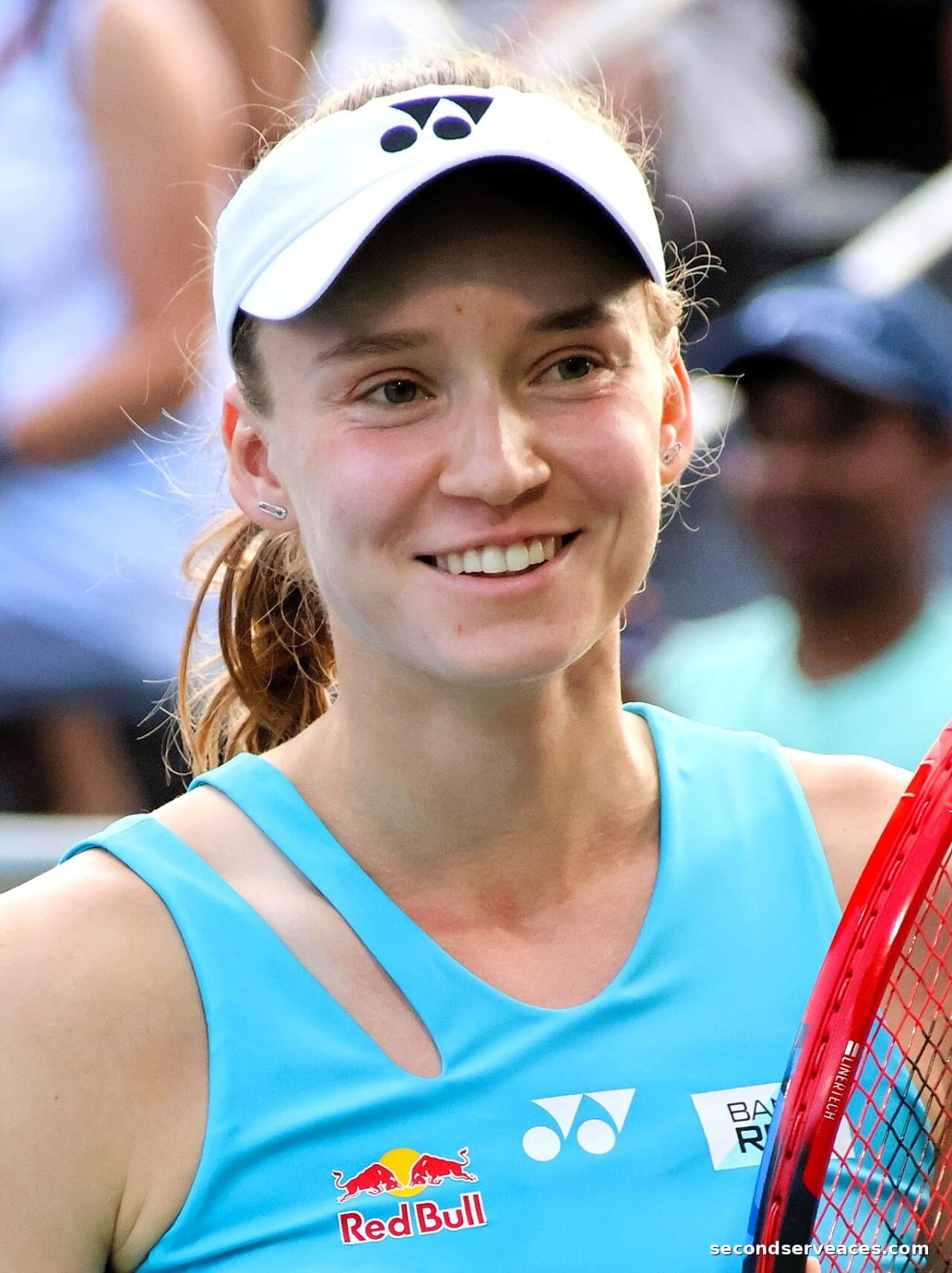
The Toronto hard courts offered no easy passages on Day 4, acting instead as a high-friction stage where elite baseliners were forced to solve complex physical equations. Elena Rybakina, Jessica Pegula, and Coco Gauff all secured their spots in the third round of the WTA 1000 tournament, but none did so without absorbing significant tactical resistance from their opponents.
Listen to the Second Serve Podcast
Get our daily AI-synthesized audio briefings and match reviews on the go.
Rybakina’s Heavy Serve Defeats Kasatkina’s Defensive Depth
Elena Rybakina's performance was less of a routine victory and more of a gritty exercise in heavy-hitting perseverance. Facing the relentless Daria Kasatkina, the Kazakh secured a 6-3, 5-7, 6-4 victory in a grueling match that stretched to two hours and 33 minutes. The contest was defined by Rybakina's aggressive baseline intent, utilizing her flat, heavy first serve to dictate play, though Kasatkina's deep, defensive return positioning constantly forced the Kazakh into extended, punishing rallies.
Rybakina leveraged her 6-foot frame to generate immense downward angles on her serve, frequently targeting the T to disrupt Kasatkina's rhythm. However, Kasatkina's tactical decision to stand nearly four meters behind the baseline allowed her to absorb the initial pace, returning deep down the middle to neutralize Rybakina's follow-up forehands. This structural tug-of-war saw Rybakina hit 41 unforced errors alongside her 38 winners, illustrating the high-wire act required to break through Kasatkina’s defense.
The deciding set became a physical test of wills, with Rybakina converting four of her nine break point opportunities. By keeping her first-serve percentage at a respectable 62% in the final set, Rybakina managed to stave off Kasatkina's late-match surge. This hard-fought triumph secures her spot in the third round and reinforces her status as one of the most formidable hard-court players on the WTA Tour today.
Pegula’s Baseline Adjustments Overcome Frech’s Slice
Jessica Pegula's path to the third round followed a similarly turbulent trajectory, requiring a 3-6, 6-3, 6-2 comeback victory over Poland's Magdalena Frech. Pegula, who recently displayed her hard-court prowess in Washington as we analyzed in our discussion of Pegula's baseline strategies, struggled early on to find her timing against Frech's heavy slice. The Polish player consistently disrupted Pegula's preferred rhythm, keeping the ball low and forcing the American to hit on the rise from awkward, half-bent postures.
The tactical shift occurred at the start of the second set, where Pegula began targeting Frech’s second serve with aggressive, early-taken returns. Pegula improved her second-serve return points won from a meager 30% in the first set to an impressive 58% in the final two sets. By stepping inside the baseline to receive, Pegula took away Frech's recovery time, forcing her opponent into defensive lunges that yielded shorter mid-court balls.
With this tactical adjustment, Pegula secured five breaks of serve over the final two sets to book her third-round meeting against Kamilla Rakhimova. Pegula's ability to problem-solve mid-match highlights her tennis intellect, converting her physical struggle into a masterclass of structural adaptation. Her flat, deep groundstrokes eventually overwhelmed Frech, proving that baseline tenacity remains Pegula's primary weapon on North American hard courts.
Gauff’s Defensive Resilience and Andreeva’s Speed Run
Coco Gauff also booked her passage into the third round, defeating fellow American Kayla Day 6-2, 7-5. Gauff's kinetic movement across the baseline was on full display as she countered Day's heavy left-handed topspin. While Gauff struggled occasionally with her second-serve delivery, coughing up eight double faults, she compensated with an exceptional 74% win rate on her first-serve points, preventing Day from establishing any consistent match momentum.
Day mounted a spirited campaign in the second set, utilizing her angled crosscourt forehand to pull Gauff off the court. However, Gauff's lateral speed and defensive depth allowed her to slide into backhand gets that most players would find unreachable, turning defensive situations into offensive counter-punches. Gauff broke Day's serve five times throughout the match, ultimately closing out the second set 7-5 to avoid a dangerous decider.
Meanwhile, young phenom Mirra Andreeva produced the most efficient performance of the day, defeating former World No. 1 Karolina Pliskova in straight sets, 6-0, 6-2. As analyzed in our pre-match analysis of Andreeva vs Pliskova, Andreeva's exceptional court coverage and tactical maturity completely neutralized Pliskova's flat, powerful groundstrokes. Andreeva broke Pliskova's serve six times, winning 61% of the total points played in a match that lasted just over an hour.
Rivalry Matchup & Player Profiles
The progression of both Elena Rybakina and Jessica Pegula sets up a potential deep-tournament clash between two of the game's most consistent top-five forces. Below is a side-by-side comparison of their career profiles:
| Metric | Elena Rybakina | Jessica Pegula |
|---|---|---|
| Rank | World No. 2 | World No. 3 |
| Country | Kazakhstan | USA |
| Age | 27 | 32 |
| Height | 6' 0" (1.84m) | 5' 7" (1.70m) |
| Handedness | Right-handed | Right-handed |
| Play Style | Aggressive baseliner | Tenacious baseline counter-puncher |
| Career Titles | 13 | 11 |
Elena Rybakina currently leads their head-to-head record 6-3. Their most recent encounter took place in March 2026 at the Miami Open, where Rybakina managed to outlast Pegula in a tight three-set battle, 2-6, 6-3, 6-4. That match, much like their potential meeting in Toronto, highlighted the contrast between Rybakina’s high-risk, first-strike power and Pegula’s relentless lateral movement and low-to-the-court groundstrokes.
When these two clash, the court becomes an existential stage of contrasting styles. Rybakina’s ability to win cheap points behind her first serve is often the deciding factor, whereas Pegula’s success relies on her ability to extend rallies and force Rybakina into low-percentage hitting positions. As both players move deeper into the Toronto draw, their contrasting methodologies continue to set the standard for modern hard-court tennis.
What Coco Gauff Plays With
Head Boom MP 2024
Head Lynx Tour 1.25
Analyze Elena Rybakina vs. Jessica Pegula
Predict tactical adjustments, momentum swings, and serve strategy options for this match-up using our AI simulator.
The Aces Tactical Panel
This report was curated and edited by Bhaskar Goel. Tactical analysis and technical insights were provided by our specialized panel of expert correspondents.
Julian Price
Senior Tactical Correspondent
Stuffy, pedantic British academic and historian specializing in match momentum and historical context.
Elena Cruz
Director of Analytical Research
Data scientist specializing in court surface physics and movement patterns.
Bhaskar
The Editor & Fan
Passionate tennis player and site editor bringing everyday amateur insights and relatable fan commentary.
Arthur Vance
Senior Existential Analyst
Deep, eccentric, and DFW-inspired. Models court metaphysics, kinetic beauty, and player psychology.
Leo Sterling
High-Performance Consultant
Hard-nosed ex-trainer from Melbourne with a no-nonsense view on tour fitness.
Related Reports
Quick Answers
How long did Elena Rybakina's match against Daria Kasatkina last?+
The match lasted two hours and 33 minutes, with Rybakina ultimately winning 6-3, 5-7, 6-4.
What tactical adjustment did Jessica Pegula make to defeat Magdalena Frech?+
Pegula stepped inside the baseline to aggressively return Frech's second serves, raising her second-serve return points won from 30% in the first set to 58% over the final two sets.
What was the score of Mirra Andreeva's match against Karolina Pliskova?+
Mirra Andreeva defeated Karolina Pliskova in straight sets with a score of 6-0, 6-2.