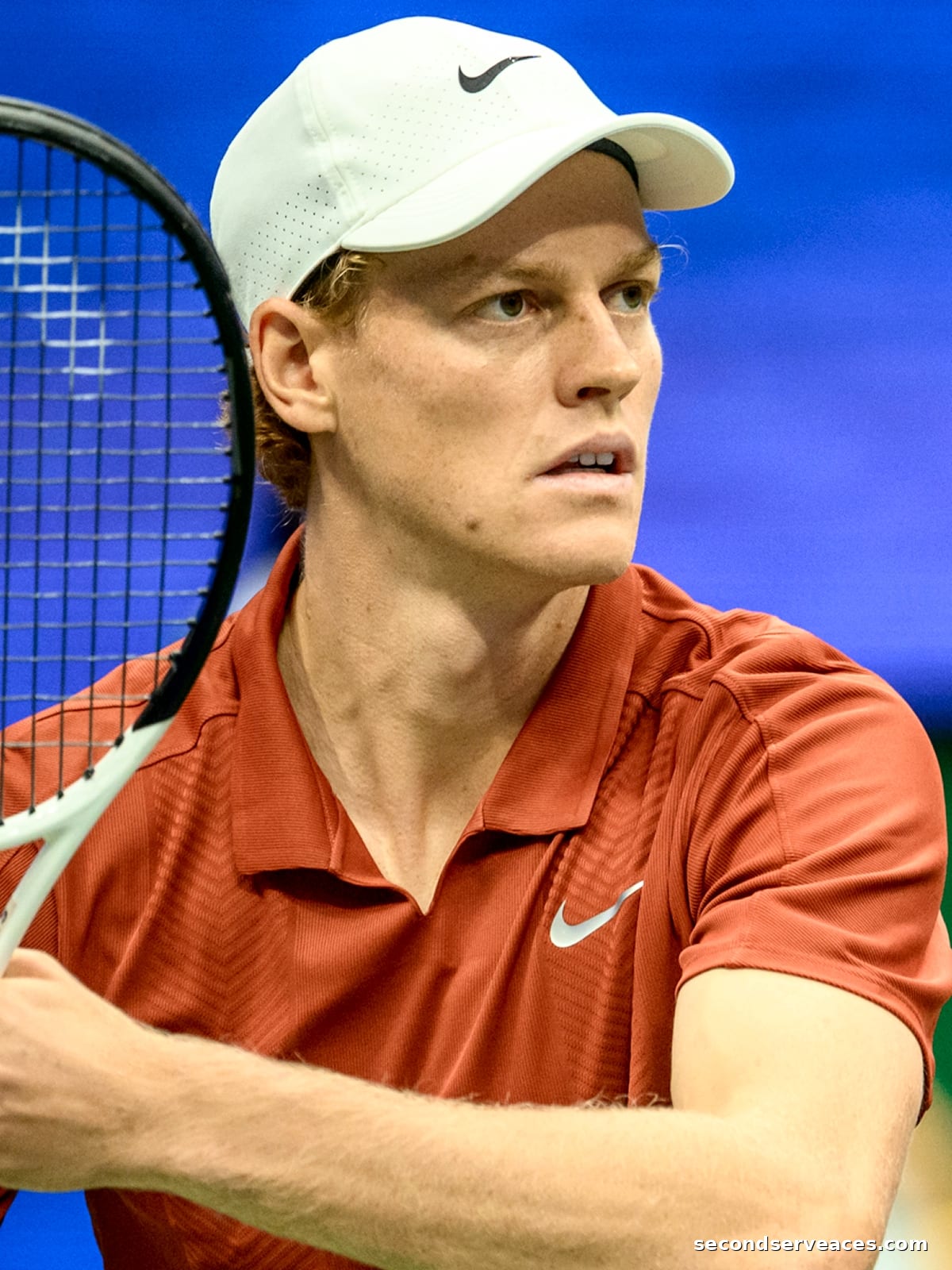
The sudden deceleration of a professional athlete at the absolute zenith of his physical powers carries a quiet, almost clinical violence. Jannik Sinner, the current occupant of the summit of the ATP rankings, has decreed an early end to his 2026 campaign. The culprit is not a dramatic, on-court collapse but rather the persistent, silent rebellion of his right knee. It is a joint that has absorbed the violent torque of modern baseline play across forty-seven matches this year, finally demanding a cessation of hostilities.
Listen to the Second Serve Podcast
Get our daily AI-synthesized audio briefings and match reviews on the go.
To understand the gravity of this departure is to look at the sheer emptiness it leaves at the top of the sport's calendar. Sinner's absence from the final autumn indoor swing removes the central mathematical puzzle that every other player on tour has spent the last ten months failing to solve. The Italian's camp confirmed the decision with a brevity that mirrors his on-court efficiency, prioritizing long-term structural integrity over the immediate lure of year-end showcases.
This premature curtain call evokes memories of previous physical breakdowns that have shaped the modern era, where the human frame simply refuses to match the ambitions of the mind. As we observed during the chaotic season-ending stretches of years past, such as the period detailed in our report on how Djokovic Wins Chaotic China Open as Medvedev Defaults, the modern tennis calendar acts as a relentless grinding machine. Sinner, at just twenty-five, has chosen preservation over pride.
Inside the Mathematical Absurdity of Sinner's 2026 Dominance
When we examine the raw, cold data of Sinner's 2026 season, the numbers take on a sort of terrifying, monolithic quality. He stepped onto the court forty-seven times and walked off victorious forty-four times, a win-loss ratio that reads more like a typographical error than an actual athletic record. In an era defined by razor-thin margins and hyper-optimized recovery, Sinner managed to convert his baseline supremacy into six titles from just nine tournaments contested.
This was not merely a run of good form; it was an extended, systematic dismantling of the ATP tour's elite tier. Five of those six titles were ATP Masters 1000 trophies, the brutal, week-long gauntlets that test a player's physical and psychological reserves to their absolute limits. The crown jewel of this run was, of course, his triumph on the lawns of Wimbledon, where his sliding defense and flat, penetrating groundstrokes proved utterly unanswerable.
The financial reward for this level of historical dominance is equally staggering, with Sinner accumulating $11,589,398 in on-court prize money alone. Yet, the true currency of his season was the psychological weight he carried into every stadium, an aura of inevitability that seemed to alter the very air pressure of the court. His ability to maintain a high first-serve percentage and dictate points from the first strike allowed him to command match momentum with an almost administrative calm.
The Anomalous Three: Deconstructing Sinner's Rare Stumbles
To truly appreciate the scale of Sinner's 2026 campaign, one must look not at his forty-four victories, but at the three singular anomalies who managed to breach his defenses. The first, predictably, was Novak Djokovic, the eternal benchmark of defensive tennis, who found a way to disrupt the Italian's rhythm in a masterclass of depth and angles. Djokovic's victory remained a rare testament to the old guard's refusal to yield to the changing of the guard.
The other two defeats, however, belong to the realm of the genuinely bizarre, reminding us of the sport's capacity for sudden, localized chaos. Jakub Mensik, the towering Czech teenager, played a match of uninhibited, high-risk aggression to catch Sinner on a rare off-day. Even more startling was the clay-court masterclass from Argentina's Juan Manuel Cerundolo, who used heavy, looping topspin to drag the world number one out of his preferred striking zone and secure a historic upset.
These three losses do not represent a blueprint for defeating Sinner so much as they illustrate the astronomical level of performance required to even threaten him. In every other contest, Sinner's lateral movement and clean ball-striking neutralized his opponents' tactical variations. His ability to handle sudden shifts in momentum meant that even when he was pushed to the brink, he almost always found a way to reassert his authority.
The Physical Tax of the Modern Slide and Strike
The modern professional game is a kinetic art form that demands its practitioners slide on hard courts as if they were clay, putting immense strain on the patellar tendons. Sinner's movement is a marvel of flexibility, a series of controlled skids and split-steps that allow him to defend the corners with unprecedented efficiency. However, this style of play acts as a compound interest of physical wear-and-tear, with the bill eventually coming due.
By shutting down his season in autumn, Sinner is attempting to avoid the chronic joint degeneration that has derailed so many promising careers before him. The decision reflects a modern, scientific approach to scheduling, where the long-term pursuit of Grand Slam titles outweighs the immediate pressure to defend ranking points. His team is clearly prioritizing a full recovery ahead of the grueling Australian summer.
This cautious approach is highly reminiscent of the strategic scheduling we have seen other top-tier players adopt. For instance, when we looked at the physical demands of early-season preparation in our coverage of how Alcaraz & Sinner Join Million-Dollar Australian Open 1 Point Slam, it became clear that modern players must calculate their schedules with mathematical precision. Sinner's early exit is a calculated withdrawal, a tactical retreat designed to ensure he returns at full strength.
Rivalry Matchup & Player Profiles
| Metric | Jannik Sinner | Alexander Zverev |
|---|---|---|
| Rank | No. 1 | No. 2 |
| Age | 25 | 29 |
| Country | Italy | Germany |
| Height | 1.91 m (6 ft 3 in) | 1.98 m (6 ft 6 in) |
| Handedness | Right-handed | Right-handed |
| Play Style | Aggressive baseliner | Aggressive baseliner |
| Career Titles | 30 | 26 |
The rivalry between the world's top two players has increasingly leaned in favor of the Italian superstar. Jannik Sinner leads their overall matchup record 11-4, a margin that became particularly pronounced during his dominant 2026 run. Sinner swept all five of their encounters this season, displaying an uncanny ability to neutralize the German's massive serve and expose minor movement liabilities during extended baseline rallies.
Their most significant battle of the year took place on the sacred lawns of southwest London. In the 2026 Wimbledon final, Sinner overcame a first-set setback to defeat Zverev 6-7(7), 7-6(2), 6-3, 6-4. While Zverev's flat backhand kept him competitive in the early stages, Sinner's superior physical conditioning and relentless depth eventually broke the German's resistance, reinforcing his status as the undisputed king of the ATP tour before his unfortunate knee injury intervened.
What Jannik Sinner Plays With
Head Speed MP 2024
Head Hawk Touch 1.25
Head Prime Tour (12-Pack)
Nike GP Challenge 1
Analyze Jannik Sinner vs. Alexander Zverev
Predict tactical adjustments, momentum swings, and serve strategy options for this match-up using our AI simulator.
The Aces Tactical Panel
This report was curated and edited by Bhaskar Goel. Tactical analysis and technical insights were provided by our specialized panel of expert correspondents.
Julian Price
Senior Tactical Correspondent
Stuffy, pedantic British academic and historian specializing in match momentum and historical context.
Elena Cruz
Director of Analytical Research
Data scientist specializing in court surface physics and movement patterns.
Bhaskar
The Editor & Fan
Passionate tennis player and site editor bringing everyday amateur insights and relatable fan commentary.
Arthur Vance
Senior Existential Analyst
Deep, eccentric, and DFW-inspired. Models court metaphysics, kinetic beauty, and player psychology.
Leo Sterling
High-Performance Consultant
Hard-nosed ex-trainer from Melbourne with a no-nonsense view on tour fitness.
Related Reports
Quick Answers
Why did Jannik Sinner end his 2026 tennis season early?+
Jannik Sinner ended his 2026 season prematurely due to a right knee injury to focus on full recovery and long-term joint health.
What was Jannik Sinner's win-loss record and title count in 2026?+
Sinner played 47 matches in 2026, finishing with an exceptional 44-3 record and winning six titles, including five Masters 1000 events and Wimbledon.
Who are the only players to defeat Jannik Sinner in 2026?+
Sinner's only three losses of the 2026 season came against Novak Djokovic, Jakub Mensik, and Juan Manuel Cerundolo.