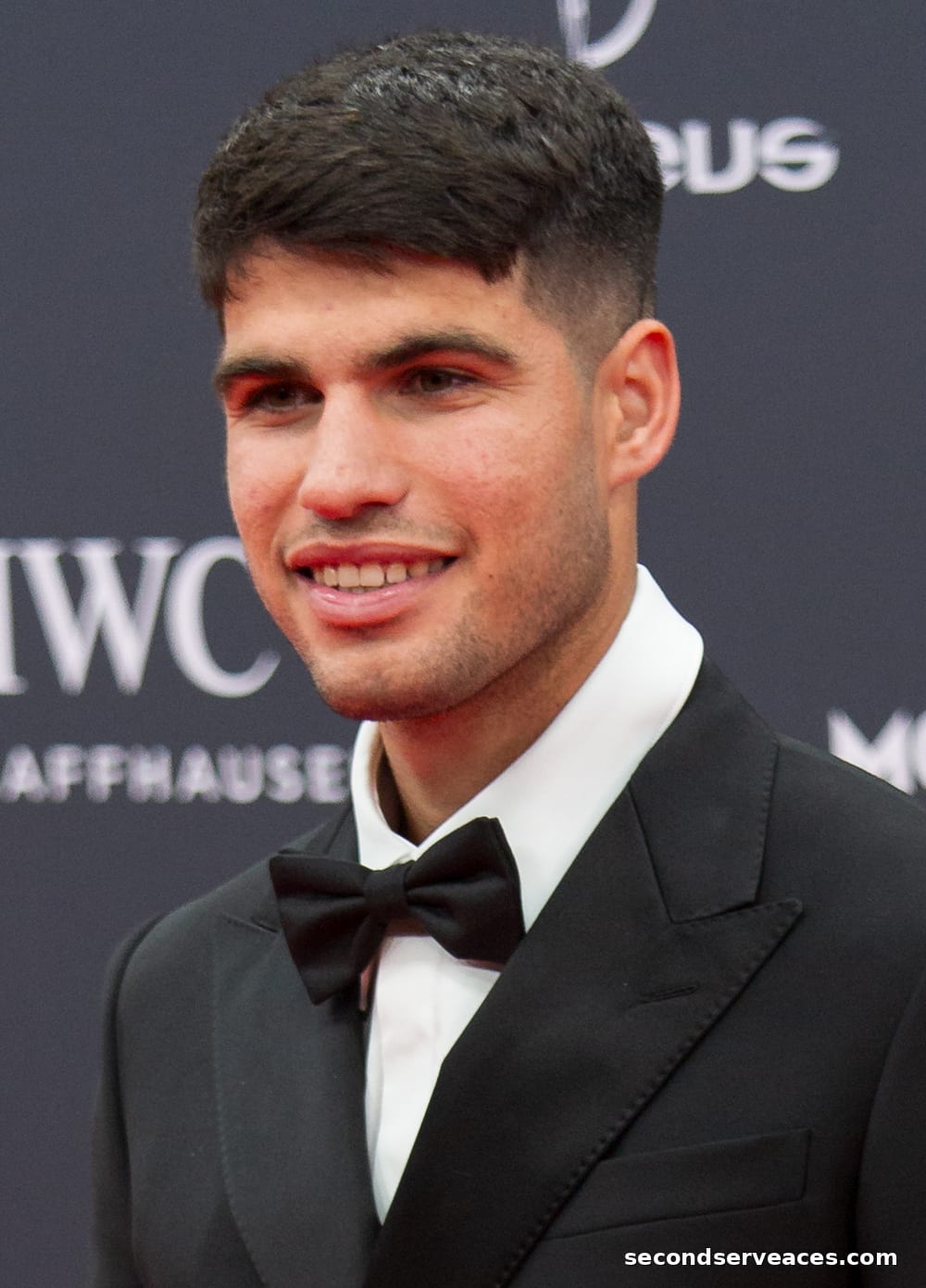
The arc of a modern tennis season is rarely a straight line; more often, it resembles the jagged peaks of an electrocardiogram, charting the violent shifts between physical peak and sudden, quiet vulnerability. For Carlos Alcaraz, the 2026 season has been a masterclass in this exact volatility. Having scaled the absolute peak of the sport in January, the young Spaniard was forced into a silent, four-month exile, only to rebuild his game from the raw clay of recovery and rise once more under the bright lights of Tokyo.
Listen to the Second Serve Podcast
Get our daily AI-synthesized audio briefings and match reviews on the go.
The Melbourne Breakthrough and the Career Grand Slam Milestone
The 2026 Australian Open final was not merely a tennis match; it was a physical dialogue of contrasting philosophies. Carlos Alcaraz’s victory over Novak Djokovic—by a scoreline of 2-6, 6-2, 6-3, 7-5—was a testament to rapid structural adjustment. After a first set where Djokovic's depth suffocated the Spaniard's baseline aggression, Alcaraz recalibrated his positioning, standing a half-meter further back to absorb the Serb's flat, penetrating backhands.
This tactical pivot allowed Alcaraz to inject raw topspin into his forehand, changing the kinetic energy of the rallies and forcing Djokovic to strike balls above his preferred strike zone. By securing his seventh major title, Alcaraz did not just win another trophy; he completed the highly coveted Career Grand Slam, establishing his presence among the sport's immortal figures at just twenty-two years of age.
The victory, recorded in the archives of the official Australian Open, felt like a definitive passing of the torch, deadlocking their legendary rivalry. Yet, the physical toll of generating such violent racket-head speed would soon demand a steep price from the young Spaniard's body, proving that even the most elastic defenses have a breaking point.
The Right Wrist Tenosynovitis in Barcelona and Four Months of Forced Exile
The bill came due in April at the Barcelona Open. A sharp, localized pain in Alcaraz's right wrist was diagnosed as tenosynovitis—an inflammation of the fluid-filled sheath surrounding the tendon. This specific pathology is the occupational hazard of the modern western-grip forehand, where the wrist must violently snap from extreme extension to flexion in milliseconds to produce heavy topspin.
The diagnosis forced a brutal four-month exile from the competitive arena. Alcaraz was sidelined during the heart of the European swing, missing the clay courts of Roland Garros, the pristine lawns of Wimbledon, and the hard courts of the Canadian Open. The tour moved on without its brightest young star, leaving fans to wonder if his explosive style was fundamentally unsustainable over a full calendar year.
This period of forced inactivity disrupted what had promised to be an uncontested run at the top ranking. As we explored in our previous coverage of how Alcaraz battles physical rust to reclaim Shanghai throne, the process of rebuilding tendon strength is a slow, non-linear progression that tests an athlete's psychological reserve far more than their physical stamina.
The Flushing Meadows Comeback and the Quarterfinal Clash with Ben Shelton
When Alcaraz finally stepped back onto the hard courts of Flushing Meadows for the US Open, his movement was sharp, but his shot-making lacked its signature, carefree velocity. The wrist, wrapped in protective tape, was subjected to the ultimate stress test under the humid New York night skies. He navigated the early rounds on instinct and court coverage rather than pure power.
The limitations of his abbreviated preparation were exposed in the quarterfinals against Ben Shelton. Shelton’s thunderous left-handed serves and flat, aggressive groundstrokes prevented Alcaraz from establishing baseline rhythm, culminating in a tough defeat that halted the Spaniard's dream comeback in New York.
This quarterfinal exit highlighted the competitive depth of the current ATP landscape, where hungry young players are rapidly closing the gap. For context on Shelton's rising trajectory, consider how Ben Shelton eyes top five status, demonstrating the caliber of opponents Alcaraz must now contend with while managing his physical recovery.
Reclaiming Authority in Tokyo with the Japan Open Triumph
Redemption arrived in Tokyo at the Japan Open, where Alcaraz finally looked like his unburdened self. Facing the formidable Jiri Lehecka in the final, Alcaraz displayed the full spectrum of his tactical arsenal to secure a 7-6(4), 6-4 victory. The opening set was a masterclass in tiebreak poise, with Alcaraz using heavy kick serves to open up the court.
Lehecka pushed Alcaraz to the limit with flat, deep returns, but the Spaniard's ability to transition from defense to offense remained unmatched. A crucial break of serve in the second set, secured via a delicate drop shot followed by a crosscourt passing shot, broke Lehecka's resistance and sealed the championship.
With this victory, Alcaraz improved his season singles record to 27-4 with three titles, solidifying his position at World No. 3. According to the official ATP rankings, Alcaraz remains within striking distance of the top two spots as the tour heads into the late-season indoor swing.
Rivalry Matchup & Player Profiles
| Metric | Carlos Alcaraz | Novak Djokovic |
|---|---|---|
| Rank | No. 3 | No. 8 |
| Age | 23 | 39 |
| Country | Spain | Serbia |
| Height | 1.83 m (6 ft 0 in) | 1.88 m (6 ft 2 in) |
| Handedness | Right-handed | Right-handed |
| Play Style | Aggressive baseliner | Counterpuncher / All-court |
| Career Titles | 27 | 102 |
The rivalry between Carlos Alcaraz and Novak Djokovic remains one of the most compelling narratives in modern sport, currently deadlocked at 5-5. Their contrast in styles—Alcaraz's explosive, aggressive baseline patterns versus Djokovic's peerless counterpunching and slide-and-glide defense—creates matches of extreme physical intensity.
Their last meeting in Melbourne, where Alcaraz secured his Career Grand Slam, proved that the young Spaniard has decoded Djokovic's defensive algorithms. However, with Djokovic still lurking inside the top ten at No. 8, any future clash will serve as the ultimate benchmark for Alcaraz's physical durability and tactical evolution.
What Carlos Alcaraz Plays With
Babolat Pure Aero 98
Babolat RPM Blast 1.30
Babolat VS Original (12-Pack)
Nike Vapor Pro 2
Analyze Carlos Alcaraz vs. Novak Djokovic
Predict tactical adjustments, momentum swings, and serve strategy options for this match-up using our AI simulator.
The Aces Tactical Panel
This report was curated and edited by Bhaskar Goel. Tactical analysis and technical insights were provided by our specialized panel of expert correspondents.
Julian Price
Senior Tactical Correspondent
Stuffy, pedantic British academic and historian specializing in match momentum and historical context.
Elena Cruz
Director of Analytical Research
Data scientist specializing in court surface physics and movement patterns.
Bhaskar
The Editor & Fan
Passionate tennis player and site editor bringing everyday amateur insights and relatable fan commentary.
Arthur Vance
Senior Existential Analyst
Deep, eccentric, and DFW-inspired. Models court metaphysics, kinetic beauty, and player psychology.
Leo Sterling
High-Performance Consultant
Hard-nosed ex-trainer from Melbourne with a no-nonsense view on tour fitness.
Related Reports
Quick Answers
What injury sidelined Carlos Alcaraz during the 2026 season?+
Carlos Alcaraz suffered right wrist tenosynovitis at the Barcelona Open in April, which sidelined him for over four months.
Which Grand Slam tournaments did Carlos Alcaraz miss in 2026 due to his injury?+
Due to his wrist injury, Carlos Alcaraz missed both the French Open and Wimbledon, as well as the Canadian Open.
How did Carlos Alcaraz perform in his first tournament win after his injury comeback?+
Alcaraz won the Japan Open by defeating Jiri Lehecka 7-6(4), 6-4 in the final, solidifying his 2026 singles record at 27-4.