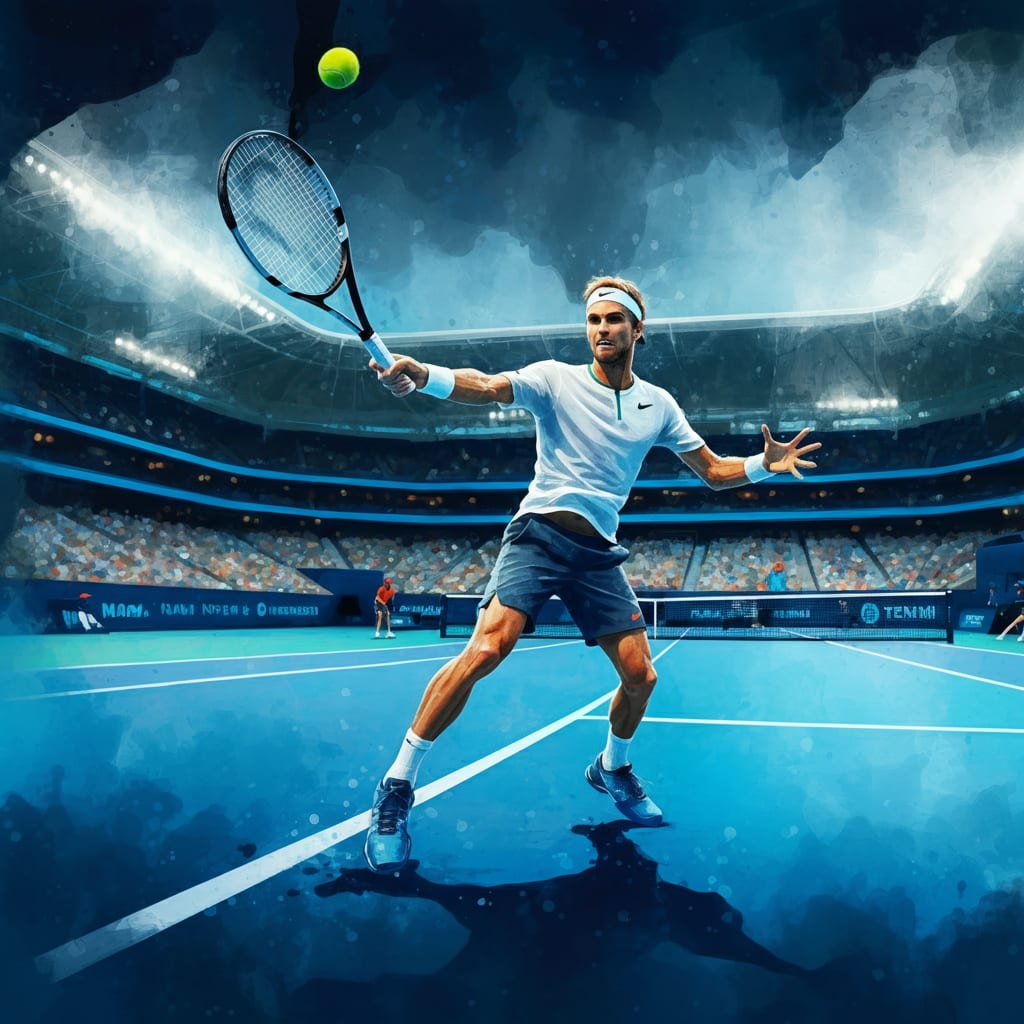
There is a specific, suffocating brand of baseline attrition native to the ATP hard-court swing, a kind of kinetic claustrophobia where neither player is willing to concede an inch of blue acrylic. On a humid evening at the Miami Open, World No. 20 Frances Tiafoe outlasted defending champion Jakub Mensik in a match that felt less like a sporting event and more like a metaphysical negotiation with exhaustion. The final score—7-6, 4-6, 7-6—reads like a barcode of sheer suffering.
Listen to the Second Serve Podcast
Get our daily AI-synthesized audio briefings and match reviews on the go.
To understand the terminal velocity of this encounter, one must look at the precipice on which it concluded. Tiafoe was forced to stare down two match points, erasing the deficit with a cocktail of sheer athleticism and heavy, parabolic topspin. Yet, securing the win required its own extended agonizing labor. The American churned through seven match points of his own before finally dismantling the Czech prodigy's defenses. At the net, amid the heavy breathing and neon glare, Tiafoe offered an embrace and a few words of profound respect to the young defending champion.
A Bracket Plunged Into Chaos
The draw in Florida has become a landscape of unpredictability. Consider the surrounding variables that contextualize this marathon:
- Tiafoe's Marathon Run: Prior to facing Mensik, Tiafoe waded through consecutive three-set grinders against Emil Ruusuvuori and Flavio Cobolli.
- The Atmane Anomaly: Unseeded Terence Atmane quietly dismantled the established order by eliminating seventh seed Felix Auger-Aliassime.
- The Defending Champion Falls: Mensik's exit ensures a new titleholder will inevitably emerge from the Miami humidity.
The Tactical Breakdown
What separates a top-20 fixture like Tiafoe from the rest of the tour is his idiosyncratic, biomechanically fascinating forehand. In the modern game, where long, sweeping takebacks are heavily penalized by the speed of the court, Tiafoe's abbreviated, whip-like motion allows him to absorb and redirect extreme pace. Against a towering offensive baseline talent like Mensik, this ability to redirect energy is paramount.
Tactically, defeating a player who thrives on first-strike tennis requires dragging them into the deep waters of rally tolerance. Mensik, defending his crown, historically dictates points through heavy serving and immediate follow-up aggression. By standing his ground on the baseline and utilizing his exceptional lateral speed, Tiafoe essentially shrank the geometry of the court. The fact that the match hinged on two tiebreaks—a format that mathematically rewards the player who can string together three consecutive points of unforced-error-free tennis—speaks to Tiafoe's superior management of match momentum in the ultimate pressure vacuums.
The Bigger Picture
Winning three consecutive three-set matches against the likes of Ruusuvuori, Cobolli, and Mensik is not just a physical feat; it is an index of psychological resilience. For Tiafoe, currently hovering at No. 20 in the ATP rankings, this tier of tournaments is critical for accumulating the requisite points to break back into the top echelon. The ATP Tour's hard-court swing is notoriously unforgiving on the joints and the psyche, demanding a hyper-specific blend of endurance and explosive power.
Defeating a defending champion always carries a distinct atmospheric weight. It signals a disruption of the expected narrative. Mensik will have to recalculate his trajectory heading into the grueling European clay swing, while Tiafoe, visibly depleted but mathematically victorious, moves forward through a draw that has suddenly opened wide following the departure of high seeds like Auger-Aliassime. Tennis, at its core, is a game of survival, and right now, nobody in Miami is surviving quite as vividly as Frances Tiafoe.
What Jannik Sinner Plays With
Head Speed MP 2024
Head Hawk Touch 1.25
Head Prime Tour (12-Pack)
Nike GP Challenge 1
Analyze Frances Tiafoe vs. Jakub Mensik
Predict tactical adjustments, momentum swings, and serve strategy options for this match-up using our AI simulator.
The Aces Tactical Panel
This report was curated and edited by Bhaskar Goel. Tactical analysis and technical insights were provided by our specialized panel of expert correspondents.
Julian Price
Senior Tactical Correspondent
Stuffy, pedantic British academic and historian specializing in match momentum and historical context.
Elena Cruz
Director of Analytical Research
Data scientist specializing in court surface physics and movement patterns.
Bhaskar
The Editor & Fan
Passionate tennis player and site editor bringing everyday amateur insights and relatable fan commentary.
Arthur Vance
Senior Existential Analyst
Deep, eccentric, and DFW-inspired. Models court metaphysics, kinetic beauty, and player psychology.
Leo Sterling
High-Performance Consultant
Hard-nosed ex-trainer from Melbourne with a no-nonsense view on tour fitness.