The Double-Handed Revolution: How the Two-Hander Conquered Tennis
There was a time when playing tennis with two hands on the racket was considered an amateurish concession. Traditionalists sniffed that it lacked reach, elegance, and variety. They were wrong. What they saw as a limitation was actually the blueprint for the modern game. Today, the two-handed backhand is the undisputed bedrock of professional tennis, a shift that transformed the sport from a polite game of courtly angles into a high-velocity war of attrition.
Listen to the Second Serve Podcast
Get our daily AI-synthesized audio briefings and match reviews on the go.
From Unorthodox Oddity to Baseline Dominance
The transformation didn't happen overnight, but when it arrived, it came with the force of a tidal wave. In the 1970s, pioneers like Björn Borg and Jimmy Connors on the men's side, alongside Chris Evert on the women's tour, proved that two hands were infinitely more reliable under pressure than one. Evert used her compact, metronomic two-hander to completely neutralize the attacking net rushers of her era, establishing a baseline dominance that reshaped the WTA Tour.
Borg, meanwhile, utilized a unique western-grip variation, releasing his dominant hand after contact to generate a looping, top-spin heavy ball that exploded off the clay of Roland Garros. These players weren't just defending; they were using the extra hand to stabilize the racket face, allowing them to swing harder and flatter without sacrificing control.
The Biomechanics: Two Hands, One Devastating Lever
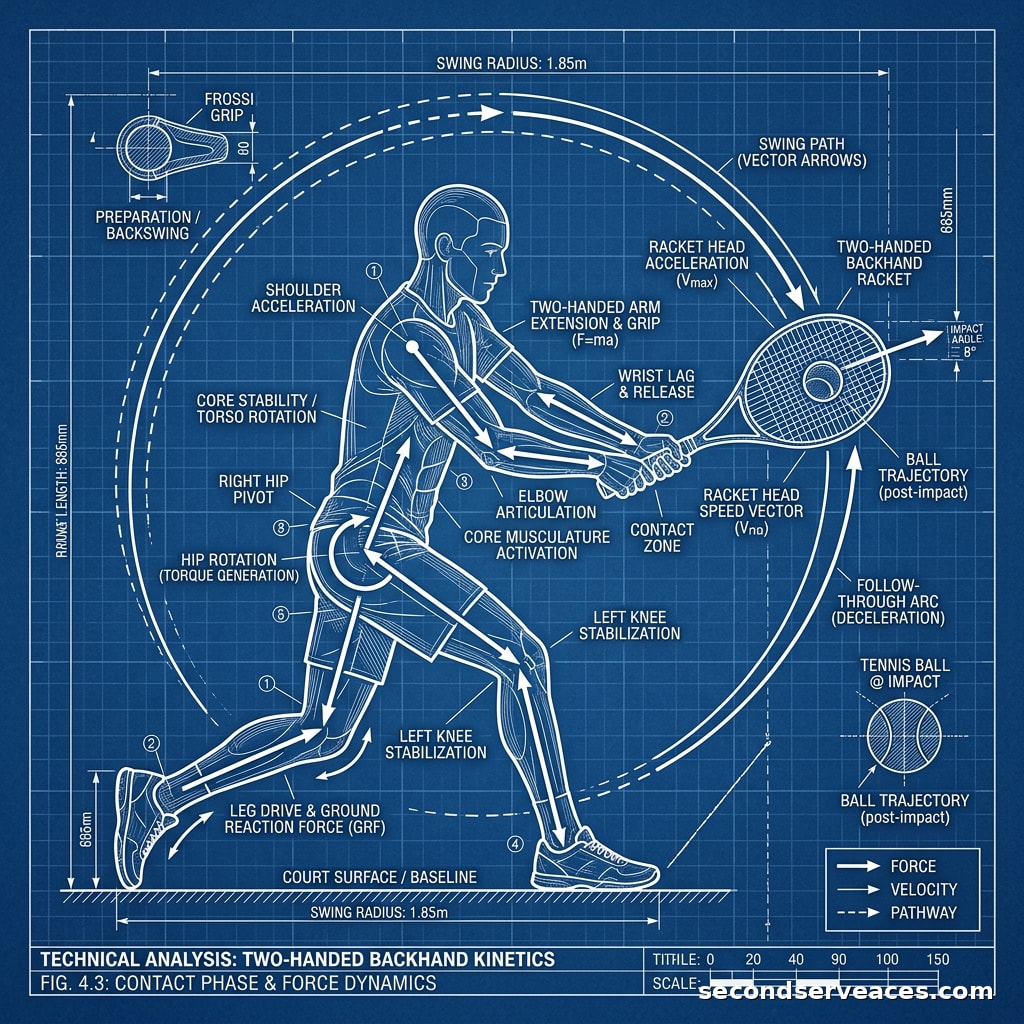
To understand why the two-handed backhand conquered the sport, you have to look at the biomechanics of the shoulder turn and the contact point. In a classic one-handed backhand, the strike zone is highly sensitive; the ball must be met well out in front of the lead hip. If a heavy, high-kicking ball pushes the player back, the single wrist simply cannot cope with the torque.
The two-hander solves this vulnerability. By adding the non-dominant hand—which essentially acts as a dominant forehand from the opposite side—the player creates a rigid, stable lever. This dual-arm system allows players to handle balls high in their strike zone, absorbing heavy topspin and redirecting it with interest. As we detailed in our analysis of Steffi Graf vs Monica Seles: The War of Strike Zones, Seles’s ability to take the ball early on both wings with two hands completely suffocated her opponents, denying them time and space.
Taking it on the Rise: Agassi’s Geometric Shift
If Borg and Evert proved the shot’s reliability, Andre Agassi turned it into an offensive weapon of absolute precision. Standing right on or inside the baseline, Agassi used a short, explosive backswing to take the ball on the rise. Because the two-handed backhand requires a shorter swing path than the long, flowing release of a single-hander, Agassi could cut down his reaction time significantly.
By hitting the ball early, Agassi changed the geometry of the court. He didn't need to run around his backhand; he welcomed the attack, using his opponent's pace to drill flat, cross-court lasers that pulled them wide, or catching them leaning with a disguised change of direction down the line. It was a masterclass in aggressive baseline positioning.
The Modern Apex: Djokovic’s Slide and Shield
Today, the absolute peak of this evolutionary line belongs to Novak Djokovic. Djokovic has turned the backhand into an impenetrable shield and a lethal spear. His execution relies on supreme flexibility and perfect footwork. Watch him slide out wide on a hard court: his left leg plants, his hips rotate, and despite being fully stretched, those two hands on the racket allow him to absorb a 90-mph forehand and whip it back deep into the corner.
This defensive solidity directly feeds his offensive transition. In the grueling baseline exchanges we explored in Djokovic vs Nadal: The Ultimate War of Tennis Attrition, Djokovic’s ability to consistently hit his backhand depth on the slide completely neutralized Nadal’s heavy topspin forehand. By refusing to give up ground, the modern two-hander allows players to dictate play from positions that would have been purely defensive thirty years ago. It is no longer just a stroke; it is the ultimate tactical equalizer on the modern ATP Tour.
What Novak Djokovic Plays With
Head Speed Pro
Luxilon ALU Power 125
Head Prime Tour (12-Pack)
Asics Court FF 3 Novak
Analyze Björn Borg vs. Jimmy Connors
Predict tactical adjustments, momentum swings, and serve strategy options for this match-up using our AI simulator.
The Aces Tactical Panel
This report was curated and edited by Bhaskar Goel. Tactical analysis and technical insights were provided by our specialized panel of expert correspondents.
Julian Price
Senior Tactical Correspondent
Stuffy, pedantic British academic and historian specializing in match momentum and historical context.
Elena Cruz
Director of Analytical Research
Data scientist specializing in court surface physics and movement patterns.
Bhaskar
The Editor & Fan
Passionate tennis player and site editor bringing everyday amateur insights and relatable fan commentary.
Arthur Vance
Senior Existential Analyst
Deep, eccentric, and DFW-inspired. Models court metaphysics, kinetic beauty, and player psychology.
Leo Sterling
High-Performance Consultant
Hard-nosed ex-trainer from Melbourne with a no-nonsense view on tour fitness.
Related Reports


Quick Answers
Who were the early pioneers who popularized the two-handed backhand in the 1970s?+
Björn Borg, Jimmy Connors, and Chris Evert were the key pioneers who demonstrated the reliability and baseline dominance of the two-handed backhand.
What biomechanical advantage does the two-handed backhand offer over the one-handed backhand?+
The two-handed backhand uses the non-dominant hand as a stabilizing lever, allowing players to absorb heavy topspin and strike balls high in their strike zone with greater stability.
How did Andre Agassi change the court geometry with his two-handed backhand?+
Agassi stood close to the baseline and used a shorter backswing to take the ball on the rise, allowing him to redirect pace and aggressively dictate play.