Steffi Graf vs. Monica Seles: The War of Strike Zones
In the early 1990s, women’s tennis was defined by a tactical clash so intense it permanently altered how the game is played from the baseline. On one side stood Steffi Graf, the athletic gold standard of her generation, armed with a devastating inside-out forehand and a low-skidding backhand slice. On the other stood Monica Seles, an iconoclast who threw out the traditional textbook to play with two hands from both sides, taking the ball inside the baseline and suffocating her opponents' reaction time.
Listen to the Second Serve Podcast
Get our daily AI-synthesized audio briefings and match reviews on the go.
The Tactical Blueprint: Neutralizing the Graf Slice
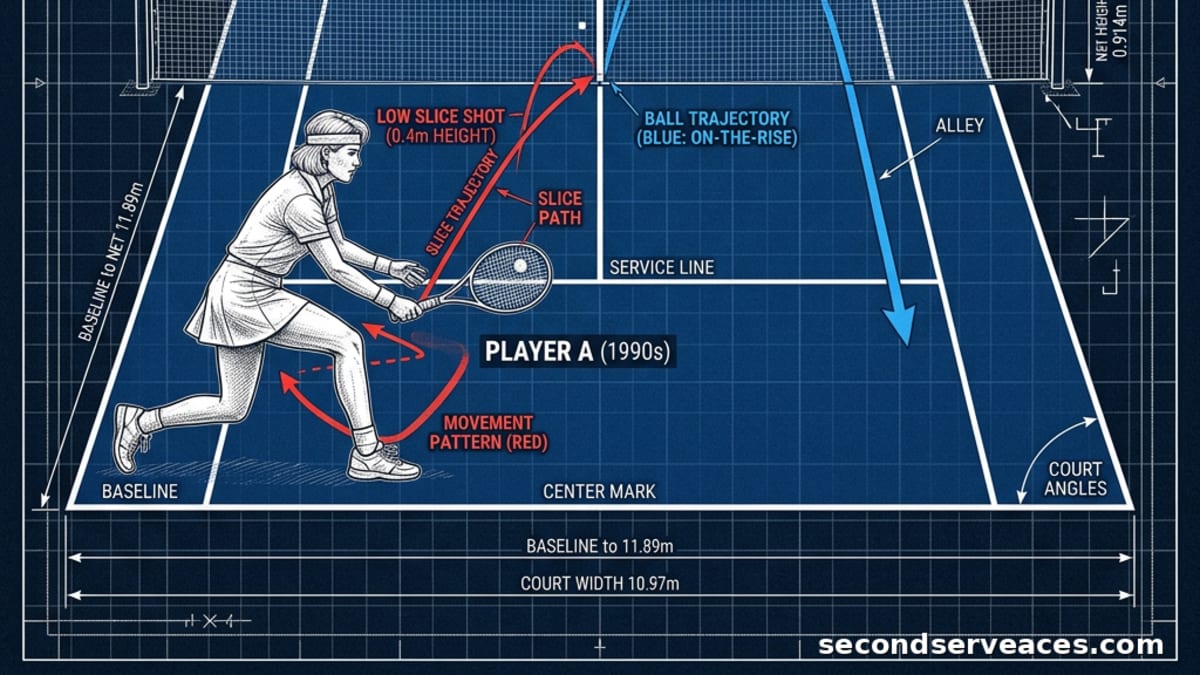
For years, Graf’s backhand slice was the ultimate defensive reset and offensive setup. It was a vicious, biting shot that stayed incredibly low. Opponents were forced to bend low, generate their own pace, and hit upward—perfectly feeding into Graf's predatory instincts. Once an opponent left a ball short and high, Graf would dance around her backhand wing and unleash her legendary forehand.
Seles, however, completely neutralized this pattern. Because she used two hands on both the forehand and backhand, she possessed immense wrist stability. Instead of waiting for Graf’s slice to slide and die on the court, Seles stepped inside the baseline, met the ball at the apex of its bounce, and drove it flat and deep into Graf's backhand corner. By refusing to let the slice drop below her knees, Seles maintained a high strike zone, turning Graf’s defensive weapon into an offensive opportunity for herself.
"Seles didn't just play tennis; she compressed the court. She took away the air, the bounce, and most importantly, the time."
The Battle for the Deuce Corner
The core tactical battleground of this rivalry was the deuce court. Graf’s preference was to camp in her ad-court corner, shielding her backhand and hunting for inside-out forehands. To do this successfully, she relied on exceptional lateral movement. Seles understood that the only way to break this pattern was to force Graf to hit on the dead run from her forehand side.
Seles executed this with devastating angles. Using her double-handed backhand, Seles could create extreme crosscourt angles that pulled Graf far out wide to her forehand side. Unlike the classical baseline battles we analyzed in our breakdown of Hingis vs. The Williams Sisters, where court positioning was a game of chess, Seles made it a game of high-speed chicken. If Graf overcommitted to covering her backhand side, Seles would ruthlessly fire a flat, two-handed forehand down the line, catching Graf completely out of position.
Redefining Court Positioning
Before Seles emerged, baseline play was primarily a game of depth and patience. Seles turned it into an offensive siege. By standing up to two feet inside the baseline to receive serve, she took away the server's angles. In their classic encounters at the French Open and Australian Open, Seles’s return of serve was a masterclass in aggressive court positioning.
When Graf served wide to Seles’s forehand, Seles did not retreat to gain a better angle. Instead, she stepped forward, catching the ball on the rise and driving it back hard and deep down the middle. This jammed Graf, who was still in her recovery phase from the service motion. According to historical data and the standard set in the WTA rankings of that era, this relentless pressure was the only strategy that consistently broke Graf's rhythm.
Ultimately, the Graf-Seles rivalry was a masterclass in how contrasting technical systems collide. Seles's flat, early-take aggression forced Graf to defend in ways she never had to before, creating a tactical blueprint that modern baseline players still use today.
Essential Matchday Add-Ons
Tournament-tested accessories and high-frequency consumables every competitive player keeps in their bag.
Tourna Grip Original Dry Feel Overgrip (10-Pack)
4.8 ★ (12,000+ reviews)
The gold standard for sweaty hands. Proprietary dry feel absorbs moisture better as play intensifies.
Luxilon ALU Power 125 Silver String Set
4.9 ★ (3,500+ reviews)
Unrivaled control and spin potential used by over 50% of the ATP Top 100 players.
Babolat Custom Damp Vibration Dampener (2-Pack)
4.7 ★ (4,200+ reviews)
Customizable dampening with removable central O-ring for fine-tuning court feedback and sound.
Penn Championship Extra Duty Tennis Balls (4-Can Pack)
4.7 ★ (8,900+ reviews)
Official ball of USTA League Tennis with extra-duty felt designed for abrasive hard courts.
Analyze Steffi Graf vs. Monica Seles
Predict tactical adjustments, momentum swings, and serve strategy options for this match-up using our AI simulator.
The Aces Tactical Panel
This report was curated and edited by Bhaskar Goel. Tactical analysis and technical insights were provided by our specialized panel of expert correspondents.
Julian Price
Senior Tactical Correspondent
Stuffy, pedantic British academic and historian specializing in match momentum and historical context.
Elena Cruz
Director of Analytical Research
Data scientist specializing in court surface physics and movement patterns.
Bhaskar
The Editor & Fan
Passionate tennis player and site editor bringing everyday amateur insights and relatable fan commentary.
Arthur Vance
Senior Existential Analyst
Deep, eccentric, and DFW-inspired. Models court metaphysics, kinetic beauty, and player psychology.
Leo Sterling
High-Performance Consultant
Hard-nosed ex-trainer from Melbourne with a no-nonsense view on tour fitness.
Related Reports


Quick Answers
How did Monica Seles neutralize Steffi Graf's backhand slice?+
Seles stepped inside the baseline to hit the ball at the apex of its bounce, using her two-handed grip to drive the low-skidding slice deep and flat before it could drop.
What was Monica Seles's primary strategy against Graf's inside-out forehand?+
Seles used sharp, double-handed crosscourt angles to pull Graf deep into her vacant forehand side, forcing her to hit on the run rather than controlling the court.
How did Seles's court positioning disrupt Graf's service game?+
Seles stood up to two feet inside the baseline to receive serves, taking the ball on the rise to jam Graf while she was still recovering from her service motion.