
Connors vs. Lendl: The Day Tennis Lost Its Innocence
There is a specific, highly localized brand of violence in tennis that does not involve physical contact but is, if anything, more psychologically ruinous because of its distance. To understand the transition of professional tennis from a theatrical, gut-driven spectacle into a cold, systematic industry, one must look at the collision between Jimmy Connors and Ivan Lendl in the early-to-mid 1980s. It was not merely a rivalry of contrasting styles; it was an ideological war over the very soul of the sport.
Listen to the Second Serve Podcast
Get our daily AI-synthesized audio briefings and match reviews on the go.
Connors, with his flat, short-skirted groundstrokes and his T2000 steel racket, played tennis like a man defending his property from home invaders. He grunted, he gestured, he weaponized the crowd's collective id. He was the ultimate counter-puncher, relying on anticipation and a flat backhand that defied the laws of aerodynamics. According to historical records on Jimmy Connors, his entire game was built on emotional friction—he needed an enemy, real or manufactured, to fuel his relentless baseline hustle.
The Arrival of the Czech Machine
Then came Ivan Lendl. If Connors was a street fighter, Lendl was a heavy industrial plant. The Czech arrived with a graphite frame, a devastating topspin forehand whipped from six feet behind the baseline, and a physical conditioning regimen that made his contemporaries look like weekend hobbyists. Lendl did not care about the crowd; he actively despised them. He did not seek friction; he sought efficiency. His tennis was a kinetic demolition of the opponent’s physical limitations, systematic and utterly unyielding.
"He doesn't play tennis," Connors once muttered of Lendl. "He just hits the ball."
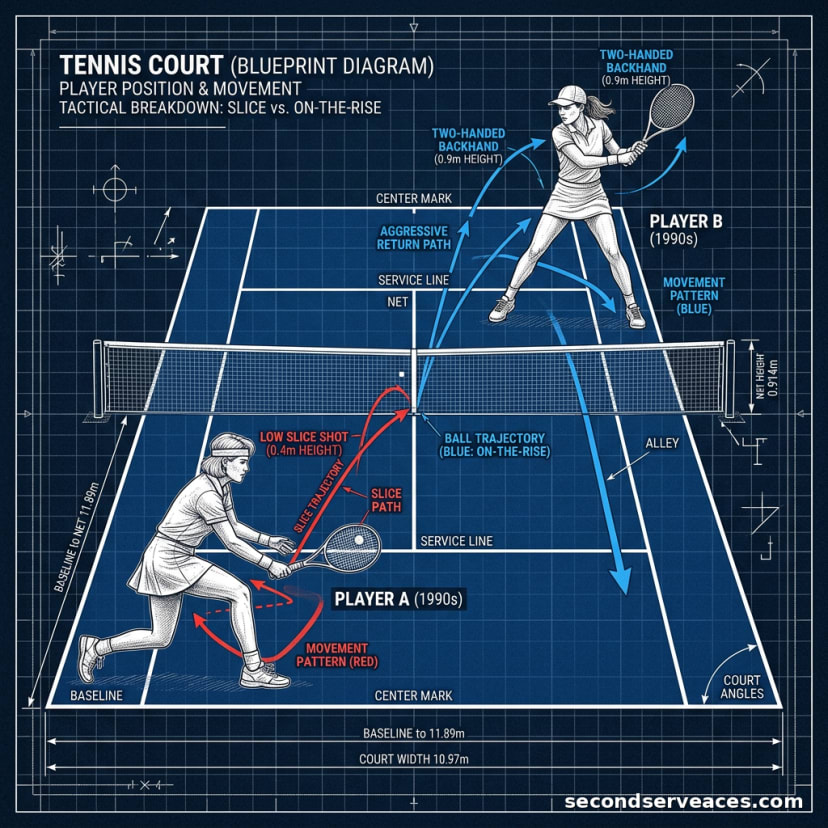
But that hitting of the ball changed everything. Lendl's heavy-topspin loops, hit with immense racket-head speed, forced Connors out of his preferred strike zone. In the past, Connors could redirect flat pace with ease. But Lendl’s ball didn't just arrive; it exploded off the court surface, jumping toward Connors’s shoulders, rendering his flat-hitting style obsolete. This shift toward mechanical dominance and baseline attrition foreshadowed the data-driven systems we detailed in The Algorithmic Court.
The Metaphysical Shift on Dirt and Hardcourts
Their matches, particularly their brutal encounters at the US Open and the Masters, were grueling physical exams. Lendl’s conditioning allowed him to play five-hour matches without his heart rate seemingly exceeding eighty beats per minute. He systematically dismantled the aging American’s legs, hitting deep, heavy balls to the corners until Connors’s legendary wheels simply gave out. This was the birth of modern baseline tennis, a style that would eventually be perfected in the brutal baseline wars of the 21st century, as we analyzed in our breakdown of Djokovic vs Nadal.
By the time Lendl assumed the world number one ranking, a position documented extensively by the ATP Tour, the sport had irrevocably changed. The era of the charismatic, seat-of-the-pants shotmaker was over. Lendl had introduced diet, off-court fitness, and heavy topspin as the baseline currency of professional tennis. It was the day the sport lost its theatrical innocence and found its modern, athletic soul.
Analyze Jimmy Connors vs. Ivan Lendl
Predict tactical adjustments, momentum swings, and serve strategy options for this match-up using our AI simulator.
The Aces Tactical Panel
This report was curated and edited by Bhaskar Goel. Tactical analysis and technical insights were provided by our specialized panel of expert correspondents.
Julian Price
Senior Tactical Correspondent
Stuffy, pedantic British academic and historian specializing in match momentum and historical context.
Elena Cruz
Director of Analytical Research
Data scientist specializing in court surface physics and movement patterns.
Bhaskar
The Editor & Fan
Passionate tennis player and site editor bringing everyday amateur insights and relatable fan commentary.
Arthur Vance
Senior Existential Analyst
Deep, eccentric, and DFW-inspired. Models court metaphysics, kinetic beauty, and player psychology.
Leo Sterling
High-Performance Consultant
Hard-nosed ex-trainer from Melbourne with a no-nonsense view on tour fitness.
Related Reports


Quick Answers
How did Ivan Lendl's playing style disrupt Jimmy Connors's game?+
Lendl used heavy topspin and extreme racket-head speed, which forced the ball to bounce high out of Connors's preferred low strike zone, neutralizing his flat groundstrokes.
What racket technology shift is highlighted in the Connors vs. Lendl rivalry?+
The rivalry highlighted the transition from older metal and wood frames like Connors's steel T2000 to modern, powerful graphite frames favored by Lendl.
Why is the Connors-Lendl rivalry considered a turning point in tennis history?+
It marked the transition from the theatrical, emotion-driven style of the 1970s to the highly conditioned, systematic, baseline-dominated modern era.