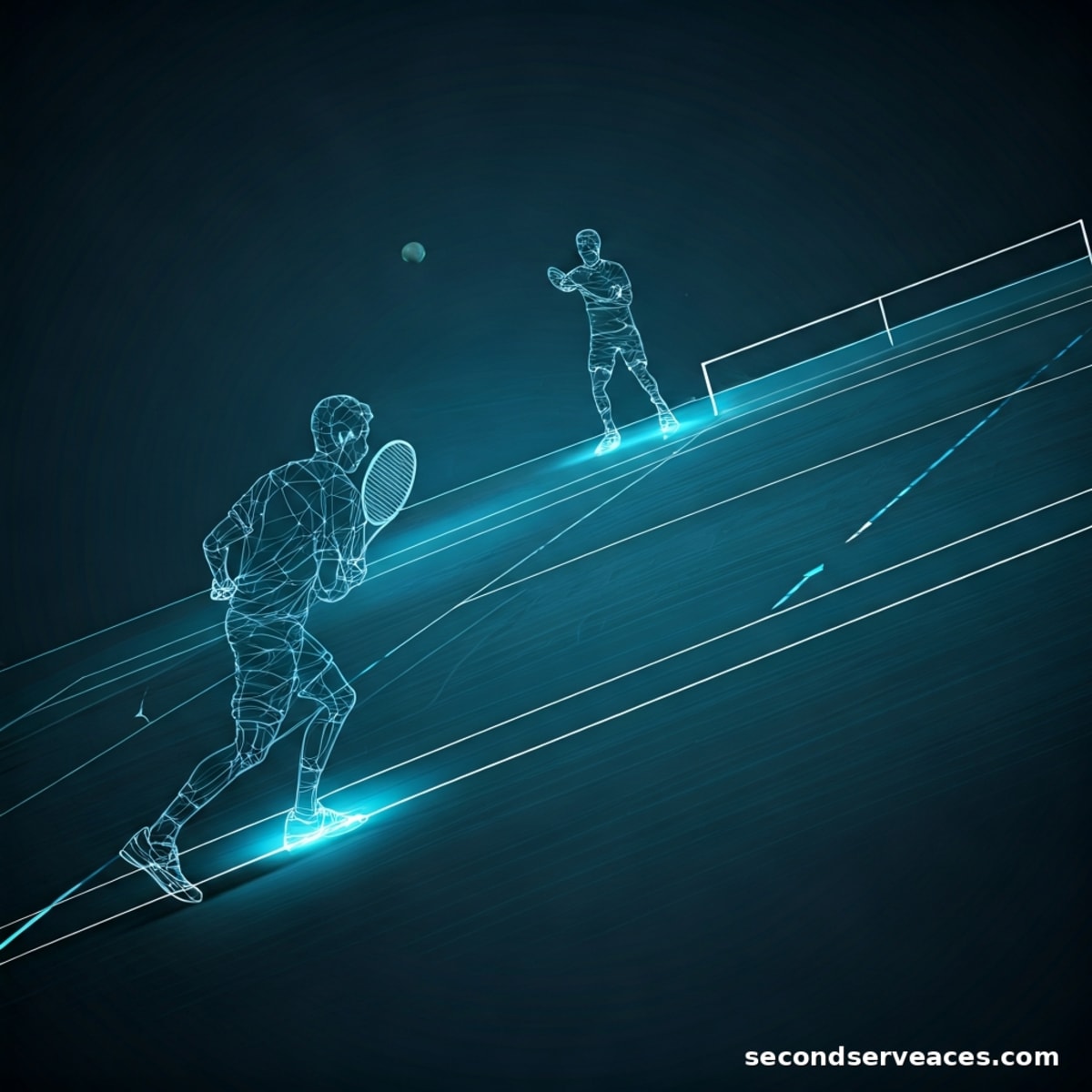
Sampras vs. Agassi: The Ultimate Clash of Court Geometry
Forget the denim shorts, the neon shirts, and the rock-and-roll marketing campaigns of the 1990s. When Pete Sampras and Andre Agassi stepped onto a tennis court, they weren't just playing a match; they were arguing a violent thesis on spatial geometry. It was the ultimate battle of court positioning: the unstoppable force of the forward-charging serve-and-volleyer against the immovable object of the baseline returner. Every rally was a high-speed chess match played with yellow felt and graphite.
Listen to the Second Serve Podcast
Get our daily AI-synthesized audio briefings and match reviews on the go.
The Serve: Pete’s Disguise and the Power of the "T"
To understand Sampras’s dominance, you must look at his shoulder turn. It was massive, coiling like a steel spring. But the real genius lay in his disguise. Whether Pete was hitting a 125-mph flat bomb down the "T" or a heavy kick serve out wide on the ad court, his ball toss was identical. This made reading the serve early virtually impossible for anyone—except, perhaps, Agassi.
Sampras didn't just rely on raw pace; he relied on the geometry of the court. By consistently hitting the "T" on the ad side, he forced opponents to reach, opening up the entire court for his first volley. While we've lamented the decline of this forward-moving style in our look at the death of serve-and-volley, Sampras was its absolute peak. According to historical data on the ATP Tour, Sampras's hold percentage on fast grass and hard courts remains among the most efficient in tennis history because he never allowed the returner to establish a rhythm.
The Return: Andre's Short Backswing and Early Strike Point
On the other side of the net stood Andre Agassi, a player who redefined the physics of the return. Most players of that era retreated behind the baseline to cope with massive serves. Agassi did the opposite. He stepped up, often standing on or inside the baseline, cutting off the angles before the ball could jump out of his strike zone.
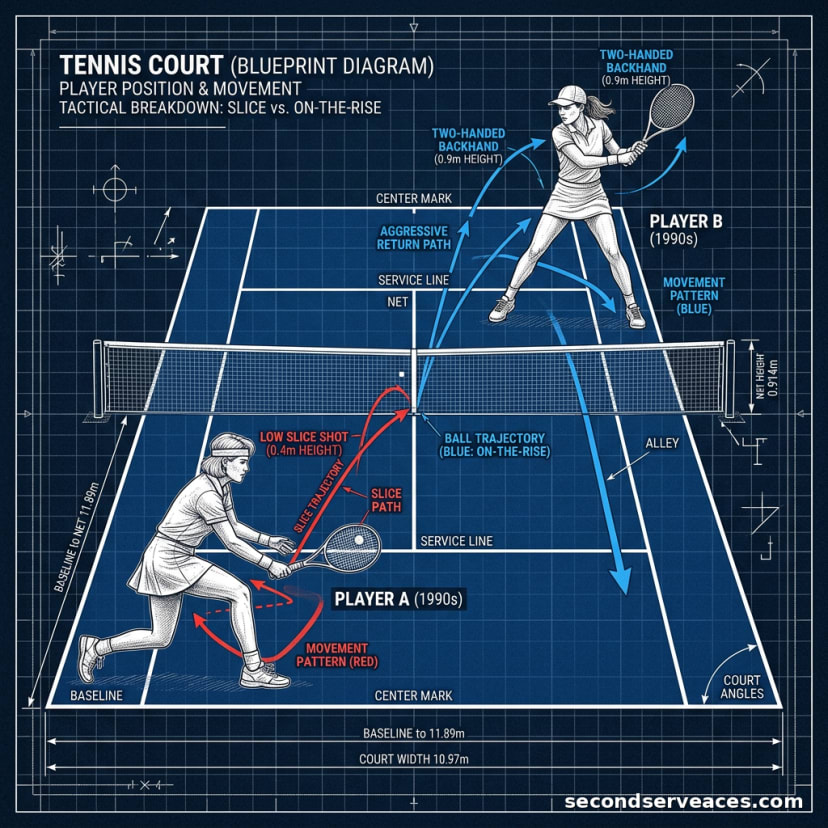
How did he do it? Biomechanically, Agassi’s return was a marvel of efficiency. His backswing was virtually nonexistent—a short, compact block that utilized the server's own pace. By taking the ball on the rise, Agassi robbed Sampras of precious split-seconds needed to reach the net. Agassi's ability to neutralize the bounce, much like his historic performances documented on Andre Agassi's Wikipedia biography, turned the return of serve from a defensive stroke into an offensive weapon.
The Tactical Battleground: Shrinking the Net vs. Stretching the Baseline
The tactical battle was simple yet incredibly complex. Sampras wanted to shrink the net. By getting tight to the net tape, he cut off Agassi’s passing angles, forcing Andre to hit micro-precise lobs or dipping passing shots at Pete's feet.
Agassi, conversely, wanted to stretch the baseline. He used his legendary lateral movement to run Sampras from corner to corner, dragging him into grueling, multi-shot rallies. While Pete possessed a formidable running forehand, his one-handed backhand was often targeted, a stroke style we explored in the elegance in extinction of the one-handed backhand. If Agassi could drag Sampras into a crosscourt backhand exchange, the point was effectively over.
"It was a clash of absolute purity. Pete wanted to play on his terms—fast, vertical, decisive. Andre wanted to play on his—wide, horizontal, exhausting. Neither man ever blinked."
This contrast in styles is what made their rivalry the definitive matchup of their generation. It was a perfect, symmetrical division of court space that we rarely see in today's homogenized, baseline-dominant game.
Analyze Pete Sampras vs. Andre Agassi
Predict tactical adjustments, momentum swings, and serve strategy options for this match-up using our AI simulator.
The Aces Tactical Panel
This report was curated and edited by Bhaskar Goel. Tactical analysis and technical insights were provided by our specialized panel of expert correspondents.
Julian Price
Senior Tactical Correspondent
Stuffy, pedantic British academic and historian specializing in match momentum and historical context.
Elena Cruz
Director of Analytical Research
Data scientist specializing in court surface physics and movement patterns.
Bhaskar
The Editor & Fan
Passionate tennis player and site editor bringing everyday amateur insights and relatable fan commentary.
Arthur Vance
Senior Existential Analyst
Deep, eccentric, and DFW-inspired. Models court metaphysics, kinetic beauty, and player psychology.
Leo Sterling
High-Performance Consultant
Hard-nosed ex-trainer from Melbourne with a no-nonsense view on tour fitness.
Related Reports
Quick Answers
How did Andre Agassi neutralize Pete Sampras's serve?+
Agassi stood on or inside the baseline, utilizing a short backswing to take Sampras's heavy serves on the rise and rob him of transition time to the net.
What was the main tactical objective for Pete Sampras in this rivalry?+
Sampras aimed to shorten the points by using disguised serves to the 'T' and quickly moving forward to shrink the net and cut off Agassi's passing angles.
Where did Sampras and Agassi typically face off in major finals?+
Their legendary rivalry was highlighted by historic showcase matches at both the US Open and Wimbledon, representing the pinnacle of fast-court tennis in the 1990s.