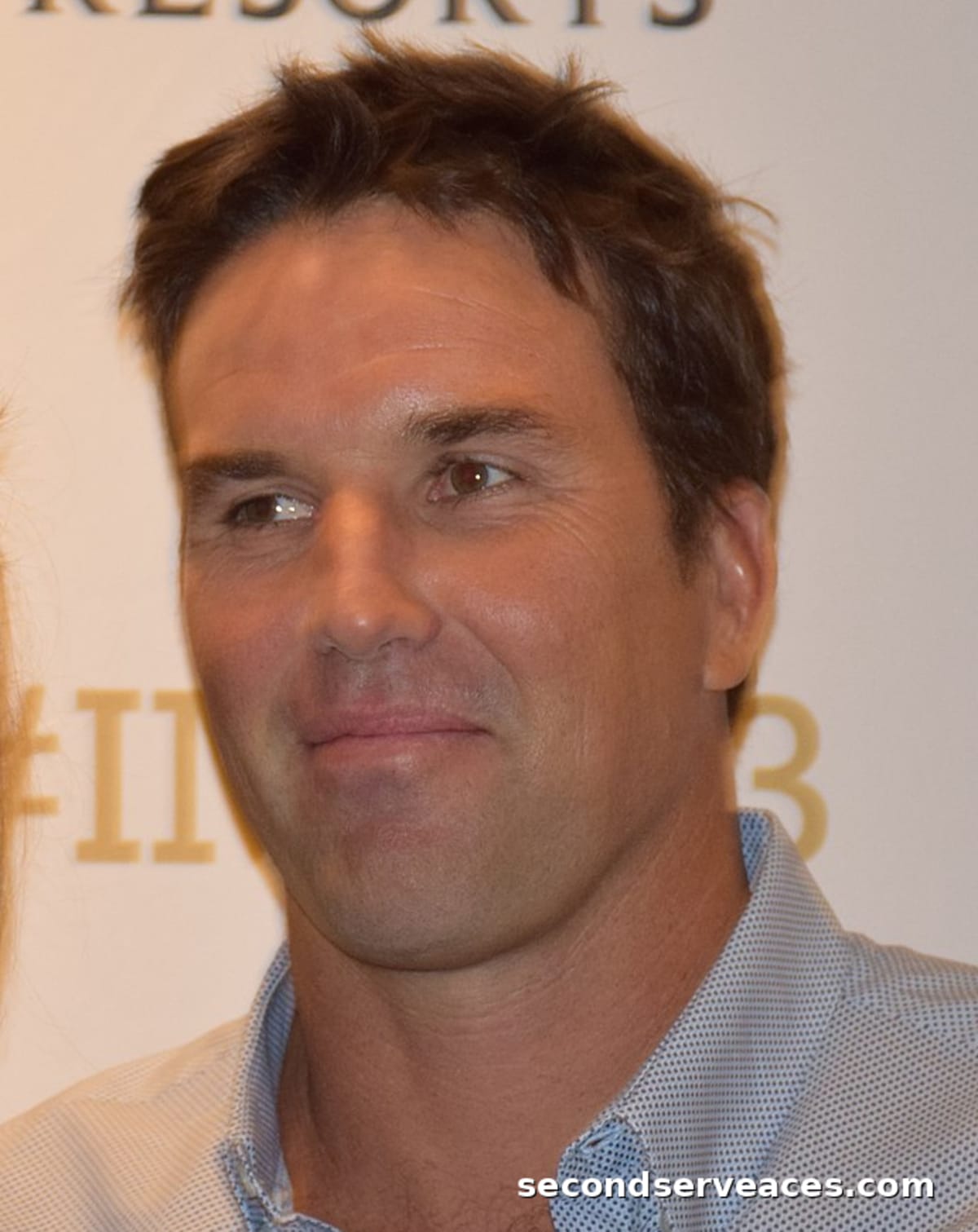
Pat Rafter, the former world No. 1 and two-time US Open champion, represents a classic era of Australian tennis defined by relentless net-rushing and sharp volleying. Today, as the vice captain for the Rest of the World team at the Laver Cup, Rafter watches a vastly different tactical landscape unfold. The modern game demands extreme baseline efficiency, a shift highlighted by the rise of Alex De Minaur, who reached a career-high of World No. 5 in July 2026, according to the official ATP rankings.
Listen to the Second Serve Podcast
Get our daily AI-synthesized audio briefings and match reviews on the go.
The transition from Rafter's chip-and-charge style to De Minaur's lightning-fast counter-punching illustrates how much court positioning has evolved. Where Rafter used his slice to force low-contact volleys at the net, modern Australian players rely on heavy topspin and sliding defensive recoveries to control the baseline. This structural shift has kept Australia at the forefront of international tennis, producing players who can adapt to the slower bounce of contemporary hard courts.
Rafter’s observations on this evolution are not merely nostalgic; they are deeply analytical. He notes that while the raw physical demands of the sport have increased, the fundamental need for spatial awareness remains identical. Whether defending the net or redirecting pace from three meters behind the baseline, the ability to read the opponent's racket face at contact is what separates elite competitors from the rest of the pack.
The Washington Clash of Lleyton Hewitt’s Dual Legacies
The intersection of Australian tennis history reached a fascinating peak in Washington, where Alex De Minaur faced 17-year-old Cruz Hewitt. This was no ordinary second-round matchup; it was a direct clash between Lleyton Hewitt’s long-term pupil and his own son. De Minaur, who has spent years absorbing the grit and court-craft of the elder Hewitt, found himself on the opposite side of the net from the teenager carrying that very same DNA.
The match lasted just 61 minutes, but it provided a masterclass in professional positioning. De Minaur exposed the physical gap between junior tennis and the top tier of the ATP Tour, consistently targeting Cruz's deeper backhand corner to force short replies. As we detailed in our previous coverage of the Washington Open, De Minaur's ability to take the ball on the rise prevented the young Hewitt from establishing any rhythm.
For Lleyton Hewitt, watching from the player box, the match was a testament to his influence on both competitors. De Minaur utilized his veteran instincts to cut off angles early, while Cruz showed flashes of his father's trademark competitive fire, attempting to counter De Minaur's depth with aggressive forehand drives. This generational crossover highlights the tight-knit mentorship structure that continues to define the Australian tennis ecosystem.
Cruz Hewitt's Transition from the Wimbledon Boys' Final to the ATP Tour
Cruz Hewitt’s rise has been rapid, marked by a stellar run to the boys' singles final at Wimbledon in 2026. Transitioning from the junior ranks to the professional circuit requires a massive adjustment in ball speed and tactical discipline. While junior opponents often allow time to recover, ATP pros like De Minaur exploit even a half-step of poor recovery positioning instantly.
In his recent ATP tour match win, Cruz demonstrated a highly capable serve-plus-one strategy, using wide serves to open up the court for flat forehand winners. However, against De Minaur, those same patterns were negated by superior return depth. Cruz found himself pushed back into defensive positions, struggling to find the racket head speed necessary to reverse the rally momentum.
Rafter has pointed out that Cruz’s development will hinge on physical maturation and refining his transition play. At 17, the teenager possesses the raw mechanics—a clean double-handed backhand and excellent footwork—but needs to build the core strength required to withstand heavy, deep balls over multiple sets. The 61-minute lesson in Washington serves as a valuable benchmark for his developmental trajectory.
Rafter’s New Court Passion and the Technical Overlap with Padel
While monitoring the next generation of tennis players, Pat Rafter has channeled his competitive drive into a new discipline: padel. As an ambassador for Padel Australia and a member of the Aussie Crocs—the national padel squad—Rafter has fully embraced this fast-growing, tennis-adjacent sport. The transition makes perfect sense for a legendary volleyer who spent his career dominating the net.
Padel relies heavily on wall rebounds, short-angled volleys, and precise lobbing, elements that directly mirror the classic serve-and-volley skill set. Rafter’s ability to read spin off the glass and execute soft-touch drop volleys has made him a natural fit for the sport. He notes that padel requires a different kind of tactical patience, where power is often punished and court positioning is entirely collaborative.
The technical synergy between the two sports is undeniable. Tennis players transitioning to padel must unlearn the instinct to hit clean winners from the back of the court and instead focus on constructing points through angles and patience. For Rafter, the sport offers a low-impact way to maintain his competitive edge, proving that the instincts developed on the grass of Wimbledon can find a vibrant second life within the glass walls of a padel court.
Rivalry Matchup & Player Profiles
| Metric | Pat Rafter | Alex De Minaur |
|---|---|---|
| Career High Rank | World No. 1 (1999) | World No. 5 (July 2026) |
| Age | 53 | 27 |
| Country | Australia | Australia |
| Height | 185 cm (6'1") | 183 cm (6'0") |
| Handedness | Right-handed | Right-handed |
| Play Style | Serve and volley, aggressive all-court | Aggressive baseliner, elite court coverage |
| Career Titles | 11 | 11 |
Because Pat Rafter retired from professional tennis in 2002, well before Alex De Minaur turned professional in 2015, they have no active head-to-head record on the ATP Tour. Despite this generational gap, their careers share a striking mathematical symmetry, with both players capturing 11 career singles titles. While Rafter reached the pinnacle of the sport as World No. 1, De Minaur has carved out his own elite status by cracking the top five in 2026, breaking a 17-year drought for Australian male singles players.
Analyze Pat Rafter vs. Alex De Minaur
Predict tactical adjustments, momentum swings, and serve strategy options for this match-up using our AI simulator.
The Aces Tactical Panel
This report was curated and edited by Bhaskar Goel. Tactical analysis and technical insights were provided by our specialized panel of expert correspondents.
Julian Price
Senior Tactical Correspondent
Stuffy, pedantic British academic and historian specializing in match momentum and historical context.
Elena Cruz
Director of Analytical Research
Data scientist specializing in court surface physics and movement patterns.
Bhaskar
The Editor & Fan
Passionate tennis player and site editor bringing everyday amateur insights and relatable fan commentary.
Arthur Vance
Senior Existential Analyst
Deep, eccentric, and DFW-inspired. Models court metaphysics, kinetic beauty, and player psychology.
Leo Sterling
High-Performance Consultant
Hard-nosed ex-trainer from Melbourne with a no-nonsense view on tour fitness.
Related Reports
Quick Answers
Who won the match between Alex De Minaur and Cruz Hewitt in Washington?+
Alex De Minaur defeated 17-year-old Cruz Hewitt in a 61-minute second-round match in Washington.
What is Pat Rafter's role in the sport of padel?+
Pat Rafter serves as an ambassador for Padel Australia and is a member of the Aussie Crocs, the national padel squad.
What major junior milestone did Cruz Hewitt reach in 2026?+
Cruz Hewitt reached the boys' singles final at Wimbledon in 2026.