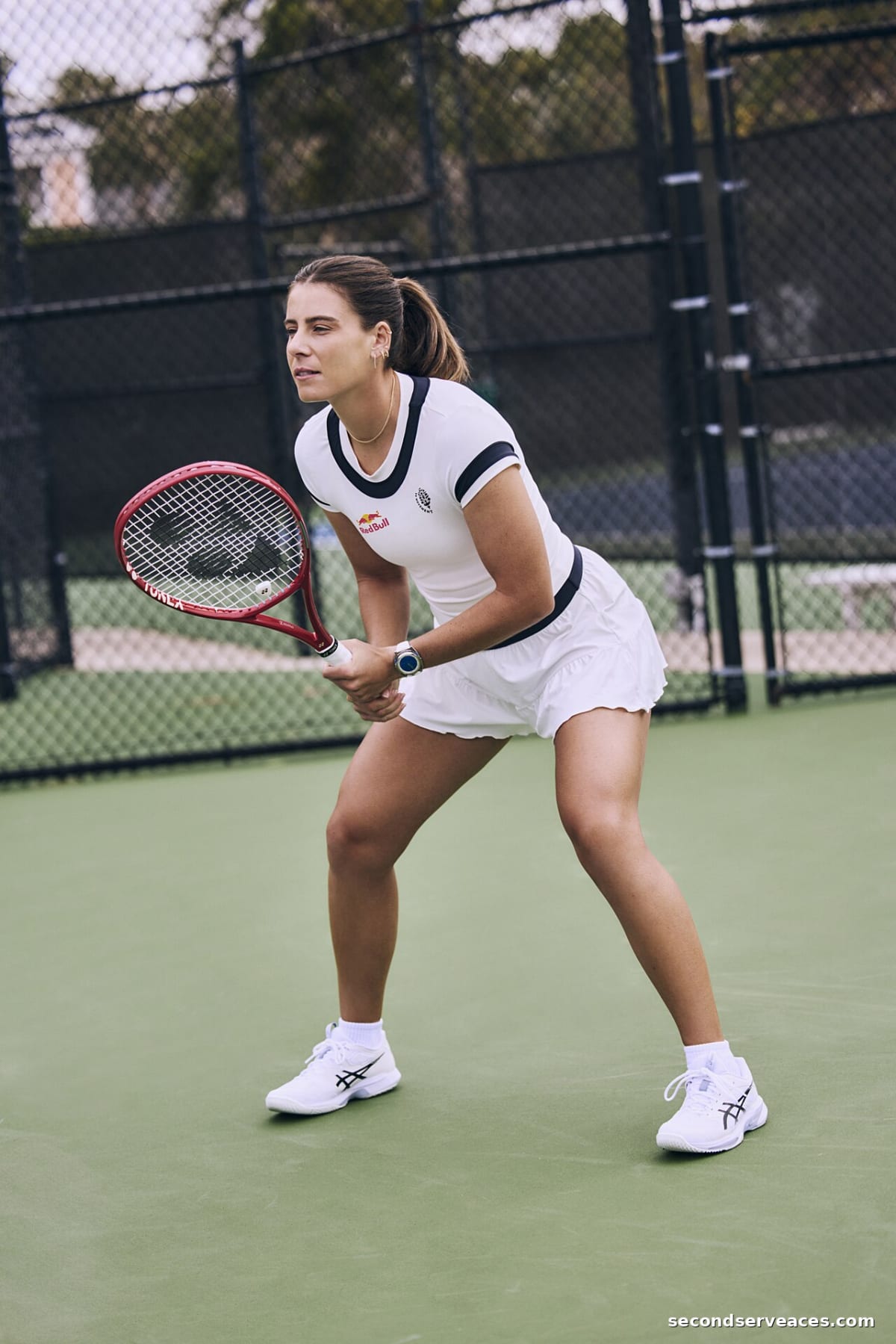
The Precision of Navarro’s Strasbourg Triumph
In the quiet, rhythmic geometry of the Strasbourg Open, Emma Navarro found a resolution that had eluded her for over a year. Her 6-0, 5-7, 6-2 victory over Victoria Mboko was not merely a scoreline; it was a testament to the recalibration of her baseline patience. As we detailed in our previous analysis of her clay-court mechanics, Navarro’s ability to manipulate the court’s friction requires a specific, almost architectural mental state.
Listen to the Second Serve Podcast
Get our daily AI-synthesized audio briefings and match reviews on the go.
The opening set was a masterclass in efficiency, with Navarro dictating the tempo through heavy, loopy topspin that forced Mboko into uncomfortable defensive postures. While the second set offered a momentary lapse—a brief entropy where the ball seemed to find the tape with cruel regularity—Navarro’s third-set response was definitive. She regained her tactical footing, ensuring her first title in over a season was earned through structural superiority rather than opponent error.
For those tracking the WTA rankings, this performance signals a significant correction. It is the kind of win that serves as an inflection point, moving beyond the mere accumulation of points and into the realm of sustained professional consistency.
Learner Tien’s Tactical Ascendance in Geneva
The Geneva Open finale between Learner Tien and Mariano Navone presented a fascinating study in contrast. Navone, a player whose game is built on the grind, found himself dismantled as the match progressed, eventually falling 3-6, 6-3, 7-5. As noted in our recent coverage of Tien’s trajectory, his capacity to absorb pace and redirect it at acute angles remains his most potent weapon.
Tien’s composure during the final set was the primary narrative differentiator. Where lesser players might have attempted a desperate, low-percentage winner, Tien chose to extend the rallies, forcing Navone to navigate the increasingly unpredictable bounce of the late-tournament clay. It was a victory of composure over raw kinetic output.
This result is a vital data point for observers of the ATP Tour. Tien is proving that the transition from junior dominance to professional stability is not a linear path, but a series of calculated adjustments to match intensity and shot selection under pressure.
Ignacio Buse and the Peruvian Resurgence
The Hamburg Open concluded with a result that resonates deep into the history books: Ignacio Buse’s 7-6 (8-6), 4-6, 6-3 defeat of Tommy Paul. In capturing this title, Buse became the first Peruvian ATP Tour winner since Luis Horna in 2007. The match itself was a frantic, high-octane affair, defined by Buse’s ability to manage the serve-break rhythm that we highlighted in our pre-match breakdown.
Buse’s win is a triumph of technical discipline. Facing a player of Paul’s caliber, Buse maintained an 8-6 edge in the opening tiebreak, a moment that required significant mental fortitude. His ability to hold serve under extreme duress in the third set effectively silenced the momentum Paul had generated during his second-set comeback.
Looking at the ATP rankings, Buse’s ascent is both sudden and deserved. It is a reminder that the field is constantly being reshaped by players willing to embrace the chaotic physics of the clay court.
The Morocco Open and the Reality of Attrition
The Morocco Open final offered a somber reminder of the physical cost of professional competition. Petra Marcinko secured her first career WTA title following the retirement of Anhelina Kalinina. While the manner of victory was unconventional, the consistency Marcinko displayed throughout the week leading up to the final was undeniable.
Retirements are an unfortunate, yet intrinsic part of the game’s infrastructure. They highlight the thin margin between peak performance and the physical limitations of the human frame. For Marcinko, this title remains a career milestone, regardless of the circumstances of the final game.
As the tour continues, we are left to evaluate these results not just as isolated scores, but as indicators of a broader shift in the competitive landscape. The talent pool is deep, the margins are razor-thin, and the game continues to demand everything from those who step onto the court.
Essential Matchday Add-Ons
Tournament-tested accessories and high-frequency consumables every competitive player keeps in their bag.
Tourna Grip Original Dry Feel Overgrip (10-Pack)
4.8 ★ (12,000+ reviews)
The gold standard for sweaty hands. Proprietary dry feel absorbs moisture better as play intensifies.
Luxilon ALU Power 125 Silver String Set
4.9 ★ (3,500+ reviews)
Unrivaled control and spin potential used by over 50% of the ATP Top 100 players.
Babolat Custom Damp Vibration Dampener (2-Pack)
4.7 ★ (4,200+ reviews)
Customizable dampening with removable central O-ring for fine-tuning court feedback and sound.
Penn Championship Extra Duty Tennis Balls (4-Can Pack)
4.7 ★ (8,900+ reviews)
Official ball of USTA League Tennis with extra-duty felt designed for abrasive hard courts.
Analyze Emma Navarro vs. Victoria Mboko
Predict tactical adjustments, momentum swings, and serve strategy options for this match-up using our AI simulator.
The Aces Tactical Panel
This report was curated and edited by Bhaskar Goel. Tactical analysis and technical insights were provided by our specialized panel of expert correspondents.
Julian Price
Senior Tactical Correspondent
Stuffy, pedantic British academic and historian specializing in match momentum and historical context.
Elena Cruz
Director of Analytical Research
Data scientist specializing in court surface physics and movement patterns.
Bhaskar
The Editor & Fan
Passionate tennis player and site editor bringing everyday amateur insights and relatable fan commentary.
Arthur Vance
Senior Existential Analyst
Deep, eccentric, and DFW-inspired. Models court metaphysics, kinetic beauty, and player psychology.
Leo Sterling
High-Performance Consultant
Hard-nosed ex-trainer from Melbourne with a no-nonsense view on tour fitness.
Related Reports
Quick Answers
Who won the Strasbourg Open final?+
Emma Navarro defeated Victoria Mboko with a final score of 6-0, 5-7, 6-2 to claim the title.
What is the historical significance of Ignacio Buse's win in Hamburg?+
Ignacio Buse became the first Peruvian ATP Tour winner since Luis Horna achieved the feat in 2007.
How did Petra Marcinko secure her first WTA title?+
Petra Marcinko won the Morocco Open title after her opponent, Anhelina Kalinina, was forced to retire from the final match.