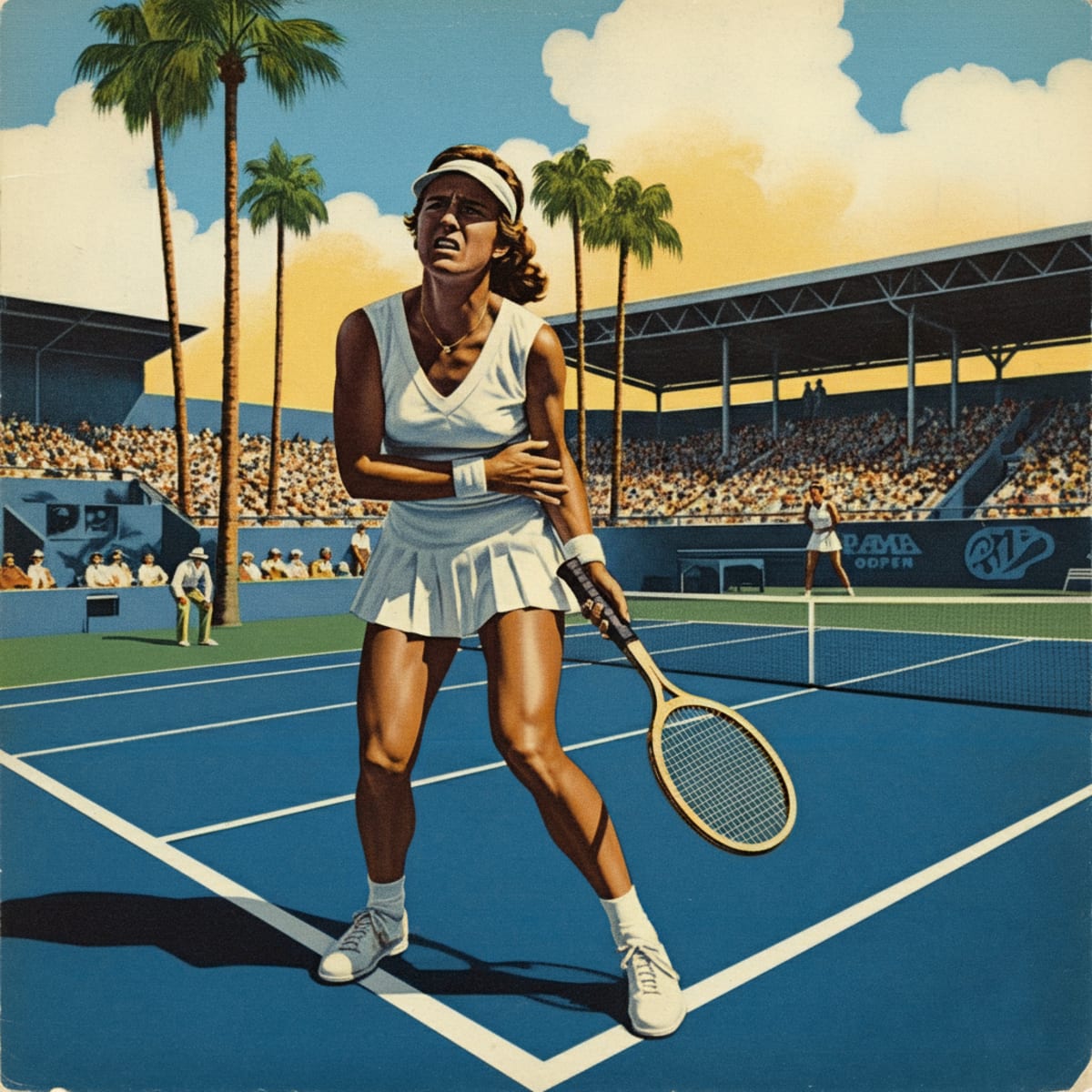
The vibrant sun over the Coachella Valley often brings out the brightest tennis of the season, but on March 8, a sudden, heavy cloud rolled over the hard courts of Indian Wells. The Delray Dynamo, Coco Gauff, found her desert campaign abruptly derailed, leaving the tennis congregation holding its collective breath. Facing the crafty young Filipina, Alex Eala, the American phenom was halted not by a tactical outmaneuvering, but by the sinister, invisible opponent of bodily betrayal.
Listen to the Second Serve Podcast
Get our daily AI-synthesized audio briefings and match reviews on the go.
Shooting pains radiating through the arm forced an unexpected retirement, fundamentally altering the landscape of the WTA's springtime hardcourt swing. Instead of plotting her path to the tournament's second weekend, Gauff was immediately routed to an MRI tube. Now, the whispers are swirling around the humid air of Key Biscayne, as breadcrumbs regarding her upcoming tournament status begin to surface.
Before we dive into the granular mechanics of what this means for the American star, here are the verified details from the desert:
- Coco Gauff retired from her Indian Wells match against Alex Eala on March 8.
- During the contest, Gauff experienced sudden, shooting pains in her arm.
- Medical personnel scheduled her for an MRI to assess the extent of the injury.
- Information regarding Gauff's official status for the impending Miami Open was seemingly posted on the tournament's official website, heightening speculation.
The Tactical Breakdown
When examining the biomechanics of elite hardcourt tennis, an arm injury is perhaps the most debilitating ailment a baseline aggressor can suffer. Gauff’s game is famously built upon a foundation of extraordinary court coverage and aggressive, heavy topspin generation. To execute her signature rally-tolerance patterns, she requires absolute fluidity in her kinetic chain.
Historically, a player wielding an extreme western forehand grip—as Gauff often utilizes to rip the ball high over the net—relies on ferocious racket head speed. The wrist and forearm must snap with violent precision at the point of contact to generate the necessary RPMs (revolutions per minute). When shooting pain enters the arm, the brain subconsciously restricts that muscular explosion. The result? The ball lands short in the service box, instantly turning a neutral rally into an offensive buffet for the opponent.
Furthermore, Alex Eala presents a uniquely complicated tactical matchup for a compromised player. As a left-handed operator, Eala naturally drives her crosscourt forehand directly into Gauff’s backhand wing. Normally, Gauff’s two-handed backhand is a veritable fortress—arguably one of the most reliable shots on the WTA tour. However, a two-handed backhand places significant torque and rotational stress on both arms. If the shooting pain originates anywhere near the elbows or the pronator muscles of the forearm, bracing for the heavy, hooking topspin of a lefty forehand becomes a grueling, agonizing task.
The Biomechanics of Discomfort
Professional tennis players are notorious for their pain tolerance, often subtly adjusting their grip pressure or altering their swing paths mid-match to mask discomfort. Yet, these micro-adjustments inevitably dismantle court geometry. If a player cannot comfortably pronate on the serve, they lose the ability to hit the wide slice in the deuce court or the heavy kick out wide in the ad court. Without those specific serve placements to stretch the returner, a server is left spinning the ball directly into the opponent's strike zone. A retirement, in this context, is not merely a surrender to pain; it is the ultimate tactical concession when the physical tools required to execute a winning blueprint simply vanish.
The Bigger Picture
The transition from the arid, flying conditions of Indian Wells to the heavy, oceanic air of the Miami Open is one of the most demanding physical pivots in professional sports. Affectionately dubbed the "Sunshine Double," this month-long gauntlet has historically chewed up and spit out even the most conditioned athletes. For Gauff, an arm injury at this specific juncture of the calendar represents a massive hurdle in her season trajectory.
We have seen legendary campaigns stall out in the desert due to upper extremity ailments. The hard courts in California are incredibly gritty, forcing balls to bounce high and requiring players to strike the ball repeatedly from above their shoulders. This constant high-contact point accelerates wear and tear on the shoulder capsule and forearm tendons. If the MRI reveals structural inflammation or a strain, her team faces a monumental decision regarding her schedule.
Looking Ahead to South Florida
The murmurs surrounding the Miami Open website update only add to the suspense. The WTA Tour is an unforgiving ecosystem; ranking points wait for no one, and the pressure to perform on home soil is a heavy mantle to bear. Yet, the long-term health of a franchise player always supersedes a single tournament appearance.
If Gauff is forced to bypass Miami, it radically opens up the bottom half of the draw, altering the strategic calculus for the rest of the field. Players who historically struggle against Gauff’s elite lateral movement will suddenly find their pathways to the quarterfinals entirely unclogged. Conversely, if she attempts to play through residual soreness, she risks exacerbating the issue ahead of the demanding European clay-court swing—a surface where she has previously thrived and reached the pinnacle of Roland Garros.
The coming days will be defined by medical imaging and careful consultation. The tennis world watches with bated breath, hoping the Delray Dynamo's signature smile and blazing backhands return to the stadium courts sooner rather than later.
What Coco Gauff Plays With
Head Boom MP 2024
Head Lynx Tour 1.25
Analyze Coco Gauff vs. Alex Eala
Predict tactical adjustments, momentum swings, and serve strategy options for this match-up using our AI simulator.
The Aces Tactical Panel
This report was curated and edited by Bhaskar Goel. Tactical analysis and technical insights were provided by our specialized panel of expert correspondents.
Julian Price
Senior Tactical Correspondent
Stuffy, pedantic British academic and historian specializing in match momentum and historical context.
Elena Cruz
Director of Analytical Research
Data scientist specializing in court surface physics and movement patterns.
Bhaskar
The Editor & Fan
Passionate tennis player and site editor bringing everyday amateur insights and relatable fan commentary.
Arthur Vance
Senior Existential Analyst
Deep, eccentric, and DFW-inspired. Models court metaphysics, kinetic beauty, and player psychology.
Leo Sterling
High-Performance Consultant
Hard-nosed ex-trainer from Melbourne with a no-nonsense view on tour fitness.