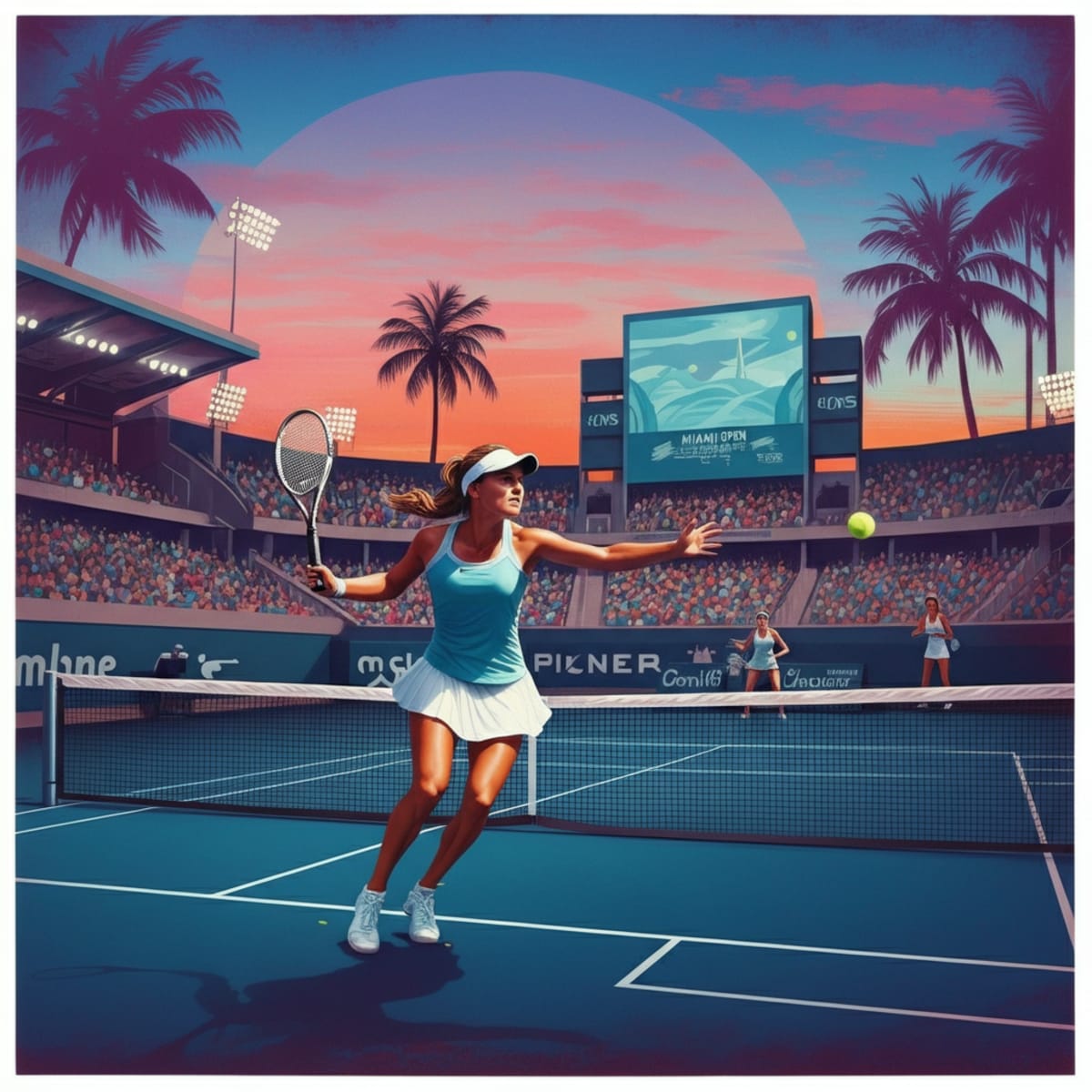
Greetings, racquet club regulars! Welcome to the Magic City, where the neon glows, the palm trees sway, and the hard courts positively sizzle. Let us talk about Florida’s own kinetic marvel, Coco Gauff. Managing a pesky left arm injury that unceremoniously curtailed her desert campaign at Indian Wells, our hometown hero leaped into uncharted territory at the 2026 Miami Open.
Listen to the Second Serve Podcast
Get our daily AI-synthesized audio briefings and match reviews on the go.
Surviving a rigorous three-set tango in the Round of 16 against the veteran Romanian ball-striker, Sorana Cirstea, Gauff booked her inaugural ticket to a Miami quarterfinal. The Sunshine State spectacle has rarely been kind to her in the later rounds, but this victory felt remarkably different—and the catalyst came from the most unlikely of places.
How exactly did she crack the Cirstea code? Not from a clandestine coaching dossier, but from the digital ether! Following the match, Gauff confessed to modifying her game plan mid-tournament after scrolling through a social media app. A digital denizen on Threads suggested she storm the net with more urgency. Coco listened, laced up her volleying shoes, and served up a spectacular stylistic shift to outmaneuver her veteran opponent.
The Tactical Breakdown
Look closely at the geometry of this Round of 16 encounter. Cirstea operates best with a metronomic baseline rhythm, teeing off on mid-court balls with flat, penetrating groundstrokes. Gauff’s historic tendency has been to grind opponents into dust using her superlative lateral movement. However, harboring that lingering left-arm ailment means extended baseline rallies—especially heavy, two-handed backhand exchanges—are hazardous to her longevity in this event.
By employing the fan-sourced strategy of elevated net approach frequency, Gauff fundamentally altered the match dynamic. Her execution relied on several key mechanical adjustments:
- Abbreviating the Rallies: Moving forward allowed Gauff to finish points in three or four shots, significantly reducing the wear and tear on her injured left arm.
- Exploiting Court Geometry: Driving a deep slice or a heavy topspin forehand into the corners, she followed the trajectory forward, suffocating Cirstea’s reaction time.
- Disrupting Eye Level: This transition game forces the opponent to hit uncomfortable, low-percentage passing shots from defensive postures.
It is a brilliant adaptation, marrying her natural athleticism with necessary injury management. When you cover the front of the court with Gauff's wingspan, the angles disappear very quickly for the baseline defender.
The Bigger Picture
Breaking the Round of 16 ceiling in her own backyard clears a monumental psychological hurdle for the young American. The Miami hard courts have occasionally frustrated her in the past, but the 2026 campaign possesses a distinct aura of adaptability. When a player begins to seamlessly integrate new dimensions into her identity mid-tournament, the rest of the locker room takes notice.
Awaiting her in the elite eight is the ever-dangerous Swiss tactician, Belinda Bencic. Bencic punched her own quarterfinal ticket by dispatching the heavy-hitting Amanda Anisimova, proving her hard-court timing is as crisp as ever. As they prepare to cross racquets, Gauff brings a comforting 4-2 head-to-head superiority into the fray.
Bencic thrives on taking the ball impossibly early, absorbing pace, and redirecting traffic. If Gauff continues her newly discovered aerial assault at the net, we are in for a fascinating clash of geometric philosophies. Will the Swiss wall hold firm, or will the Floridian's net-rushing barrage carry her into the weekend? Grab your panama hats, folks—Miami is heating up.
What Coco Gauff Plays With
Head Boom MP 2024
Head Lynx Tour 1.25
Analyze Coco Gauff vs. Sorana Cirstea
Predict tactical adjustments, momentum swings, and serve strategy options for this match-up using our AI simulator.
The Aces Tactical Panel
This report was curated and edited by Bhaskar Goel. Tactical analysis and technical insights were provided by our specialized panel of expert correspondents.
Julian Price
Senior Tactical Correspondent
Stuffy, pedantic British academic and historian specializing in match momentum and historical context.
Elena Cruz
Director of Analytical Research
Data scientist specializing in court surface physics and movement patterns.
Bhaskar
The Editor & Fan
Passionate tennis player and site editor bringing everyday amateur insights and relatable fan commentary.
Arthur Vance
Senior Existential Analyst
Deep, eccentric, and DFW-inspired. Models court metaphysics, kinetic beauty, and player psychology.
Leo Sterling
High-Performance Consultant
Hard-nosed ex-trainer from Melbourne with a no-nonsense view on tour fitness.