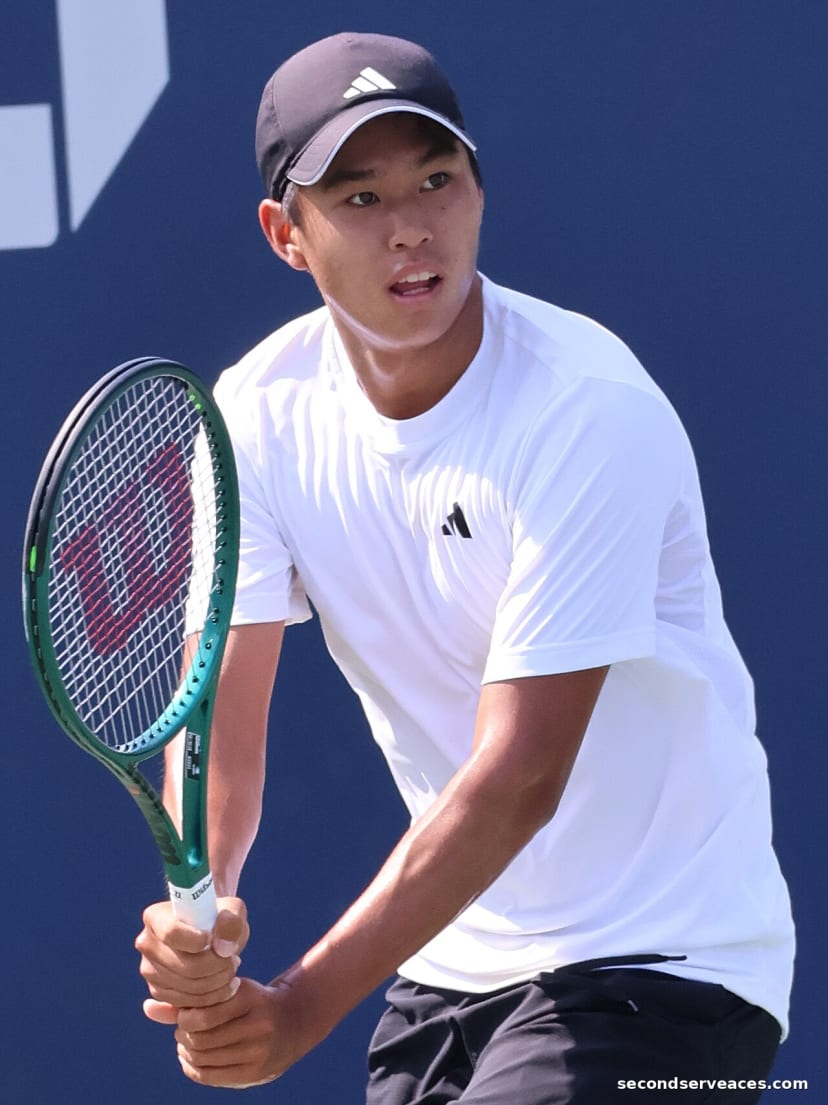
The professional tennis tour is a living, breathing entity that rarely relinquishes its grip without a fight. When a player walks away, they don't just leave behind the locker rooms and the relentless travel; they attempt to sever a core piece of their identity. Chris Eubanks has officially realized that severing the tie is easier said than done. The towering American has confirmed he is no longer retired, officially reversing an initial announcement made last year to step away from the sport.
Listen to the Second Serve Podcast
Get our daily AI-synthesized audio briefings and match reviews on the go.
Whispers of his impending exit initially crystallized during a raw, candid November appearance on the Served with Andy Roddick podcast. Sitting across from a former world number one who intimately understands the crushing weight of expectation, Eubanks first discussed the very real potential of laying down his rackets. Yet, the quiet that follows retirement is often deafening. The complete absence of match momentum, the sudden lack of a structured physical regimen, and the void of that primal, one-on-one combat can drive a competitor back to the baseline. For Eubanks, the negotiation with the sport isn't finished.
Unretiring is an open book of vulnerability. It requires looking at the grueling, unforgiving calendar of the ATP Tour and consciously choosing the pain again. This isn't just about picking up a racket and hitting some balls; it involves recalibrating the mind to endure the friction of professional competition, where every break point faced feels like an interrogation of your willpower.
The Tactical Breakdown
Stepping back into the arena requires more than just a renewed desire; it demands an immediate re-sharpening of the tactical tools that make a player dangerous. Eubanks' game is not built on exhausting baseline attrition. He is a first-strike artisan, a player whose entire tactical philosophy revolves around shortening points and dictating terms on his own racket.
When analyzing Eubanks' stylistic blueprint, three critical tactical pillars must be rebuilt for this comeback to succeed:
- The Serve as a Primary Weapon: At his height, Eubanks' serve is an absolute necessity, not just a way to start the point. Historically, his most successful stretches feature an unreturnable rate that puts him in the upper echelon of the tour. Returning to elite form means relocating the explosive, fast-twitch muscle memory required to hit his spots flawlessly under pressure. If his toss drifts even a fraction of an inch, his entire aggressive game plan falters.
- Protecting the One-Handed Backhand: Opponents inevitably target his one-handed backhand, peppering it with heavy topspin to push him out of the court geometry. Eubanks' counter-tactic has always been to step inside the baseline and take the ball early, flattening it out or using his slice to reset the rally. After a hiatus, timing that aggressive strike against tour-level pace is the hardest element to recover. He must find a way to keep the ball out of his strike-zone extremities.
- Net Approach Frequency: You cannot play Eubanks' brand of tennis by camping behind the baseline. He must use his wingspan at the net to suffocate passing lanes. Reintegrating into the tour means trusting his transition game, closing the net quickly behind his heavy forehand, and actively looking to volley rather than getting trapped in side-to-side, lung-burning rallies.
Tactically, the challenge of a comeback lies entirely in the margins. The difference between a clean winner and an unforced error when operating a high-risk, low-margin game is imperceptible to the naked eye, but brutally obvious on the scoreboard.
The Bigger Picture
Walking away and deciding to return forces a player into a brutal confrontation with their own physical limitations and historical standing. History is littered with athletes who believed they were done, only to realize that the locker room camaraderie, the adrenaline of a hostile crowd, and the pure, kinetic joy of a perfectly timed ball strike were impossible to replicate in civilian life.
From a broader career trajectory standpoint, Eubanks is operating on borrowed time—a reality every veteran must face. The ATP landscape is unforgiving, heavily populated by hyper-athletic baseliners who view an aging veteran as a target. Eubanks' chat with Andy Roddick last November was likely an exploration of this exact dynamic. Roddick, who famously walked away on his own terms after a grueling US Open run, understands the psychological calculus of retirement better than most. Eubanks evidently found something in that reflection, or perhaps in the months following, that reignited the internal fire.
The road ahead is steeped in the unglamorous reality of fitness blocks and endless repetition. Eubanks will need to earn his way back up the ranking ladder, utilizing wildcards or navigating the qualifying draws where the courts are outer, the crowds are sparse, and the opposition is starving. But there is a distinct freedom in playing with house money. He has already peered over the edge of the cliff, stared into the void of life without professional tennis, and decided he wasn't quite ready to jump.
This isn't about proving anything to the critics; it is a deeply personal continuation of a lifelong obsession. Eubanks is back on the clock, and the tennis world will be watching closely to see if the mind and body can sync up for one final, explosive chapter on the hard courts.
Essential Matchday Add-Ons
Tournament-tested accessories and high-frequency consumables every competitive player keeps in their bag.
Tourna Grip Original Dry Feel Overgrip (10-Pack)
4.8 ★ (12,000+ reviews)
The gold standard for sweaty hands. Proprietary dry feel absorbs moisture better as play intensifies.
Luxilon ALU Power 125 Silver String Set
4.9 ★ (3,500+ reviews)
Unrivaled control and spin potential used by over 50% of the ATP Top 100 players.
Babolat Custom Damp Vibration Dampener (2-Pack)
4.7 ★ (4,200+ reviews)
Customizable dampening with removable central O-ring for fine-tuning court feedback and sound.
Penn Championship Extra Duty Tennis Balls (4-Can Pack)
4.7 ★ (8,900+ reviews)
Official ball of USTA League Tennis with extra-duty felt designed for abrasive hard courts.
Analyze Chris Eubanks vs. Andy Roddick
Predict tactical adjustments, momentum swings, and serve strategy options for this match-up using our AI simulator.
The Aces Tactical Panel
This report was curated and edited by Bhaskar Goel. Tactical analysis and technical insights were provided by our specialized panel of expert correspondents.
Julian Price
Senior Tactical Correspondent
Stuffy, pedantic British academic and historian specializing in match momentum and historical context.
Elena Cruz
Director of Analytical Research
Data scientist specializing in court surface physics and movement patterns.
Bhaskar
The Editor & Fan
Passionate tennis player and site editor bringing everyday amateur insights and relatable fan commentary.
Arthur Vance
Senior Existential Analyst
Deep, eccentric, and DFW-inspired. Models court metaphysics, kinetic beauty, and player psychology.
Leo Sterling
High-Performance Consultant
Hard-nosed ex-trainer from Melbourne with a no-nonsense view on tour fitness.